
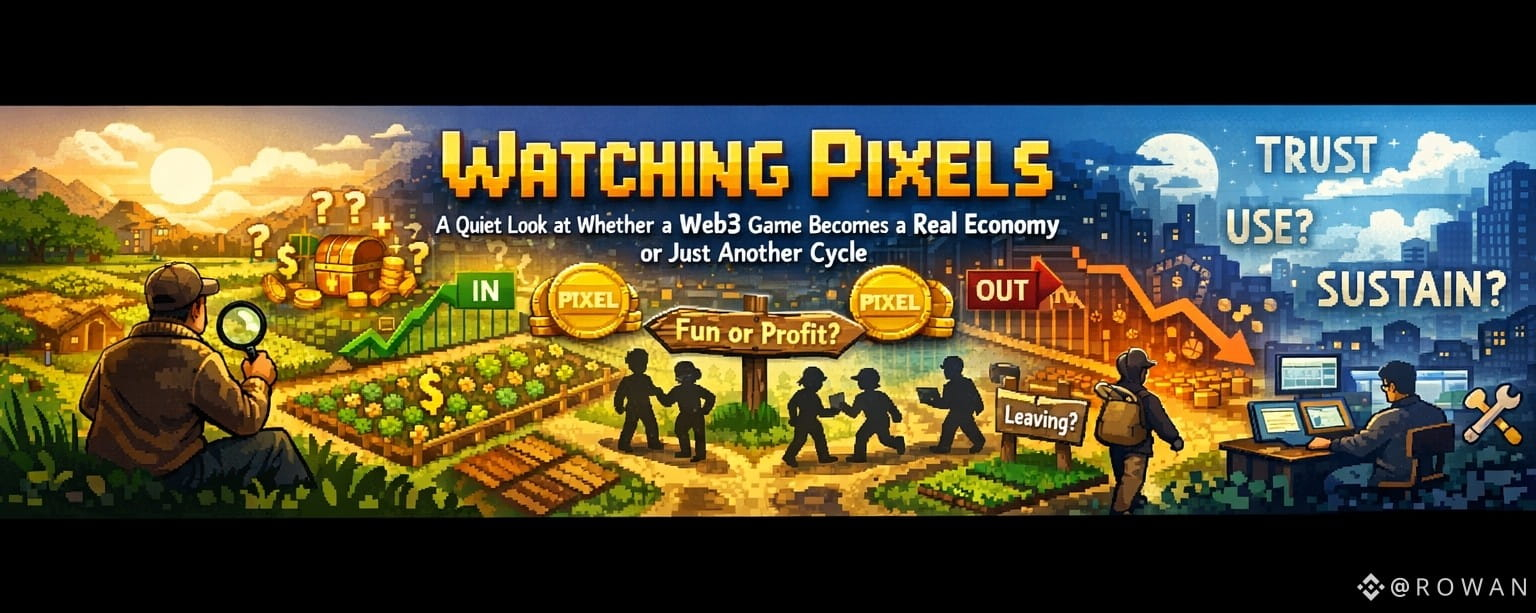
I’m watching Pixels closely, and I’m waiting to understand what it really is beneath the surface. I’ve noticed that Pixels attracts attention quickly because it looks simple, accessible, and familiar, but I focus on what happens after that first wave. I stopped looking at narratives around Web3 gaming and started paying attention to how people actually behave inside Pixels. I remember when I used to think a growing player count meant success, but now I care more about who stays and why they stay.
When I think about Pixels, I don’t see just a farming game, I see a system trying to balance fun and money at the same time. That balance is never easy. If it leans too much toward earning, it starts to feel like work. If it leans too much toward gameplay, the crypto side becomes less relevant. So I keep asking myself, are people playing Pixels because they enjoy it, or because they expect something in return?
I watch how the in-game economy moves. Players are farming, crafting, trading, but I try to understand what’s actually driving those actions. Is there real demand for items, or are people just cycling through activities because rewards are attached? A healthy system usually has people spending without thinking about profit all the time. But if every action is calculated, then it starts to feel fragile.
The infrastructure behind Pixels, especially being on Ronin, makes things smoother. Transactions are cheap and fast, and that lowers the barrier for new users. But I don’t think smooth infrastructure alone can keep a project alive. It just makes it easier for people to enter and exit. What matters more is whether they find a reason to stay.
Trust is something I keep coming back to. In Pixels, players are putting in time, and sometimes money, so they need to believe the system won’t suddenly shift against them. I try to sense whether the community feels stable or temporary. In regions where people are more sensitive to income opportunities, games like Pixels can quickly turn into something more than entertainment. But that also changes the behavior inside the game. It becomes more about extracting value than enjoying the experience.
Then there’s the PIXEL token itself. I keep asking what role it really plays. Is it something players naturally use every day, or is it mostly something traders care about? If the token isn’t deeply connected to what players are doing, then it starts to drift away from the game. And when that happens, the whole system can lose its balance.
Ownership inside Pixels is interesting, but I question how meaningful it feels to players. Owning land or assets sounds powerful, but I wonder if people actually care about what they own, or if they just see it as something to flip later. Real ownership should create attachment, not just opportunity.
I also pay attention to how people interact. Are players building connections, helping each other, forming groups? Or is everyone just focused on their own progress and rewards? Games that last usually create some kind of social layer that keeps people coming back even when rewards are lower.
The developers behind Pixels are another part of the picture I keep observing. Not just what they say, but what they do consistently. Are they improving the game step by step? Are they adjusting things based on how players behave? Because a system like this needs constant attention, especially when real value is involved.
From the outside, Pixels still feels like it’s being tested. There’s interest, there’s activity, but I don’t feel strong long-term conviction from the market yet. It feels like people are participating, but they’re also ready to leave if things change.
The real question in my mind is simple. What happens to Pixels when incentives slow down? Do players still log in because they enjoy the game, or does activity drop? That moment will say more about the project than any growth phase.
So I keep watching Pixels quietly. I’m not rushing to judge it, and I’m not assuming it will succeed or fail. I’m just trying to understand if it can become something people genuinely care about, or if it’s just another system that works as long as rewards are flowing. Right now, it feels like it’s still proving itself, and I’m more interested in what it does over time than what it promises today.