
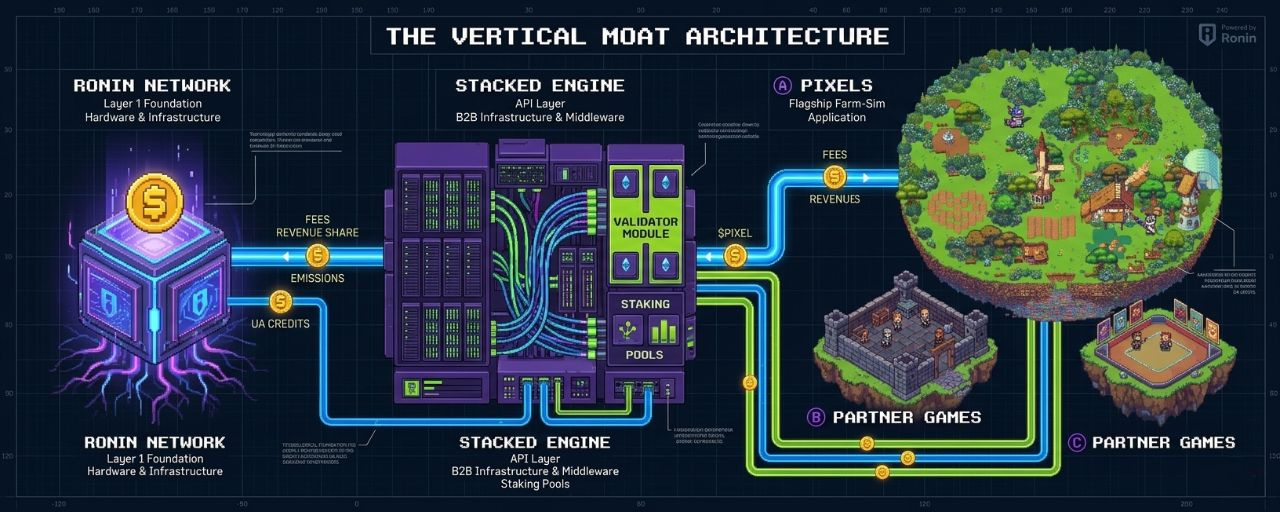
Most analysts treat $PIXEL as a standalone game. They look at the daily active users (DAU) and token price in isolation. But after auditing the entire tech stack, I realize we are watching something much more ambitious: Vertical Integration. Pixels isn't just a tenant on the Ronin Network; it is the anchor tenant of a closed-loop digital nation.
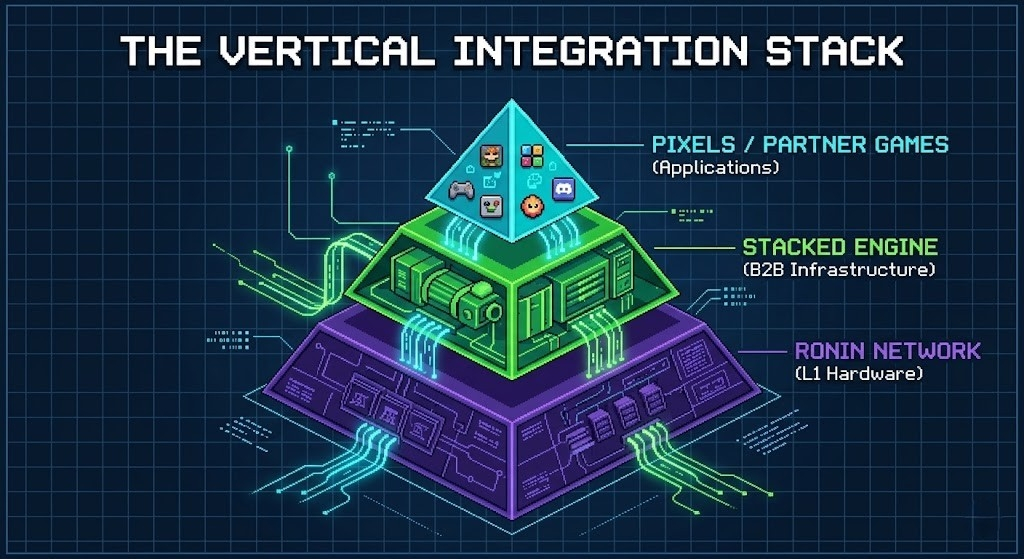
The Walled Garden: Network & Application Synergy
In the tech world, Apple wins because they own the hardware, the software, and the store. Pixels is replicating this on-chain.
- The Network (Ronin): Low-latency, high-throughput infrastructure designed specifically for gaming.
- The Store (Mavis Marketplace): Where the secondary value of assets (Lands/Pets) is captured.
- The Fuel ($PIXEL): The currency that moves through the entire stack.
By keeping the user journey entirely within the Ronin ecosystem, Pixels eliminates the "Bridge Risk" and "Fee Friction" that kills 90% of other Web3 titles.
Vertical Liquidity: The PIXEL to $RON Flywheel
One of the most underrated features of the Pixels Whitepaper is the Revenue Share to Stakers. In Phase 2 and 3, the ecosystem doesn't just emit rewards; it recycles them. When $PIXEL spent in-game, a portion flows back to the treasury and stakers.
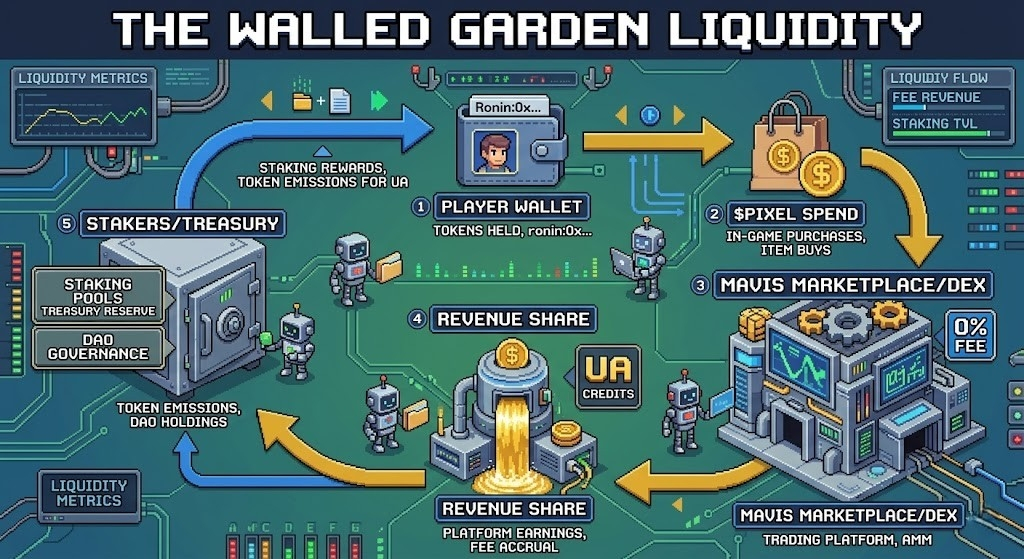
This isn't just tokenomics; it's a Capital Efficiency Engine. Studios can "borrow" from ecosystem emissions to fund their UA (User Acquisition), but only if they prove they can return value to the stakers. It's a decentralized meritocracy that protects the network's principal capital.
Verification of Randomness: The Trust Factor
As we see with the minting of Pixels Pets, the system relies on On-chain Randomness. From an IT perspective, this is the ultimate "Proof of Fairness." By encoding trait inheritance and mutation rates directly into the smart contracts, Pixels removes the need for "Trust in the Developer" and replaces it with "Trust in the Code."
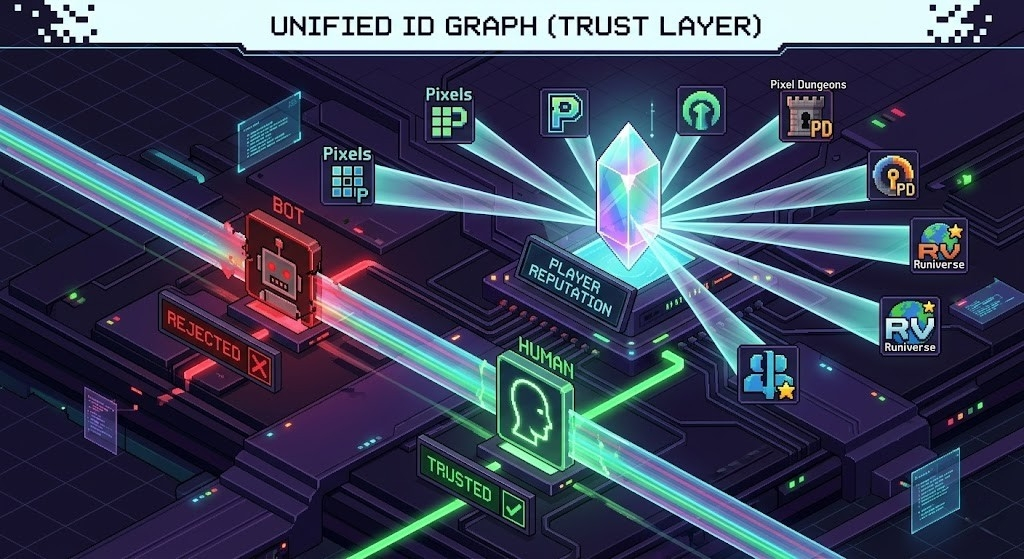
The Skeptic's Challenge: Can the Garden Scale?
The risk of vertical integration is stagnation. If the "Walled Garden" becomes too restrictive, new developers might choose more open (but fragmented) chains. However, with $25,000,000 in proven revenue, Pixels has already provided the "Incentive" for other studios to join the Stacked engine.
Stacked isn't just a rewards platform - it's the B2B Operating System for the Ronin network.
The Verdict:
The era of fragmented "GameFi" is over. We are moving toward unified Gaming Ecosystems. Pixels isn't building a game; they are building the standard for how digital assets, reputation, and liquidity interact in a high-trust environment.