
I didn’t expect a simple farming game to turn into one of the most interesting experiments in gaming.
Pixels looks easy at first
You plant crops, collect resources, and slowly build your land. That’s it. But the deeper I went, the more I realized this wasn’t really about farming. It was about fixing something broken in online games.
The person behind this shift,
Luke Barwikowski, made a call that most game developers avoid. He stopped chasing better graphics. He started watching players instead. Not just what they say, but what they actually do inside the game. Where they click. How long they stay. Whether they come back.
That decision changed everything.
Pixels grew fast.
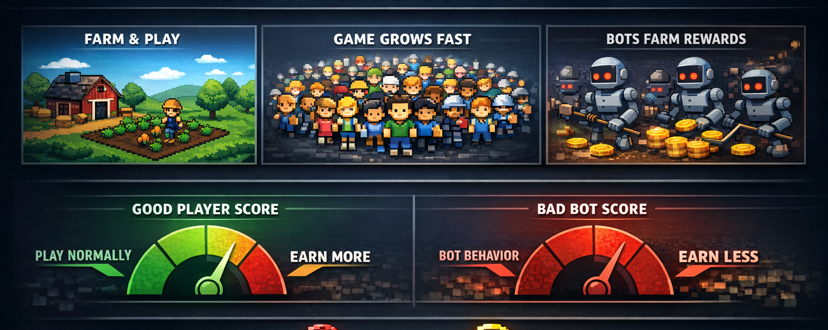
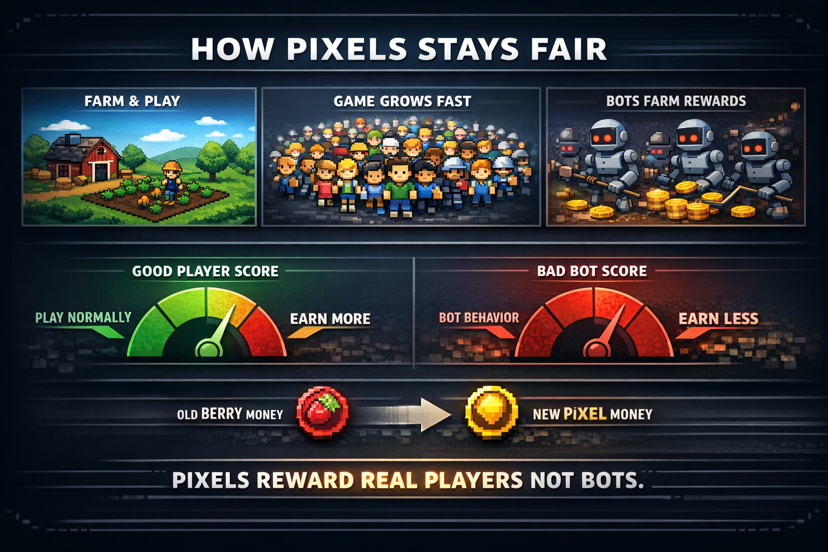
Millions of players showed up, and with them came a problem that quietly kills most online economies. Bots. Fake players running scripts, farming rewards, and draining value from the system. At one point, it wasn’t just a few bad actors. It was an army.
Most games panic here. They lock accounts or ask for identity checks. Pixels went a different route. They built a system that watches behavior and learns from it.
If you play normally, invest time, and stay active, your score improves. If you behave like a bot, repeating the same actions over and over just to extract rewards, your score drops. The system doesn’t care who you are. It cares how you act. And that score quietly decides how many rewards you get.
You don’t see it directly.
This wasn’t always the plan. Earlier versions of the game ran on a simpler system using BERRY, the original in-game currency. It worked for a while. Then cracks started to show. Too many players were earning without contributing, and the balance started to slip.
So the team rebuilt the economy.
They introduced PIXEL as the main in-game money and slowly shifted toward a model where rewards are tied to real activity, not just presence. Around April 19th, a big unlock of PIXEL tokens added another layer to this story. More supply entered the system, which meant more pressure on how rewards are handled. That’s where their data-driven approach started to matter even more.
Because handing out money is easy. Making sure the right people get it is hard.
That pressure led to something bigger. The team realized they weren’t just building a game anymore. They were building a system to manage player behavior.
So they created Stacked.
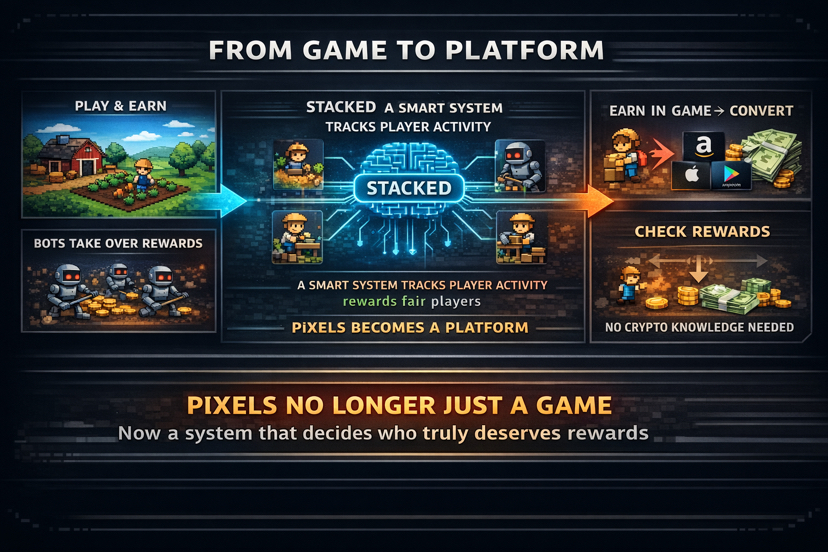
It didn’t come out of nowhere. It came from a simple observation. Bots were winning because traditional reward systems were too dumb to tell the difference between real effort and automated grinding. So instead of patching the game again, they built a new layer outside it.
Stacked works like a central brain. It tracks what players do, groups them based on behavior, and decides who deserves rewards. If you spend time farming, crafting, and actually playing, the system notices. If you try to game it, rewards quietly disappear.
And here’s where it gets interesting for beginners.
You don’t even need to understand crypto to use it.
Players can earn inside Pixels and later log into Stacked to see what they’ve made. From there, they can turn those rewards into gift cards or even regular money. No complicated wallets. No technical steps. Just play, earn, and cash out.
That’s a big shift.
Because for years, games like this were built for crypto users first and everyone else second. Pixels is trying to flip that. Make it feel like a normal game on the surface, while all the complex systems run quietly in the background.
It’s still early. There are risks. Token unlocks can shake things. Player behavior can change overnight. And no system is perfect when money is involved.
But something about this approach feels different.
It’s not trying to trick the system anymore. It’s trying to understand it. And maybe that’s the real evolution here. Games are no longer just about what you see on the screen. They’re about how players behave when rewards are real, and whether a system can stay fair when everyone is trying to win.
If Pixels gets this right, it won’t just fix one game. It might quietly set the rules for how future games survive.