
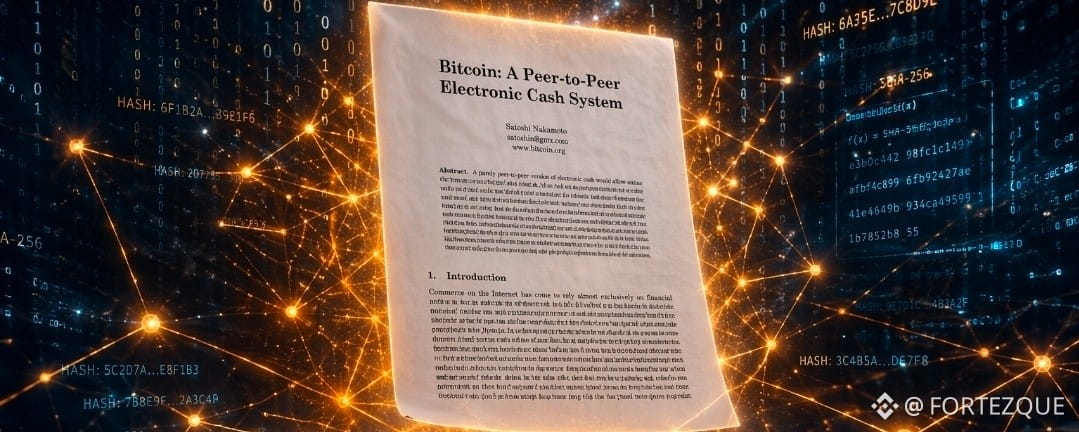
On October 31, 2008, while the financial world was reeling from the subprime mortgage crisis, an anonymous cryptographer under the pseudonym Satoshi Nakamoto sent an email to a list of experts. The subject said: "Bitcoin P2P e-cash paper". Attached was a document of just nine pages that contained the solution to a computer and economic problem that was considered unsolvable: how to create digital money without relying on a central bank.
That document, originally titled "Bitcoin: A Peer-to-Peer Electronic Cash System", is now considered the "canonical text" of financial sovereignty.
1. The premise: Money without permission
Satoshi identified that the "underlying problem" of traditional money is trust. For the system to work, we must trust that banks won't dilute the value of our savings and that they won't censor our transactions. The White Paper proposes something radically different: a system based on cryptographic proofs instead of third-party trust.
2. Solving the "Double Spend"
Until 2008, digital money had a fatal flaw: since it was just bits, it could be copied and spent twice, like a music file. The only solution was a bank to validate every transaction. Satoshi solved this with Proof of Work. Instead of a banker, a global network of computers competes to "seal" transactions in a chronological and immutable blockchain, making it computationally impossible to counterfeit.
3. The majority consensus: The "Heart" of the network
The White Paper explains that the network is secure as long as the majority of processing power (CPU) is in the hands of honest nodes. These nodes do not know each other, but they agree by following simple mathematical rules. This is known as Nakamoto Consensus: the longest chain is not only the record of what happened but the source of absolute truth.
4. An incentive for honesty
Why don't miners attack the network? Satoshi's design is brilliant because it uses Game Theory. The system rewards those who secure the network with new bitcoins. Satoshi argues in the paper that an attacker will find it more profitable to follow the rules — which favor them with new coins — than to undermine the system and destroy the value of their own wealth.
5. A fun fact: The code was born first
Although the White Paper is the theoretical foundation, Satoshi later revealed that he first wrote all the Bitcoin code. Only when he was convinced that he could solve all the technical issues in practice did he draft the paper to explain it to the world.
Conclusion: A gift of freedom
The Bitcoin White Paper is not just a technical document; it's a political and social manifesto. It combined decades of research from cypherpunks to give us a tool that allows us to own real, unconfiscatable, borderless digital property.
Today, that nine-page PDF is the foundation of a network that has already moved hundreds of millions of dollars in seconds, without asking permission from any government or bank.