
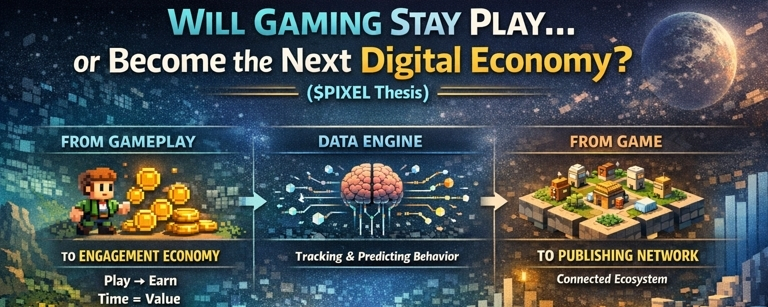
Will gaming remain just entertainment-or evolve into a full digital economy?
Projects like $PIXEL are forcing that question into the spotlight.
At first glance, Pixels looks familiar: tokens, rewards, SDKs, analytics. We’ve seen this Web3 formula before. But the real shift isn’t in the surface features-it’s in how the system is structured.
This isn’t just a game. It’s closer to a publishing ecosystem.
Think of it like this:
Movies used to be just stories. Today, they’re platforms-driven by data, ads, and user behavior. Pixels is moving gaming toward that same transformation.
1. From Gameplay → Engagement Economy
Pixels flips the traditional model.
Instead of platforms monetizing your attention, it routes value back to the player.
Play the game → earn tokens.
Stay active → generate value.
Simple on the outside.
But underneath, your time becomes capital.
Here’s the catch:
When rewards become the main reason to play, the experience shifts.
It’s no longer just a game-it becomes a system you optimize.
2. Data Is the Real Engine
The Pixels Events API isn’t just analytics-it’s a behavioral engine.
It tracks:
Player actions
Spending patterns
Retention cycles
Then it learns.
This means game economies are no longer random-they’re predictable and tunable.
Powerful? Yes.
But there’s a trade-off:
When everything is optimized…
surprise disappears.
And without surprise, games risk losing their magic.
3. From Game → Network
Pixels isn’t building one game-it’s building infrastructure.
With SDK integration:
Developers plug into an existing economy
Users become part of a shared identity graph
Growth and analytics come pre-built
It’s like building a city where others can instantly open shops.
But there’s a flip side:
Once you’re inside the system, leaving isn’t easy.
4. The Bigger Shift
Recent updates show where this is heading:
RORS Dashboard → Real ROI visibility
Staking + Emissions → Controlled liquidity
Cross-game economy → Shared value across titles
$BERRY → $PIXEL → Unified narrative
This isn’t just token design.
It’s economic architecture.
So What Is Pixels Really Building?
Something closer to a Google/Facebook-style network
but instead of ads, it runs on gameplay.
Instead of passive data, it runs on player action.
Players → earn from participation
Developers → scale faster with built-in systems
Traders → read engagement as a signal
The Real Question: Trust
When behavior + money combine, things get complicated.
If rewards fluctuate → engagement becomes unstable
If everything is optimized → experience feels engineered
So the question isn’t just technical.
It’s human:
Do people actually want to live inside game economies long-term?
Final Thought
Pixels isn’t a finished product.
It’s a live experiment.
If it works, gaming becomes more than entertainment-it becomes a distribution layer for value.
If it doesn’t, it proves a limit:
that not everything fun should be financialized.
Either way…
this space is no longer just about playing games.
It’s about redefining what a game is. 🤔