
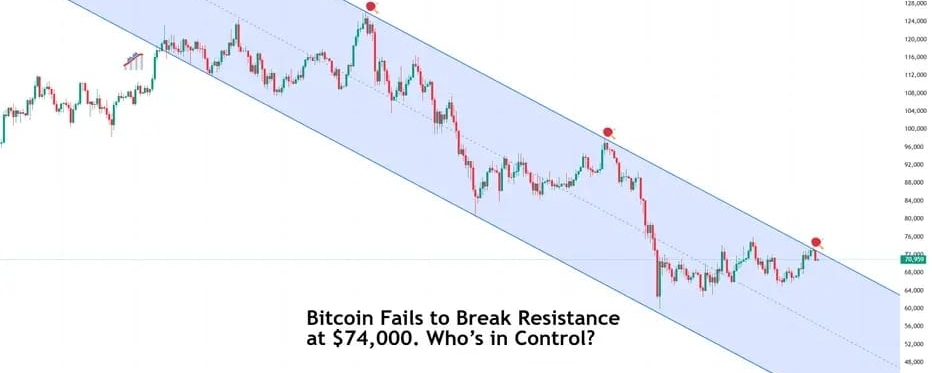
Bitcoin (BTC) is hovering in a tight range around $75,000–$76,000 as of mid-to-late April 2026, showing resilience after a volatile start to the year.
The flagship cryptocurrency has climbed from lows near $70,000 earlier in the month, briefly testing $75,000–$76,000 amid strong institutional buying via spot Bitcoin ETFs and easing geopolitical tensions in the Middle East. Recent short squeezes and positive ETF inflows have fueled optimism, with analysts eyeing a potential push toward $80,000 in the near term if momentum holds.
Institutional Demand: The New Driving Force
The game has changed since the 2024 ETF approvals. Spot Bitcoin ETFs continue to attract significant capital, acting as a steady demand engine that dwarfs daily mining supply. In recent sessions, inflows have supported price action even during consolidation phases, with some days seeing hundreds of millions in net purchases.
This institutional rotation—away from pure retail speculation toward TradFi channels—has created a more mature market structure. Bitcoin’s market cap sits comfortably above $1.5 trillion, while its dominance hovers around 59%, signaling it still commands the lion’s share of crypto attention even as altcoins show sporadic life.
Key Tailwinds and Headwinds
- Geopolitical relief: Easing U.S.-Iran tensions and falling oil prices have boosted risk assets, including BTC, by reducing macro uncertainty.
- Regulatory horizon: Progress on U.S. bills like the CLARITY Act could bring much-needed clarity, potentially unlocking more institutional flows in 2026.
- Supply dynamics: Post-halving effects from prior cycles linger, with reduced new supply meeting persistent ETF and whale accumulation. Exchange reserves are tightening, making the asset more sensitive to demand spikes.
- Challenges: The market remains range-bound after last year’s highs, with some profit-taking pressure from holders in the green. Broader economic signals (Fed policy, risk appetite) will likely dictate the next major leg.
Technical analysts note BTC testing overhead resistance near $76,000 while holding above key moving averages like the 50-day EMA. A clean breakout above $76K–$78K could open the door to $80,000–$85,000 quickly, while failure to hold $72,000–$73,000 might invite a retest of lower supports.
Outlook: Consolidation Before the Next Leg?
Bitcoin in April 2026 feels like a coiled spring. The halving-era playbook has evolved—**ETF liquidity** and corporate treasury adoption are now the primary price drivers rather than pure cycle timing.
Short-term predictions cluster around $75K–$80K for the rest of the month, with bullish scenarios targeting higher on sustained inflows and regulatory wins. Longer-term 2026 forecasts remain optimistic, with some institutions eyeing six-figure levels if macro conditions align (e.g., rate cuts or broader 401(k)-style access).
Bottom line: Bitcoin’s current circumstances reflect a maturing asset—less explosive than early cycles, but backed by deeper, more structural demand. Volatility is still part of the DNA, yet the floor appears firmer thanks to institutional participation.
Whether BTC breaks out to fresh highs or grinds higher in a range, one thing is clear: the narrative has shifted from “speculative gamble” to “digital gold with institutional backing.” Traders and long-term holders alike are watching ETF flows and regulatory headlines closely—these will likely set the tone for the rest of 2026.
Stay tuned. The king of crypto rarely stays quiet for long.
#Kalshi’sDisputewithNevada #BitcoinPriceTrends #CZ’sBinanceSquareAMA #AltcoinRecoverySignals? #KelpDAOFacesAttack