
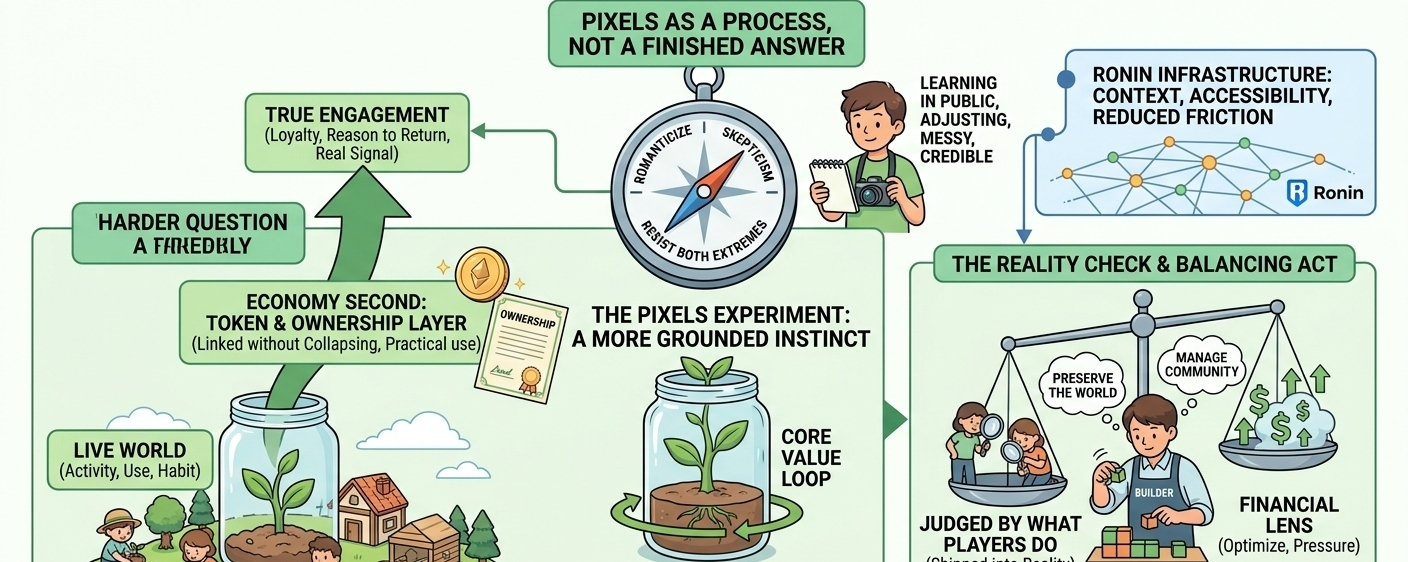

Pixels becomes more interesting when you stop looking at it as a “Web3 gaming narrative” and start looking at it as a game that has had to earn its audience through repetition, updates, and actual use.
At the highest level, it is a social casual game on Ronin built around farming, exploration, and creation inside an open world. That description is straightforward enough, maybe even ordinary. There is no grand mystery in the format. Farming loops are familiar. Open-world interaction is familiar. Community-driven play is familiar. In a strange way, that familiarity is exactly what makes it worth paying attention to. Pixels is not trying to invent a new human instinct. It is working with habits players already have and seeing whether those habits can survive inside a crypto-linked environment without collapsing into pure speculation.
That is a more serious test than people sometimes admit. For years, Web3 gaming was crowded with projects that talked endlessly about ownership, incentives, and digital economies, while the games themselves felt thin, unfinished, or secondary. The player was often treated like a future economic participant before being treated like a person looking for something enjoyable to do. That order rarely works. If the game loop is weak, the token layer does not save it. If the world feels empty, ownership does not suddenly create attachment. Most of the time it just creates noise around a product that has not yet given people a reason to care.
Pixels seems more aware of that problem than a lot of projects in the same category. It does not come across as something trying to lecture the market about the future. It feels more like a live experiment in building a persistent, social game where players have reasons to return that are not purely financial. That does not mean it is above criticism, and it definitely does not mean it has solved the old Web3 gaming tension. But it does suggest a more grounded instinct. The team appears to understand that activity has to come before mythology.
What stands out is the emphasis on a world people can inhabit, not just a system they can optimize. Farming, exploration, and creation are not flashy ideas, but they are durable ones when handled well. They give players routine. They create small reasons to log in, check on progress, interact with others, and slowly build familiarity with a space. In traditional games, that rhythm is often underestimated because it looks simple from the outside. But simple loops are usually what make a world feel lived in. Not every game needs dramatic combat or constant spectacle. Sometimes it needs consistency, texture, and a reason to come back tomorrow.
That is where Pixels feels a bit more honest than many crypto games that came before it. It is not selling intensity. It is building around habit. And habit, in games, is usually a more reliable foundation than excitement. Excitement spikes and disappears. Habit is quieter. It forms when players find a loop that is easy to understand, socially sticky, and flexible enough to support different types of behavior. The farming matters, but the social layer matters just as much. People stay in these worlds because other people are there, because there is shared rhythm, because the space starts to feel familiar.
Of course, that is also where skepticism should stay alive. Social casual games can look healthy very quickly because activity is visible, but visible activity is not the same thing as depth. A world can appear full without being particularly meaningful. A player base can be active without being loyal. And in crypto, there is always the question of how much of the engagement is rooted in genuine attachment and how much is pulled forward by incentives, expectation, or market mood. That question never fully disappears, even when the product looks stronger than average.
Pixels does not escape that tension just by being better made or more accessible. If anything, being more successful only puts more pressure on the design. Once a game starts attracting attention, the surrounding economy becomes harder to ignore. Players begin to interpret mechanics through a financial lens. Outside observers stop asking whether the game is enjoyable and start asking whether the numbers can sustain themselves. Builders then face a difficult balancing act: preserve the world as a world, while managing a community that may not always approach it with the patience or intentions of a traditional player.
That is why I find Pixels more interesting as a process than as a finished answer. The real value is not in pretending it has cracked some final formula for Web3 gaming. It has not. The value is in watching a team ship into reality and deal with the mess that follows. That still matters because too much of this sector spent years operating in abstraction. Whitepapers were treated like products. Economies were modeled before communities existed. Vision came first, friction came later. Pixels, by contrast, seems to have learned through contact. People showed up, systems were tested, weaknesses became visible, and the product had to adapt.
That kind of building is less glamorous, but it is usually more credible. Real games are shaped by player behavior, not just by internal theory. A design decision that looks clean on paper can feel awkward once thousands of people interact with it. A mechanic that seems minor can become central if it creates routine or social attachment. A system that looks strong can break the moment players start optimizing it in ways the team did not expect. There is no shortcut around that. Shipping is the filter. Use is the teacher.
Ronin also matters in this context, not because infrastructure alone makes a game good, but because environment shapes what a game can become. Web3 games do not exist in isolation. They live inside networks, communities, and technical ecosystems that influence accessibility, identity, and player behavior. Pixels being built on Ronin gives it a certain context: a chain associated with gaming, a user base already closer to interactive products than pure financial primitives, and an environment where game-native experimentation feels less forced than it does elsewhere. That does not guarantee quality, but it does lower some of the friction around trying to build an actual game instead of a token wrapped in a game skin.
Still, I think the most useful way to look at Pixels is to resist both extremes. It is not some magical proof that Web3 gaming has finally arrived, and it is not just another empty farming loop with a token attached. It sits somewhere in the middle, which is usually where the more important stories are. It reflects an attempt to build something usable, social, and persistent in a category that has often confused attention with retention and speculation with design. Sometimes that effort works. Sometimes it exposes new limits. Either way, it produces more signal than another polished promise.
What I keep coming back to is that Pixels seems willing to be judged by what players actually do inside the product. That should be the baseline, but in this space it still feels unusual enough to mention. The open world matters only if people move through it with purpose. The farming matters only if routine turns into attachment. The creation layer matters only if players feel some ownership over the world in a practical sense, not just a financial one. These are ordinary tests by game standards, but maybe that is exactly the point. If Web3 games want to be taken seriously, they probably have to pass ordinary tests before they can make extraordinary claims.
Pixels feels like one of those projects that is more useful to observe than to romanticize. It is building, shipping, adjusting, and learning in public. That does not make it flawless. It just makes it real enough to study. And right now, that may be more valuable than another big theory about where gaming is going. Sometimes the best signal comes from watching what builders are willing to keep improving when the novelty wears off. Pixels is worth following for that reason alone, quietly, carefully, and without pretending the work is finished.