
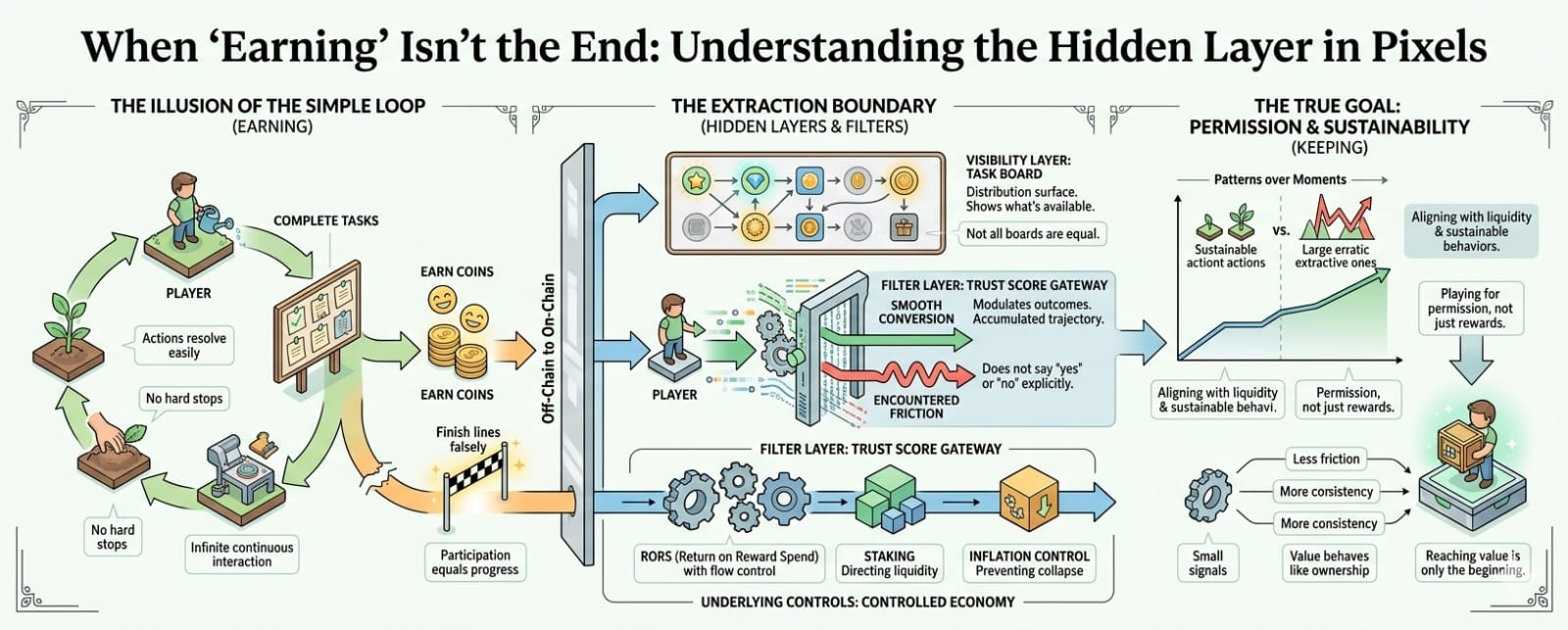
At first, Pixels feels simple in the way all good games do.
You plant, you harvest, you craft, you move. The loop is clean. Nothing resists you. Coins flow endlessly, actions always resolve, and even mistakes don’t really punish you—they just become part of the rhythm. Eventually, you reach a moment that feels like a breakthrough: the Task Board lines up, a chain connects, and suddenly you’re not just playing… you’re earning.
Or at least, it feels that way.
Because nothing inside the loop tells you that this isn’t the final step.
The Illusion of Completion
The first time you see value appear on the board, it feels like crossing a line. Effort becomes output. Time becomes reward. The system seems to validate you.
But that moment is carefully designed.
Inside Pixels, everything is optimized for continuity. The game doesn’t interrupt you. It doesn’t question your actions. Even inefficient loops continue running. Even low-value production still “works.” You can stay active indefinitely, and the system will keep responding.
This creates a powerful illusion: that participation equals progress, and progress equals ownership.
But Pixels separates those ideas.
What you see on the board is not the same as what you own.
The Break in the System
The difference only becomes visible when you try to move value outward—when you stop playing inside the loop and try to extract something from it.
That’s where the smoothness breaks.
Not in obvious ways. There’s no hard stop, no clear rejection most of the time. Instead, you feel something subtler:
Transfers don’t feel as consistent
Outputs don’t behave the same way every time
Some rewards convert cleanly, others don’t
What looked like a straight path inside the game becomes uneven once it tries to leave it.
And that’s when it becomes clear: the loop you’ve been playing in is not the full system.
The Role of the Board: Visibility, Not Guarantee
The Task Board is often misunderstood as a reward engine.
In reality, it’s closer to a distribution surface.
It shows you what’s available. It connects actions to rewards. It reflects parts of the system that are currently funded or active. But it doesn’t guarantee that every surfaced reward carries equal weight beyond the loop.
Not all boards are equal.
Some are backed by stronger reward flows. Some are tied to better-funded pathways. Others exist more as structural filler—valid interactions that keep the system alive but aren’t designed to carry value all the way out.
The board decides what you see.
It doesn’t decide what survives.
The Hidden Gate: Trust as a Filter
This is where the system changes shape.
After the loop, after the board, after the reward appears—there’s another layer: Trust Score.
And it doesn’t behave like a typical game mechanic.
It doesn’t announce itself clearly. It doesn’t interrupt your gameplay. It doesn’t say “yes” or “no” in obvious terms.
Instead, it modulates outcomes.
Two players can complete the same chain and see the same reward, but what happens next may not be identical. One experiences smoother conversion, faster exits, more consistency. The other encounters friction—subtle, but persistent.
That difference isn’t random.
It’s accumulated.
Patterns Over Moments
Pixels isn’t evaluating you based on a single action.
Anyone can:
Hit a good board once
Complete a profitable chain
Have a strong session
But over time, patterns emerge.
The system begins to recognize:
Whether you keep engaging during low-reward periods
Whether you return after resets
Whether your activity aligns with consistently funded parts of the system
Whether your behavior looks sustainable, not extractive
This shifts the focus completely.
You’re no longer optimizing for a moment—you’re optimizing for a trajectory.
Earning vs. Keeping
This leads to a difficult realization:
Earning isn’t the hard part.
Keeping it is.
Inside the loop, value is fluid. It appears, moves, and recirculates freely. But once it approaches the boundary between off-chain activity and on-chain ownership, it becomes conditional.
Not blocked—filtered.
Pixels doesn’t stop you from reaching value.
It decides how easily that value can leave with you.
Why the System Works This Way
At a structural level, this design solves a major problem that earlier play-to-earn systems couldn’t.
If every visible reward could be extracted equally and instantly:
Reward pools would drain too quickly
Inflation would spiral
The system would collapse
Pixels avoids this by introducing layers:
RORS (Return on Reward Spend): controls how efficiently rewards generate value back into the system
Staking: directs liquidity and influences where rewards flow
Task Board: distributes opportunities
Trust Score: filters what exits cleanly
Together, these layers create a controlled economy—one that doesn’t just distribute value, but regulates its movement.
A Different Kind of Game
This changes what Pixels actually is.
It’s not just a farming simulator.
It’s not just a reward system.
It’s a permissioned economy disguised as an open loop.
You can:
Explore freely
Experiment endlessly
Participate without restriction
But extraction—the moment where value becomes truly yours—is governed.
Not by a single rule, but by alignment with the system over time.
So When Is It Actually Yours?
This is the question that doesn’t have a clean answer.
Is it yours when:
It appears on the board?
The chain completes?
It reaches your wallet?
Or only when it moves without friction—consistently, repeatedly, predictably?
Pixels never defines that moment explicitly.
Instead, it lets it emerge.
Over time, if your activity aligns with the parts of the system that remain funded and sustainable, things begin to feel different:
Exits become smoother
Conversions become more reliable
Value behaves more like ownership
Not instantly. Not uniformly. But gradually.
What You’re Really Playing For
At some point, the goal shifts.
You’re no longer just chasing better loops or higher rewards.
You’re aligning yourself with:
Systems that continue to receive liquidity
Paths that survive resets
Behaviors the game can sustain long-term
In other words:
You’re not just playing for rewards.
You’re playing for permission.
Final Thought
Pixels doesn’t tell you when you’ve “made it.”
There’s no milestone, no badge, no clear threshold where everything changes.
Instead, it gives you signals:
Slightly less friction
Slightly more consistency
Slightly stronger conversion
And over time, those signals add up to something that feels close to ownership—but never fully guaranteed.
Because in Pixels, reaching value is only the beginning.
What matters is whether the system decides you’re allowed to keep it.