

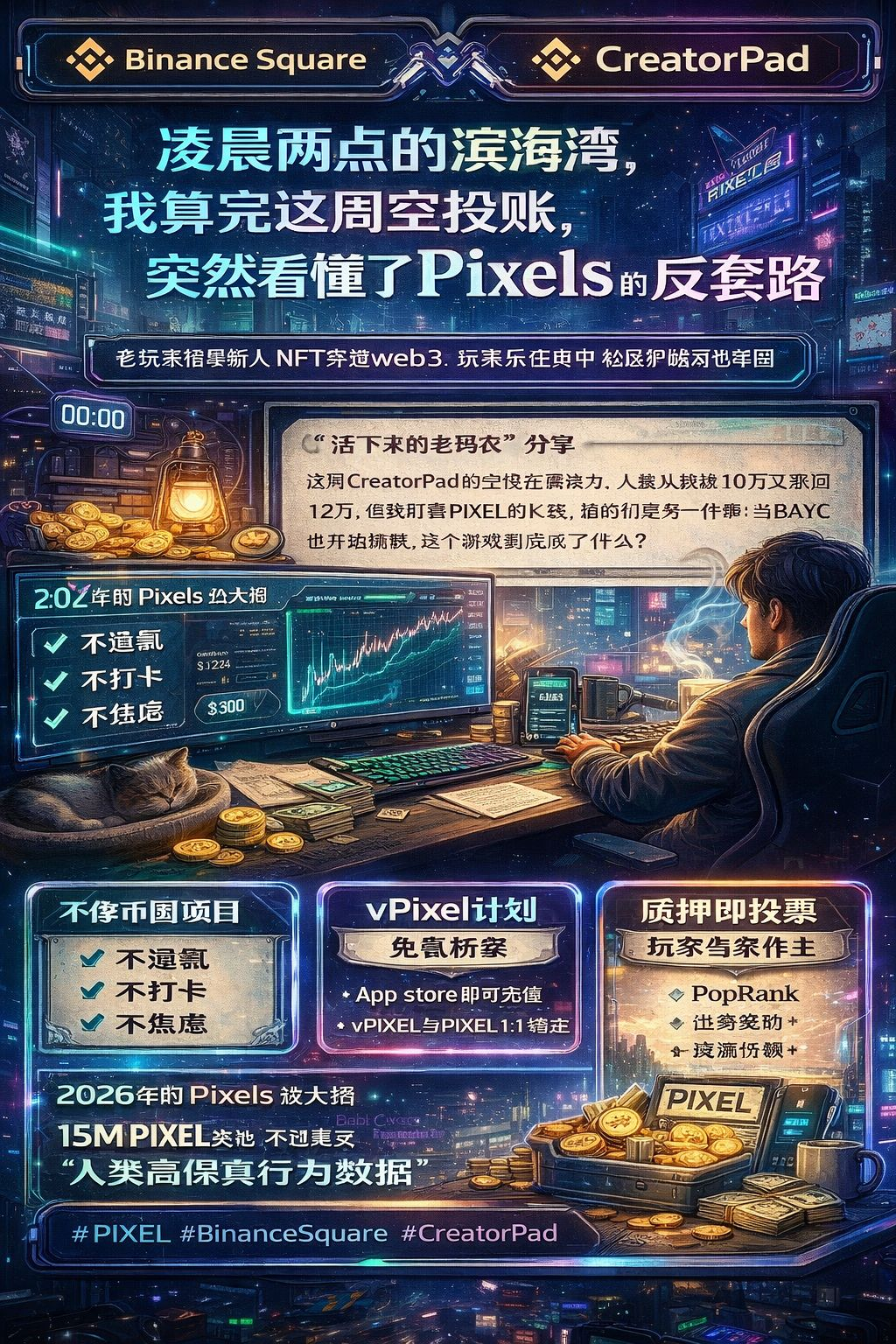
 This week's CreatorPad airdrop was quite generous, with a total of $300 distributed. The number of participants dropped below 100,000 and then rose back to 120,000. But while I'm watching the K-line of PIXEL, I'm thinking about something else: when BAYC also starts planting rice, what has this game really become?
To be honest, as an old coder who has survived since 2017, I instinctively dislike the marketing phrase "blue chip NFT crossover." But the data is here—Pixels now supports over 65 NFT series as in-game avatars. The boring ape you bought for tens of ETH can not only be used as a profile picture on Twitter but can also wear work pants and farm in the game. This extension of social signals related to identity recognition is far more effective in retaining high-net-worth users than just airdropping a few tokens.
But this is not the main point I want to make.
The key is that Pixels has made the smartest move: it has finally given Web3 games a "human touch."
Other blockchain games rely on token incentives to attract players, while Pixels relies on veteran players teaching newcomers how to raise pets, and neighbors actively helping you to water your fields. This kind of real human connection makes you stay not because of APY, but because you can't bear to leave what you've gotten used to. Refer to the early promotion of WeChat—not relying on red envelope fission, but on the social stickiness of "you've already added your parents, you can't leave."
The 15M PIXEL prize pool of CreatorPad seems to be throwing money, but in reality, it's a stress test of the capacity of this social consensus.
From farms to the universe: the real trajectory of ecological expansion I have seen
Pixels in 2026 is no longer that pixelated version of Happy Farm. It has entered the multi-game publishing platform phase—Core Pixels, Forgotten Runiverse, Pixel Dungeons, Pixels Pals. PIXEL has evolved from a single-game token to a cross-game reward and loyalty currency. According to the information I found, founder Luke Barwikowski revealed that he is in deep cooperation talks with another blockchain ecosystem. If realized, the influx of new users will completely change the parameters of the existing economic model.
vPixel plan: the "seamless bridge" between Web2 and Web3
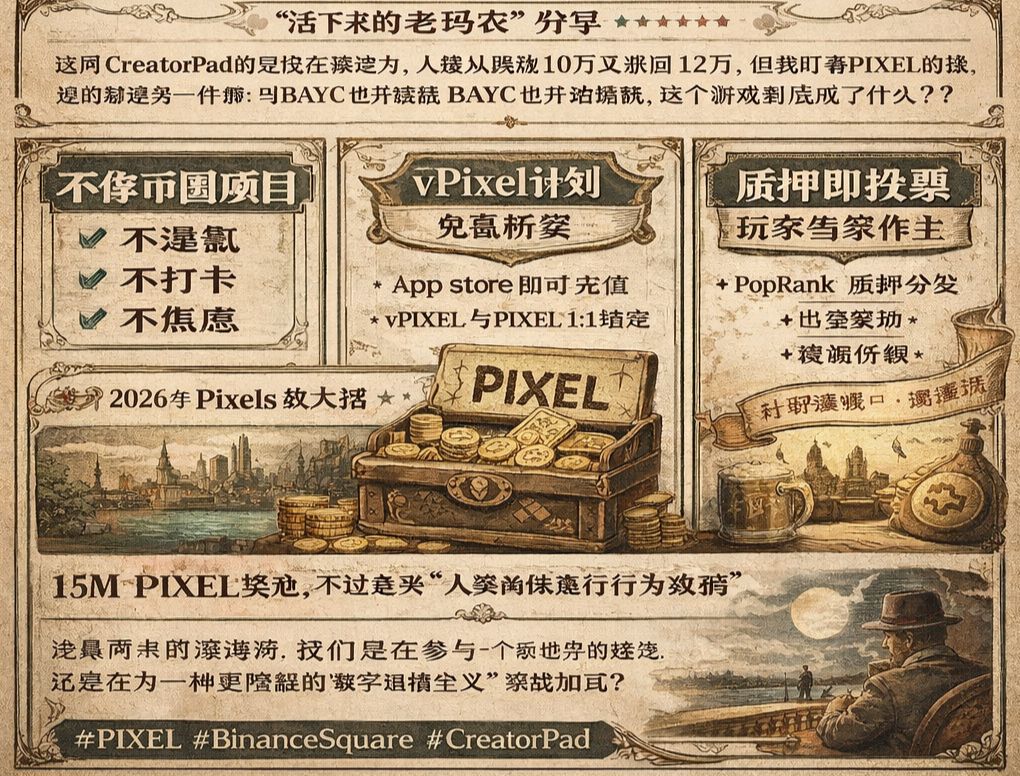
This is the design I find the most ruthless. vPixel is a stable in-game currency pegged 1:1 to PIXEL, and players can use $BNB Apple Pay/Google Pay to purchase directly, completely avoiding the need to deal with cryptocurrency. It is zero threshold for Web2 players and a compliance moat for project parties. Looking further ahead, PIXEL may transition to a pure staking model, no longer distributing rewards, but directly becoming a value reserve tool for the entire ecosystem—completely separating gaming from investment, so ordinary players are no longer tied to token volatility.
Staking is voting: can we finally "take charge"?
After the upgrade of the Pixels staking system, players can stake PIXEL to different game validators, and the community votes to decide which games receive ecological resources. 28 million PIXEL are distributed to games within the ecosystem each month through this system—this is not about earning interest on tokens, but about making decisions with tokens.
In conjunction with the PopRank mechanism: the more support for staking and higher player participation in a game, the greater the exposure and reward share. Good games → attract staking → drive exposure → bring players → consolidate token value; this positive cycle is more solid than any "Ponzi flywheel," because it binds real participation rather than capital expectations.
Stacked engine: advertising fees go directly to players, not to Facebook
This is Pixels' biggest move. Stacked is not just a concept; it is a validated underlying infrastructure—helping Pixels earn over 25 million USD and processing hundreds of millions of reward distributions through a reward-based LiveOps engine.
Core logic: do not buy volume, buy behavior. Do not give money to Facebook/Google, but directly reward players who create value in games—completing meaningful tasks, bringing new friends, being active in the long term. Players earn cash, cryptocurrency, and gift cards, not worthless points. Game companies can clearly see how much retention and LTV each reward of one dollar brings back.
As an old resource, why am I willing to give Pixels patience?
To be honest, what I feel from Stacked is: finally, someone is not treating players as mere resources. The rewards are not charity; they are a return for real contributions. Pixels is transforming "making money by playing games" from a Ponzi scheme into a sustainable economic model.
The campaign of CreatorPad made me see that this project is testing a wilder proposition: when market liquidity is drained, can this system based on social consensus and real behavior operate on its own?
The 15M PIXEL prize pool is not a cost, but a budget for purchasing "high-fidelity human behavior data." Every task you complete on the Task Board helps their algorithm distinguish between machines and real people. Your time, your social relationships, and your "reluctance to leave" are the true cross-cycle hedging assets of this project.
So, when you are calculating airdrop profits at 2 AM, or staring blankly at virtual land on the balcony of the Strait of Malacca, think about this:
Are we participating in the construction of a new world, or are we adding bricks to a more covert "digital sentimentalism"?
Although this fire is weak and carries a carefully calculated flavor, it indeed gives many people an illusion of not being treated as mere resources amidst the ruins where all blockchain games are forcing spending, checking in, and creating anxiety.
And this may be what CreatorPad really wants to test.