
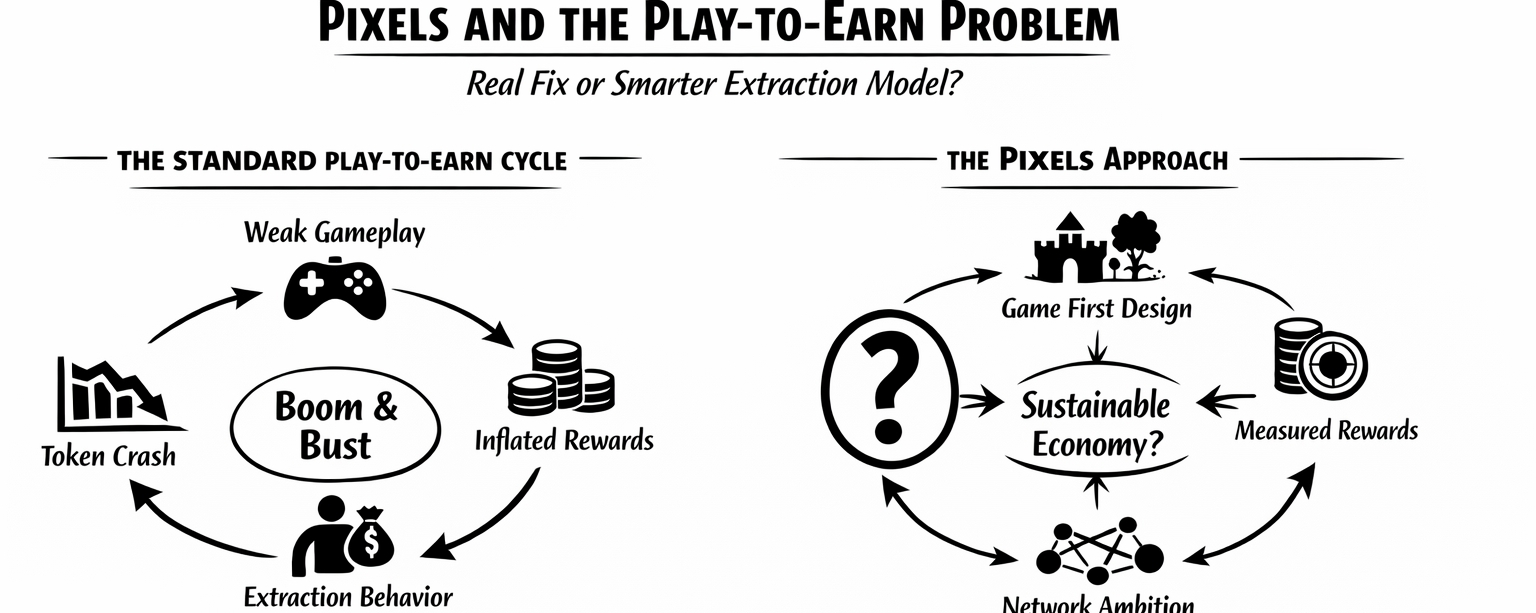

Play-to-earn was supposed to change gaming.
Instead, most of the time, it just changed the way people extract from it.
That sounds harsh, but honestly, that is what a lot of crypto gaming became. Not games people actually wanted to play, but systems people wanted to farm. The focus shifted fast. It stopped being about fun, progression, community, or even curiosity. It became about yield. About how quickly you could come in, optimize, collect rewards, and get out before the whole thing started breaking.
And once that happens, the game is usually already in trouble.
To be completely honest, this is why I have a hard time getting excited every time a crypto game starts talking about “player-owned economies” or “reward alignment.” We have heard some version of that story before. It usually sounds smart at the start, then a few months later the token is down, players are dumping, bots are everywhere, and the “economy” turns out to be more fragile than anyone wanted to admit.
That is the backdrop Pixels has to deal with.
Because Pixels is not launching into a clean market where people are still idealistic about play-to-earn. It is entering a category that already burned a lot of trust. So the real question is not whether Pixels looks better than the worst projects from the last cycle. It clearly does. The real question is whether it is actually fixing the core problem, or just packaging the same model in a way that feels more polished and more sustainable for a little longer.
That is what makes it interesting.
Because Pixels does seem more self-aware than most crypto games. It feels like a team that understands where earlier projects went wrong. But understanding the problem and solving it are not the same thing.
And that gap matters.
Most crypto games do not fail because people hate the idea of earning.
They fail because the design quietly teaches players to behave in the worst possible way.
If the gameplay is shallow, people do not stay because the game is fun. They stay because the rewards are still worth farming. If the token is inflationary, then the system needs a constant flow of new demand just to keep the whole thing from weakening. If rewards are too easy to farm, then users naturally turn into extractors. They stop playing like players and start acting like operators. Multi-accounting, grinding, optimizing, dumping. It becomes mechanical very quickly.
And once the dominant behavior becomes extraction, the economy starts eating itself.
That, to me, has always been the biggest problem with play-to-earn. Not that people earn, but that the system often rewards the wrong kind of participation. It does not reward people for making the world better, deeper, or more interesting. It rewards them for pulling value out faster than the system can replace it.
It sounds good on paper, but in practice it usually creates a community full of short-term behavior.
That is why so many of these economies collapse into the same pattern. Weak gameplay. Inflated rewards. Token pressure. User drop-off. Then the desperate search for new sinks, new features, new narratives, anything that can make the numbers look stable again.
So when I look at Pixels, that is the baseline I start from.
Not “is this promising?”
More like: “is this actually different in a meaningful way?”
I think Pixels is trying to solve the right problem, or at least a more real version of it.
Not by pretending incentives do not matter, but by trying to design them more carefully.
That is already better than a lot of projects.
The clearest thing Pixels gets right is that it seems to understand a simple reality: if the game itself is not sticky, no economy is going to save it. You cannot build a lasting system on top of a weak game loop. Eventually the token loses strength, and when that happens, all that is left is the product itself. If the product is weak, people leave.
Pixels at least appears to take that seriously.
The farming gameplay, the social layer, the world-building side of it — all of that suggests an attempt to make something people might actually spend time in, not just extract from. That matters. A lot. Because crypto gaming has had too many projects where the “game” felt like a thin wrapper around emissions.
Pixels feels more aware of that trap.
But this is also where I think people can get a little too generous.
Saying “game first” is one thing. Proving that players would still care without the financial layer is something else entirely. A game can feel active and healthy while rewards are flowing, then look much weaker once those incentives cool down. That is the real test. Not whether people show up when there is money on the table, but whether they stay when the easy extraction phase is over.
That part is still unresolved.
So yes, putting the game before the economy is the right direction. But it is also the kind of idea that sounds better than it is unless the gameplay is genuinely strong enough to stand on its own.
And in crypto, that is still rare.
Another area where Pixels looks more thoughtful is rewards. Instead of treating rewards like a giant faucet and hoping for the best, it seems to be leaning into a more measured, data-aware approach. That makes sense. If you already know most reward systems get abused, then the obvious response is to stop handing them out blindly.
In theory, that is a strong move.
Better targeting can reduce wasted emissions. It can help filter out low-quality activity. It can slow down farming behavior. It can create a system where rewards are tied more closely to useful participation instead of raw repetitive behavior.
Compared to the older “everyone gets tokens, good luck” model, this is clearly smarter.
But again, there is a tension here.
The strength of a data-driven reward system is also its risk.
Because once the economy gets too optimized, it can start feeling less like a game and more like a behavior engine. Players are no longer just exploring a world or progressing naturally. They are being pushed, measured, segmented, and nudged based on what the system thinks is most efficient.
That may improve retention. It may improve monetization. It may even improve token efficiency.
But it does not automatically make the experience healthier.
The real issue is that a smarter incentive machine is still an incentive machine. If the underlying economy still depends on carefully controlling user behavior to prevent extraction, then the model may be more advanced, but it is not necessarily more durable.
It may just fail more slowly.
And I do not say that to dismiss what Pixels is doing. I actually think this is one of the more thoughtful parts of the project. But thoughtful design is not the same as solved design.
Then there is the bigger ambition behind it.
Pixels does not seem like it wants to stay just one game. It feels more like it is trying to turn itself into a broader network — something that can distribute users, rewards, and attention across multiple experiences.
That is a much bigger idea.
If that works, it gives Pixels a stronger foundation than the average crypto game. A single game can fade quickly. A network has more room to adapt. More entry points. More surfaces for growth. More ways for the token and the ecosystem to matter.
On paper, that is compelling.
Because if Pixels becomes a real network, then the value proposition changes. It is not just “here is one game with a token.” It becomes “here is an ecosystem with shared incentives, shared traffic, and some kind of publishing or distribution layer behind it.”
That is much more ambitious.
But it also introduces another kind of risk.
A network story can be powerful, but sometimes it also becomes a way of expanding the narrative faster than the fundamentals. Saying you are building an ecosystem is easy. Actually building one where each part adds real value is much harder. If the network is not producing stronger games, stronger retention, and stronger demand, then all you have really done is spread the same economic pressure across more products.
That is not a flywheel. That is just wider exposure.
So I think this is one of those areas where Pixels deserves credit for aiming higher, but not a free pass for doing so. The network angle makes the project more interesting. It also makes execution way more difficult.
And no matter how well the game is positioned, this still comes back to the token.
That is where I think people need to stay honest.
Because $PIXEL does not get a pass just because the broader strategy sounds smarter. If anything, the expectations should be higher. A more advanced reward model should lead to a more sustainable token structure, not just better storytelling around why sell pressure is manageable.
That is the hard part.
Every crypto game says it is working on sustainability. Very few actually solve it. Tokens keep facing the same pressures: emissions, unlocks, reward expectations, farming behavior, and constant sell-side activity from users who never intended to hold long term in the first place.
Pixels may be trying to reduce that pressure through better sinks, stronger utility, and a wider ecosystem role. That is the right direction. But I do not think anyone should pretend that this risk is gone.
It is still there.
If players mainly see $PIXEL as something to earn and sell, the economy stays fragile. If demand depends too heavily on ongoing growth, the structure stays exposed. If utility exists mostly to support the token narrative rather than genuine player need, that gets tested sooner or later.
And that is usually where crypto gaming gets uncomfortable.
Because eventually you have to ask a very simple question: if rewards get weaker, what still holds people here?
If the answer is not strong enough, everything else starts looking temporary.
This is why I think Pixels is worth watching, even if I am not fully sold.
It does seem to be trying to move beyond the dumbest version of play-to-earn. It seems more thoughtful about incentives, more aware of farming behavior, and more serious about building systems that can last longer than one hype cycle.
That is real progress.
At the same time, I do not think it has escaped the category’s core tension. It is still trying to mix gaming with financial incentives. And that is always unstable in some way, because money changes how people play. Even when the design is smarter, people still optimize. They still push systems to the edge. They still ask what they can get out, not just what they can build inside the game.
That does not mean the model cannot work.
It just means the burden of proof is still high.
My honest read is that Pixels is conceptually stronger than most crypto games. The team seems to be asking better questions. The structure looks more intentional. The project has more of a real thesis behind it than the usual tokenized game loop.
But the execution risk is still high. The token pressure is still real. And there is still a chance that what looks like a more refined model is, underneath it, another version of the same extraction problem — just with better design, better pacing, and better optics.
That is why I land somewhere in the middle.
Pixels is not just a copy-paste play-to-earn project. I do think it is trying to do something more serious. But whether it is actually solving crypto gaming’s core problem, or simply managing it better than most, is still an open question.
Interesting, yes.
Convincing in parts, definitely.
But time will tell.
