
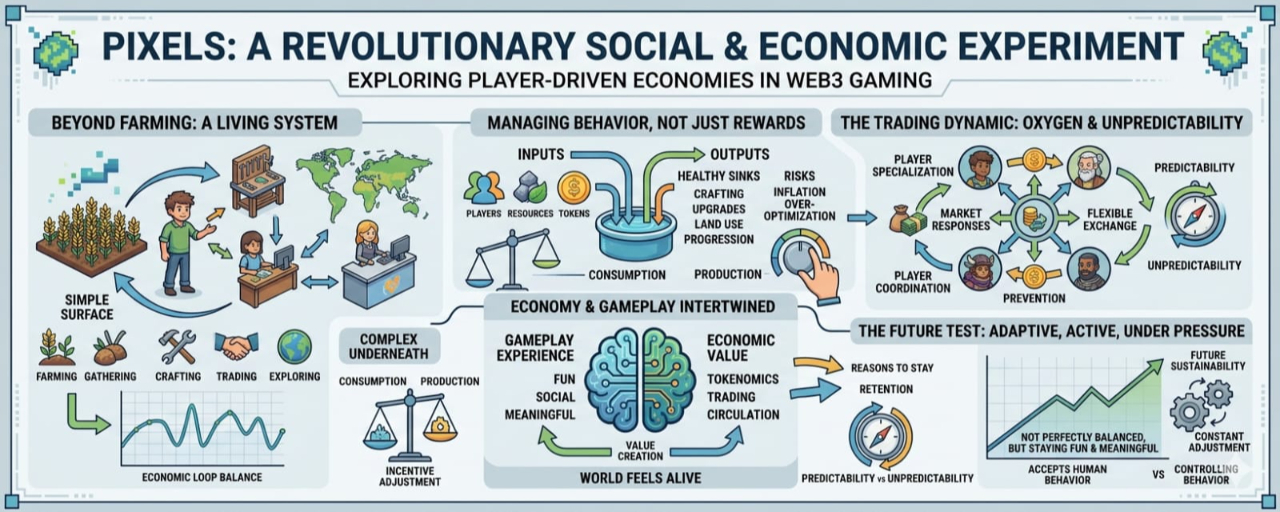
i keep coming back to the same thought whenever i look at Pixels: this is not just a farming game with a token attached. It feels more like a carefully balanced economic system that works because players have not fully pushed it to the edge yet.
That is not me dismissing it. Honestly, that is exactly why it holds my attention.
A lot of Web3 gaming projects failed because they misunderstood what makes people stay. They treated players like temporary yield hunters, not like actual humans looking for something fun, social, and worth returning to. The result was predictable. Bad gameplay, weak onboarding, inflated rewards, and economies that looked exciting early but collapsed once everyone started optimizing for extraction.
Pixels feels different because it seems to have learned from that mess.
On the surface, it looks simple. Farming, gathering, crafting, trading, exploring. Easy to understand. Soft style. Low pressure. But underneath that simplicity, there is a more serious design question being tested: can a player-driven economy stay healthy when every player is naturally trying to improve their own position?
That is where things get interesting.
Most people talk about game economies as if they are fixed systems. I do not think Pixels works like that. It behaves more like a living environment. If one activity becomes the best source of value, players will move toward it. If one resource becomes more profitable, supply can quickly flood the market. Prices weaken, crafting loses its appeal, and suddenly the balance of the whole loop starts shifting.
This is why the real challenge is not just adding rewards. It is managing behavior.
Pixels seems to understand that better than many earlier projects did. It does not rely only on earning. It also builds sinks through crafting, upgrades, land use, and in-game progression. That matters because value cannot survive in a system where resources only enter and never leave. Without enough consumption, inflation does not arrive like a dramatic crash. It arrives quietly. Players just begin to feel that their effort matters less.
And once that feeling spreads, retention gets harder.
What makes Pixels stronger than older GameFi experiments is not that it has solved this forever. I do not think any project really has. The stronger point is that Pixels treats economy and gameplay as connected, not separate. The game is not only trying to distribute value. It is trying to create reasons to stay inside the world long enough for value to circulate.
That is a much smarter foundation.
Trading also plays a big role here. It gives the system oxygen. It lets players specialize, respond to market changes, and exchange time in a flexible way. That kind of player-to-player coordination is powerful because it makes the world feel alive. But it also creates unpredictability. The more freedom players have, the harder stability becomes.
That tension may define the future of Pixels.
If the team keeps adjusting incentives carefully, strengthening useful sinks, and protecting the experience from turning into pure optimization, Pixels could become more than a successful Web3 game. It could become one of the first examples of a game economy that stays interesting because it accepts human behavior instead of pretending it can control it.
That is why i do not see Pixels as “fixed.” I see it as active, adaptive, and constantly under pressure.
And maybe that is the real test for the future: not whether a player-driven economy can be perfectly balanced, but whether it can stay fun and meaningful while never being fully stable.