
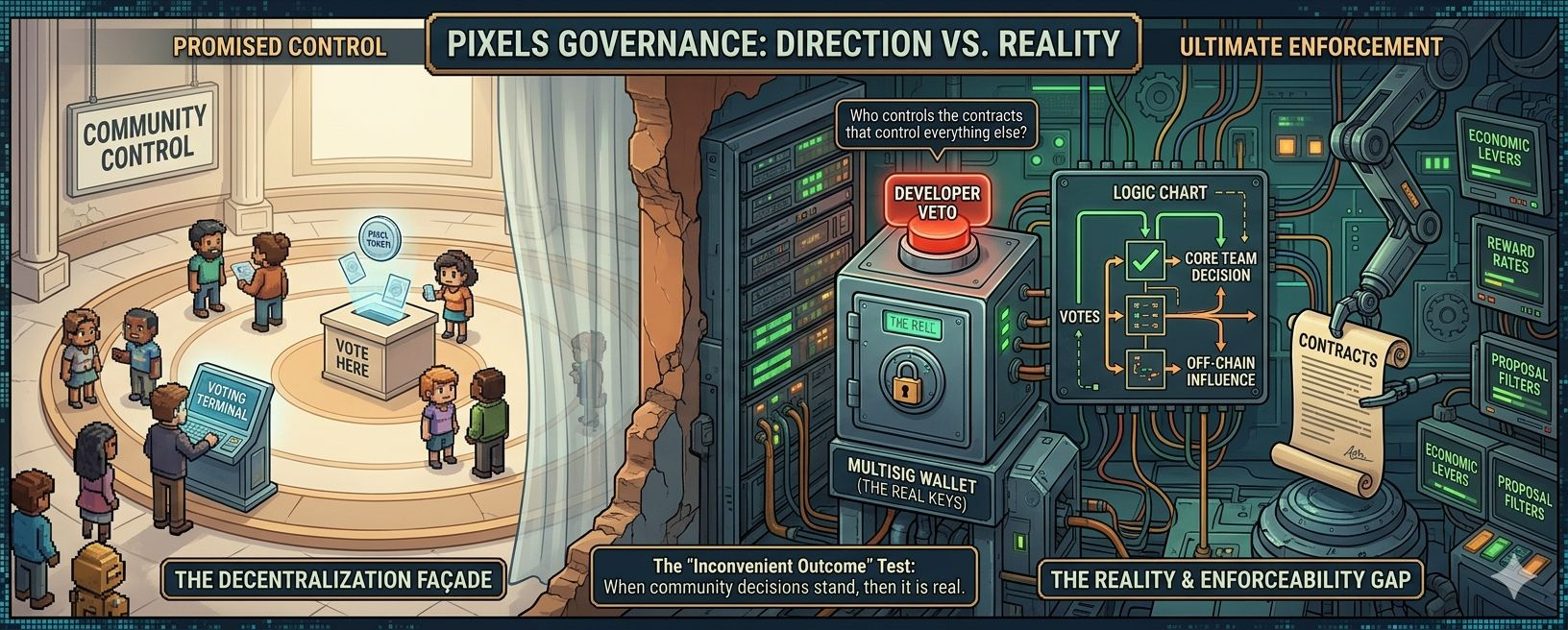
Most Web3 projects love to talk about decentralization like it’s an end state—clean, fair, inevitable. But every time I hear it, I come back to the same question: control over what, and when does it actually change hands?
Pixels is moving in that direction with governance tied to the PIXEL token. On paper, it sounds right. Token holders influence the economy, shape content, and participate in balancing the system. It reads like ownership. But governance in Web3 has never really been about what’s promised. It’s about what’s enforceable when decisions start to matter.
There’s a pattern most people don’t question until they’ve seen it play out. Voting systems go live, proposals get discussed, participation looks healthy—but when something critical comes up, real control tends to stay where it always was. Not always openly, but structurally. Through multisig wallets, proposal filters, off-chain influence, or “guidance” that quietly overrides outcomes. It’s not exactly fake decentralization, but it isn’t full transfer of power either. It sits somewhere in between, where the community can act, but not necessarily decide.
What makes this moment slightly different is that Pixels isn’t avoiding the conversation. That alone sets it apart from projects that treat governance like a delayed feature instead of a foundational system. The intent is visible early—governance connected to actual game mechanics, economic levers potentially exposed, and players positioned as participants in shaping the environment rather than just operating inside it. That doesn’t prove anything yet, but it does change how seriously the model needs to be evaluated.
Because the real test isn’t whether people can vote. It’s whether those votes carry weight when the outcome isn’t convenient for the core team. Can the community push through a decision that the developers wouldn’t have chosen? Are those decisions binding, or can they be adjusted behind the scenes? Is governance actually on-chain, or is it something that still relies on off-chain enforcement? And most importantly, who ultimately controls the contracts that control everything else?
If this works the way it’s being positioned, the system starts to shift. The game stops being just a structured environment and becomes something closer to a coordinated economy where players aren’t just optimizing strategies, they’re influencing the rules those strategies depend on. That’s a different level of interaction entirely, and it’s where most projects fail to follow through.
I’m not assuming Pixels will get it wrong. I’m just not assuming it will get it right either. Governance isn’t proven when it’s announced—it’s proven the first time the community makes a decision the core team wouldn’t have made, and that decision still stands.
Until then, decentralization is still a direction, not a reality.