
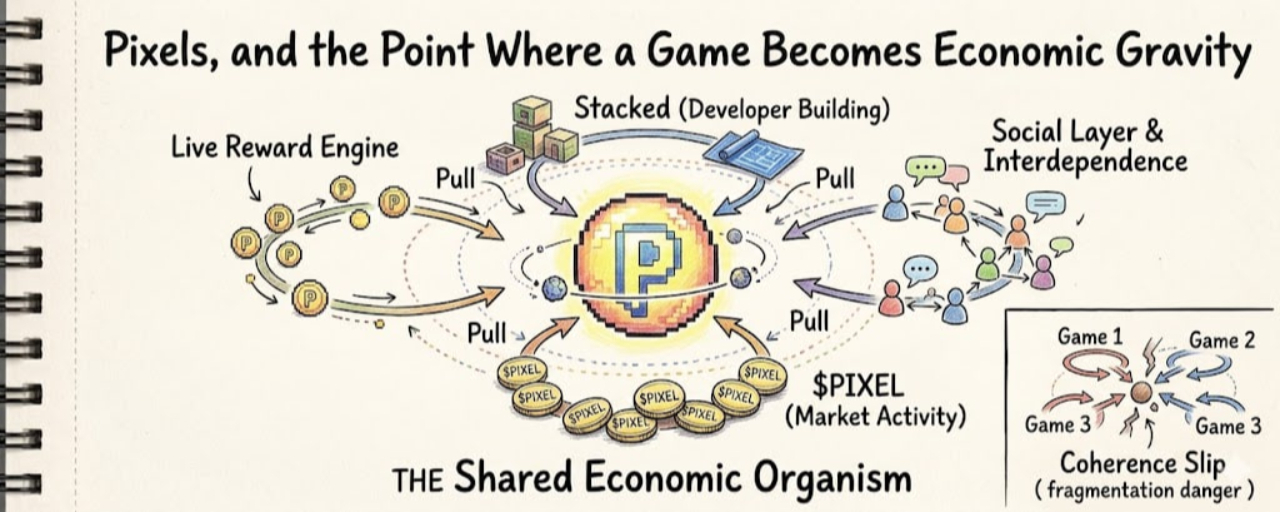
I keep coming back to Pixels @Pixels , and honestly, I think calling it “four pillars” or even an “App Store moment” undersells what might actually be forming.
Because I’m not just seeing structure anymore.
I’m starting to see gravity.
Not a feature. Not just a platform. Something that pulls.
When I look at what Pixels is building alongside Stacked, I don’t just see a better reward loop. I see a system that’s beginning to decide where value naturally wants to go.
And that’s a different level entirely.
An App Store organizes apps. A good game retains players.
But something with economic gravity pulls in players, builders, and capital—even when no one is forcing it.
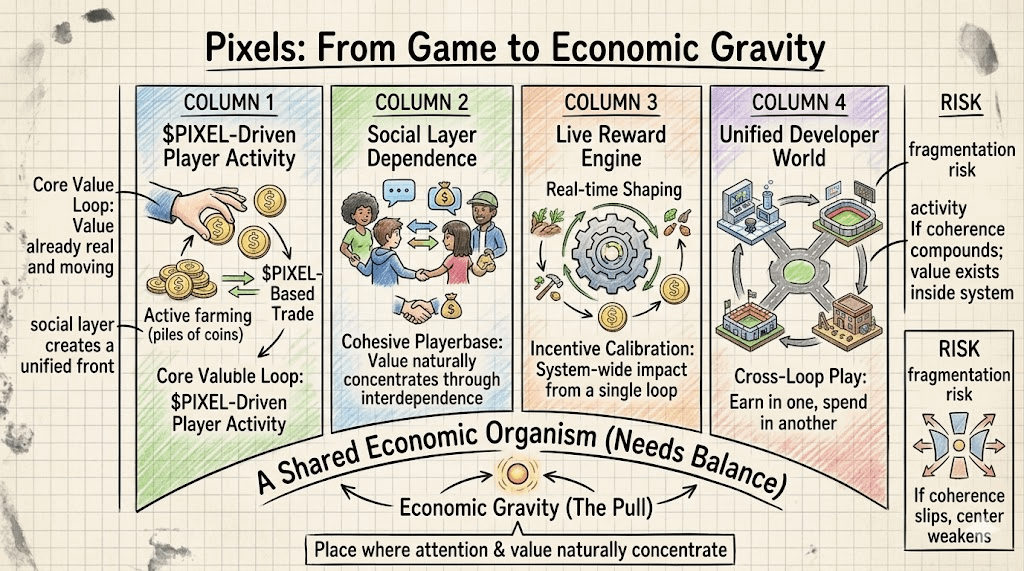
That’s what I think Pixels is getting close to.
I’m noticing how the pieces are starting to connect:
There’s $PIXEL already moving through real player activity.
There’s a live reward engine shaping behavior in real time.
There’s a social layer where players actually depend on each other.
And now there’s this idea of other developers building inside the same world.
Individually, I’ve seen all of this before.
But I haven’t really seen it working together like this.
Because once multiple systems plug into the same economic layer, something changes. I’m not just playing a loop anymore. I’m moving across loops. I can earn in one place, spend in another, interact somewhere else—and it all still makes sense inside the same environment.
At that point, I don’t think I’m inside a game anymore.
I’m inside a system where activity compounds.
And that’s where it gets powerful.
But also where it gets risky.
Because I’m realizing this only works if everything still feels connected. If too many different experiences start pulling on the same economy without coherence, the whole thing can start to feel fragmented. I’m no longer in a world—I’m just jumping between disconnected reward zones.
And that breaks the illusion fast.
That’s why I think the “App Store” comparison misses something important.
Apps don’t need to feel connected to each other.
But inside Pixels, everything shares the same economy, the same players, and the same incentives.
If one part over-rewards, I feel it everywhere.
If one loop dominates attention, it affects everything else.
If one experience becomes too extractive, it weakens the system as a whole.
I’m not looking at a marketplace.
I’m looking at a shared economic organism.
And organisms need balance, not just growth.
That’s why I think the real challenge here isn’t just getting developers to build.
It’s maintaining coherence while they do.
Because if Pixels gets this right, I don’t think it just becomes a successful GameFi project. I think it becomes the place where activity naturally concentrates—not because it’s forced, but because it’s simply more efficient to exist inside it.
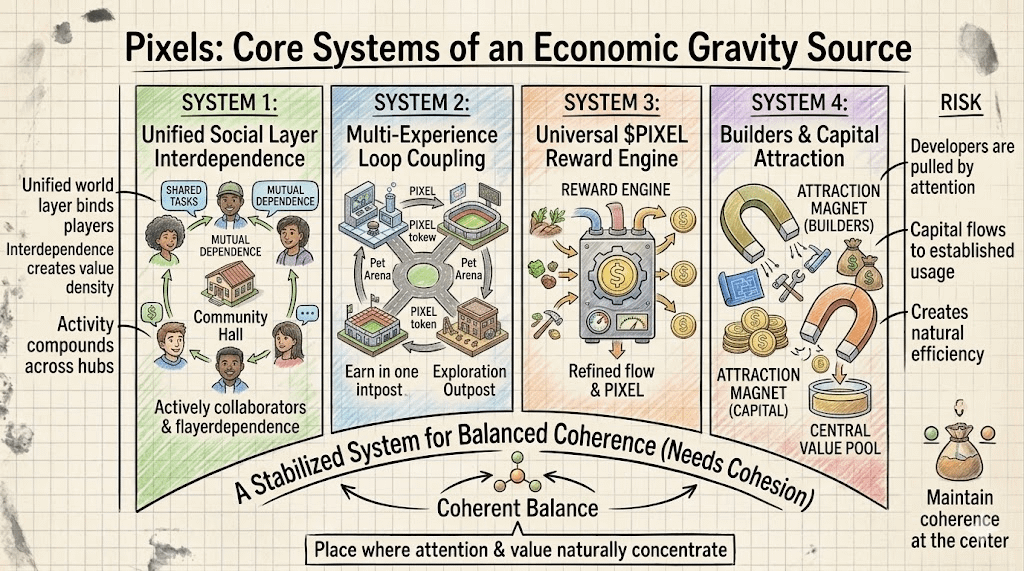
I’d go there because players are already there.
Builders would go there because attention is already there.
Value would flow there because usage is already real.
That’s what economic gravity feels like.
But I also know it can break the other way. If coherence slips, everything starts pulling apart instead of together.
And once that center weakens, it’s hard to rebuild.
That’s why I can’t just look at Pixels as a game anymore.
I’m watching to see if it becomes the place everything else starts orbiting—
or just another system that almost held it all together.