In the past few days, #CZ币安广场直播 as soon as it opened, the attention of the entire square was drawn back to the question of whether there is real demand on-chain. Many projects are talking about narratives, but when the traffic comes, it exposes the truth: no one is using it, there are no retention rates, no payments; no matter how well the tokens tell stories, they won't last long. On the contrary, @Pixels I believe that what is most valuable now is not just the farm game itself, but the gradual transformation of Pixel from a single game currency into a cross-game economic layer. Very few teams can actually walk this path.
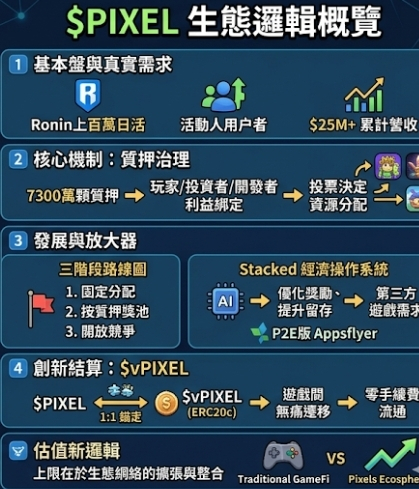
First, looking at the basics, Pixels has achieved over a million daily active users and cumulative revenue exceeding 25 million US dollars on Ronin. This indicates that it is not only relying on airdrops to attract new users but has continuously operating content and consumption scenarios. Next, the key is the staking design: $PIXEL now supports Pixels, Pixel Dungeons, and Forgotten Runiverse simultaneously, with 73 million tokens already staked. The significance of this number is not just 'locked assets looking good,' but rather binding the interests of players, investors, and developers to the same table. Who gets the resources and which game should be increased is no longer just a unilateral decision by the team, but is determined by the votes of stakers, turning tokens from consumables into governance rights.
The smarter thing is the three-stage roadmap: first, fixed allocation to ensure predictable resources for newly onboarded games; next, determining the prize pool based on staking amounts, using market preferences for filtering; finally, complete openness, allowing the ecosystem to form its own competition. This is essentially creating a capital allocation market for games, where resources are no longer distributed based on sentiment, but rather determined by participants' real money and behavioral data.
Looking one layer deeper, Stacked is the amplifier. Many people treat it as a tool, but I prefer to see it as an economic operating system: AI observes player behavior, helping game developers adjust reward timing, amounts, and targets, enhancing retention and monetization, much like a P2E version of Appsflyer. When third-party games integrate into this system, the demand for $PIXEL will no longer come solely from native players but from the overall growth engine of the ecosystem. Next, pet games (Pets Game) are coming in, and this network effect will only become more pronounced.
Finally, let's talk about $vPIXEL. It is pegged 1:1 to $PIXEL, using ERC20c to achieve cross-game circulation with zero transaction fees, which is a critical step: previously, it was difficult to bring the value earned in Game A to Game B with low friction; now it means liquidity and usage rights are interconnected. When players' assets can migrate painlessly between multiple games, the token upgrades from 'points in a certain game' to 'ecosystem universal fuel.' Therefore, my position is very clear: the real limit of $PIXEL is not in a single blockbuster, but in whether it can continuously onboard more games into the same staking governance plus data-driven allocation plus cross-game settlement network. Once this process runs smoothly, the valuation logic of #pixel will be completely different from traditional GameFi.