
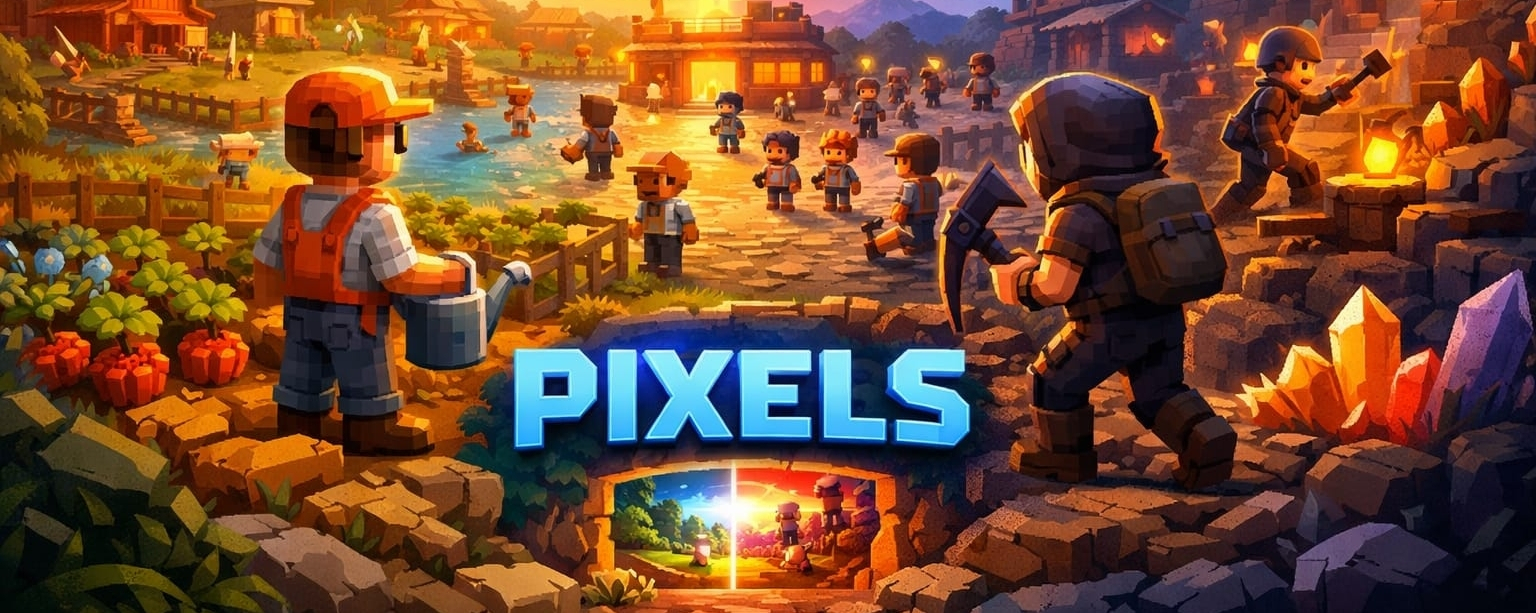
There’s a phase in Pixels (PIXEL) where nothing obvious seems to be happening. No big updates, no sudden hype, no clear moment you can point to and say something has shifted. And yet, if you spend enough time inside the game, it starts to feel different in a way that’s hard to explain at first. You log in like you always do, your character appears exactly where you left it, your farm looks the same, and the routines haven’t changed. You begin the usual cycle planting, collecting, moving through familiar actions but this time your attention drifts toward something else. Not the mechanics, but the people around you.
Some players seem slower now, not in a negative way, but more controlled. They’re not rushing toward every opportunity or reacting to every small change. They look more selective, more intentional in how they move. At the same time, there are others doing the opposite, moving faster, grinding harder, trying to extract as much as possible from every moment, almost as if they’re afraid of missing something. That contrast wasn’t always this visible, and it raises a quiet question. If nothing in the game has changed, why has the behavior inside it started to shift?
In systems like this, especially ones built on Ronin Network, the real signals rarely come from announcements or updates. They show up in how people start acting before anything becomes obvious. Some players begin to zoom out and stop treating the game like a checklist. Instead of repeating the same loop endlessly, they start observing patterns where attention is going, where it’s fading, what feels crowded, and what feels overlooked. Others stay inside the loop because it feels productive and safe. Farming, collecting, repeating. It works, and for a while, it feels like progress.
But that’s where the subtle difference begins to grow. The system doesn’t force anyone to change. You can keep playing the same way for a long time and still move forward. But eventually, a realization forms quietly in the background. Progress isn’t always about doing more. Sometimes, it’s about seeing differently. The players who notice small shifts early don’t necessarily work harder, but they adjust sooner. They start making small decisions that look insignificant at first spending less time on crowded resources, moving toward areas others are ignoring, focusing on relationships instead of just routines. None of this stands out immediately, but over time, it compounds.
From the outside, everyone still looks the same. They’re all farming, building, and playing. But underneath that surface, something deeper is happening. Some players are reacting to the system as it is, while others are slowly positioning themselves for what it might become. And those two paths don’t separate instantly. They drift apart gradually, almost invisibly, until the difference becomes impossible to ignore.
Pixels doesn’t explain this shift, and it doesn’t guide you toward it. There’s no clear signal telling you when to change or how to think differently. You either notice it through experience, or you stay inside the familiar loop. And if you stay, nothing breaks. The game continues, progress still happens, it just feels slower, less intentional. But if you do notice it, the entire experience changes. Not because the game becomes harder, but because it becomes clearer. You stop chasing everything, and you start choosing more carefully.
In the end, nothing about the system itself needs to change for everything to feel different. Because the real shift isn’t happening in the game. It’s happening in how you see it. And that leads to a simple but important question are you still reacting to the game, or are you starting to understand it ?