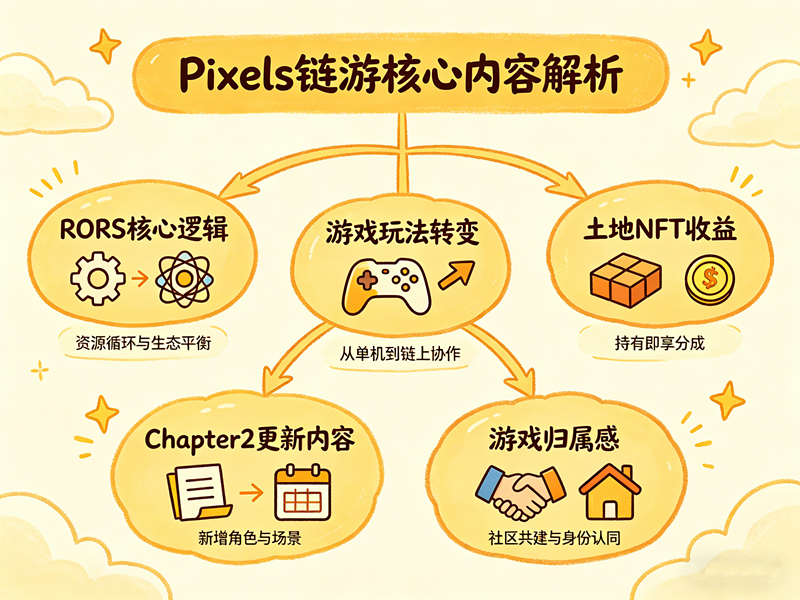
To be honest, @Pixels this farming-type chain game is quite special in the Web3 gaming circle. It's not like those early P2E projects that desperately issued tokens to attract users, boosting short-term activity, and once the incentives stopped, everyone ran away. Pixels, on the other hand, is more pragmatic; they created something called RORS (Return on Reward Spend). Simply put, before issuing rewards, they calculate whether this 'investment' is worth it, rather than throwing around traffic subsidies. The core logic of RORS is: how much value can the rewards issued by the project ultimately recover from the user's real behavior. If the rewards given out can generate income that approaches or even exceeds their value, then a positive cycle can slowly be established. This metric is impressive because it transforms the act of issuing tokens from a 'marketing tool' into a 'quantifiable investment' that must be accountable for user retention and long-term results like repurchases. Personally, I really appreciate this approach. Previously, too many chain games had rough growth methods; users would just take the rewards and leave, making it impossible for the ecosystem to sustain itself. Pixels is at least pushing chain games from 'whoever issues the most wins' to 'how to use more reasonable incentives to retain high-quality users'. This is somewhat similar to how traditional internet shifted from blindly buying traffic to performance advertising; the reasoning is the same.
Of course, it's easier said than done. RORS requires strong data tracking capabilities to determine which behaviors can truly create long-term value. If the model is inaccurate, reward distribution can easily go off track. Pixels was also in a phase of subsidizing for growth in its early days, and later gradually optimized the reward structure to encourage long-term participation, which is why it has been moving in a positive direction step by step. I think this direction is at least worth keeping an eye on. I have been playing for a few months, and my experience has become increasingly three-dimensional. At first, like most people, I logged in daily to complete tasks, farm, and quickly cash out the tokens I earned; it felt very mechanical. Later, I gritted my teeth and bought a few land NFTs, originally just wanting to try out what it felt like to 'be a farmer', but unexpectedly this completely changed my mindset towards the game.
Additionally, the staking rewards brought by the land are quite appealing: after acquiring land, when staking $PIXEL , I can receive a portion of extra rewards, and it can also be stacked (there is a limit for a single piece, but multiple pieces can accumulate). Gradually, I realized that holding assets long-term and continuously managing them is completely different from simply completing tasks. I used to want to log off after finishing daily tasks, but now I am more willing to think about how to improve resource output and how to make the tokens play a bigger role in the system. After Chapter 2 was updated, the game gradually added mechanisms like item consumption, facility upgrades, guild resource pools, and reputation points, making the gameplay much deeper all at once. Reputation points affect task acquisition and overall experience, and it feels like the system encourages your stable participation. The flow of resources and guild interactions also adds a social and collaborative flavor to the game; although it takes some time to adapt, it indeed makes people want to stay. For me, the most moving aspect of Pixels is that it allows me to no longer just be a passerby in the game, but to gradually manage my own little world, with a few pieces of land, facilities built up slowly, and a resource warehouse that brings a sense of achievement. The design of item consumption gives tokens practical uses, no longer relying solely on newcomers. Of course, not everyone is suited for this kind of long-term investment, but if you enjoy rooted management, it really provides you with a space where you can truly 'own' assets, and you can continue to manage them or adjust the pace at any time.
I am quite optimistic about the future of Pixels. The team is continuously optimizing the balance mechanism, hoping to attract more people who enjoy this casual management style. Of course, every game has a lifecycle, and how far it can go depends on whether the entire ecosystem can develop healthily. However, over the past few months, every time I wanted to manage my assets, looking at the land and resources I personally managed, I couldn't help but want to stay and try again. To put it bluntly, the core attraction of Pixels for me is this: it doesn't rely on short-term high rewards to keep people, but rather makes you unwilling to part with the things you have gradually managed. In Web3 games, this sense of 'belonging' is truly rare. (This article is a platform task and does not constitute any investment advice.)