

A System That Felt Too Smooth
I remember when restaking started getting attention—it felt like the kind of idea that just made sense. You stake once, earn more than once, and still keep your liquidity. Simple on the surface. Efficient by design.
KelpDAO was one of the projects pushing that idea forward. And for a while, it worked. rsETH spread across protocols, integrated into lending markets, and became part of a much bigger system than it originally started in.
Then, in a matter of minutes, that system broke.
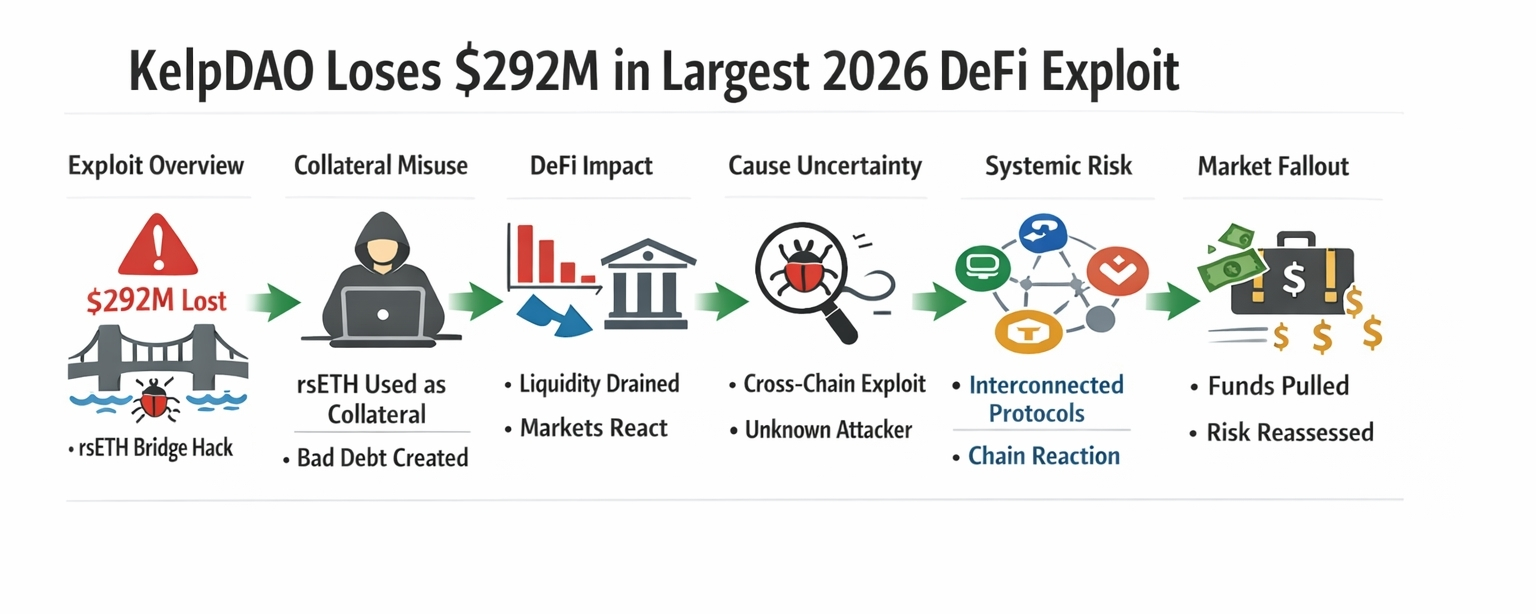
On April 18, 2026, KelpDAO lost around $292 million worth of rsETH. It quickly became the largest DeFi exploit of the year. But what stood out wasn’t just the size—it was how the damage moved.
This didn’t stay contained.
What Actually Went Wrong
The attack didn’t begin with a typical contract vulnerability. There was no obvious “drain the vault” moment.
Instead, it started with cross-chain activity that shouldn’t have been trusted—but was.
Somehow, the attacker managed to send a malicious message through the system that was accepted as legitimate. That message triggered the release of a massive amount of rsETH.
That’s a different kind of failure.
It means the system didn’t just have a bug—it believed something it shouldn’t have believed.
KelpDAO reacted by pausing contracts across multiple networks, but by the time that happened, the attacker already had control of the funds.
The Exploit Didn’t End With the Theft
Here’s where things get more uncomfortable.
The attacker didn’t rush to sell everything. They didn’t need to.
Instead, they used the stolen rsETH as collateral inside lending protocols. That’s what changed this from a large hack into something bigger.
Because once that collateral was accepted, real assets—like ETH—could be borrowed against it.
Now the problem wasn’t just missing funds. It was borrowed liquidity backed by something that might not be real anymore.
That’s how bad debt forms. And that’s how it spreads.
When One Protocol Becomes Everyone’s Problem
On the surface, DeFi is built on connection. Protocols integrate with each other, assets move freely, and everything becomes more efficient.
Underneath, that also means risk moves just as freely.
KelpDAO wasn’t isolated. rsETH was already being used across multiple platforms. So when it broke, the impact didn’t stop at KelpDAO.
Lending markets had to react. Collateral had to be frozen. Users started pulling funds out—not always because they were directly affected, but because they didn’t want to wait and find out.
Liquidity started shrinking. Confidence started slipping.
And suddenly, this wasn’t just one exploit anymore.
The Uncertainty Around the Cause
Even now, the full root cause isn’t completely settled.
Early analysis points toward a failure in how cross-chain messages were verified or accepted. Some believe it’s tied to the infrastructure layer. Others think it may come down to how the protocol itself handled incoming data.
There are also early claims suggesting the attack could be linked to a highly sophisticated group, possibly even state-backed. But at this stage, that’s still developing and shouldn’t be treated as confirmed.
What’s clear is this: the system trusted something it shouldn’t have, and that trust was enough to unlock millions.
The Real Weak Point
If you look at it closely, the exploit didn’t just expose a vulnerability—it exposed an assumption.
In DeFi, we often treat collateral as stable as long as it’s backed by something real. But once that asset moves across chains, gets wrapped, and is used in multiple places, it stops being simple.
It becomes layered.
And every layer adds another point where things can go wrong.
rsETH wasn’t just one thing anymore. It was a representation, a bridge asset, a piece of collateral, and part of several different systems—all at the same time.
When one layer failed, the others didn’t immediately adjust.
That delay is where the damage happens.
The Market Reaction
After the exploit, the reaction was fast—but not chaotic. It was cautious.
Funds started moving out of lending protocols. Liquidity shifted toward safer positions. Some platforms saw sharp drops in total value locked within a short period.
This wasn’t panic selling. It was risk being re-evaluated in real time.
And when that happens in DeFi, things move quickly.
A Pattern That Keeps Repeating
There’s something familiar about this.
DeFi pushes toward efficiency. It builds systems that are faster, more connected, more flexible. And for a while, that works.
Until something breaks.
Then the system has to slow down again. Reassess. Add friction where there wasn’t any before.
KelpDAO isn’t the first time this has happened. It probably won’t be the last.
But each time, the same question comes back: how much complexity can the system handle before it starts working against itself?
The Quiet Reality
On the surface, this was a $292 million exploit.
Underneath, it was a reminder.
DeFi doesn’t just fail because of bugs. It fails when too many things depend on each other working perfectly at the same time.
KelpDAO didn’t collapse on its own. It was part of a much larger structure—and that structure amplified the damage.
That’s the trade-off.
The same connections that make everything feel seamless are the ones that make failure travel faster.
And right now, DeFi is still figuring out where that balance should be.