
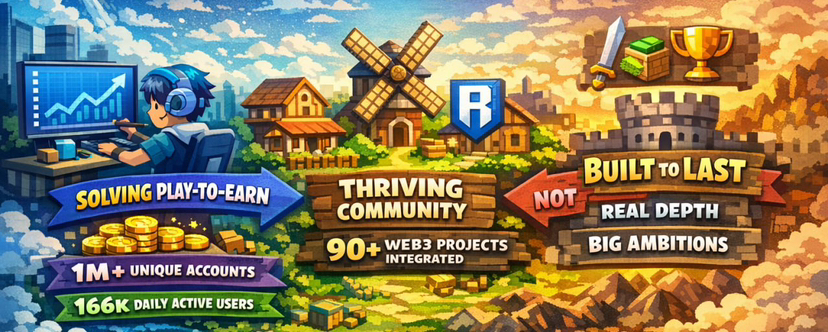
There's something I think a lot of people misunderstand about Pixels, including some of the people currently holding their token. They look at Pixels and see a web3 farming game, compare it to a handful of other gamefi names, and conclude they're more or less the same thing. But if you actually read through the Pixels whitepaper carefully, there's one sentence that stands out sharply from the way most projects describe themselves: they say Pixels was founded to solve play-to-earn, not to exploit it. Those are two completely different things, and that difference explains why Pixels is still here while a wave of other gamefi projects have already returned to dust.
Play-to-earn in the early days of web3 was essentially a token distribution mechanism disguised as a game. People didn't play because the game was good, they played because the token was going up and they needed to farm before everyone else did. When the price fell, the only reason to stay fell with it. Pixels saw that problem from the beginning, and instead of chasing the trend they chose to build something different, a genuine growth model where players come for the game and stay because of community and real depth in the in-game economy.
The results aren't accidental. Pixels currently has around 166 thousand daily active users and has onboarded over 1 million unique accounts. This number grew most strongly after Pixels migrated to Ronin Network, and that detail is worth paying attention to because moving blockchains isn't a small decision, it costs time, resources, and carries real risk of losing users if the transition disrupts the experience. The fact that Pixels not only held onto its users but actually grew after that event shows their community foundation was already solid enough to carry the weight.
The Pixels community isn't a passive one in the sense of just reading announcements and waiting for airdrops. They genuinely have a role in determining which direction the project moves, and Pixels acknowledges that formally in the whitepaper, not just as a throwaway line on Twitter. As of early 2024, the community already had over 150 thousand daily active players and Pixels had integrated more than 90 other web3 projects into its gameplay. That number 90 isn't a badge to show off, it's evidence that Pixels is functioning as a connection point within the broader web3 ecosystem, not an isolated island running on its own.
But I want to return to the original vision of Pixels because I think that's the most important thing when talking about a project's survivability going forward. Pixels doesn't just want to win in web3 gaming, they want to build a model that mainstream gaming can actually learn from. That's a big ambition, and big ambitions aren't always easy to hear, but it creates something more important than any individual metric, which is a reason to keep building even when market conditions are working against you.
Most gamefi projects collapse not because they run out of money, but because they run out of reasons to exist. When the token falls the narrative falls with it, and when both the team and the users stop believing in the story, the project is basically dead even if it's still tweeting every day. Pixels has set its sights beyond a single market cycle, and that's something I find genuinely rare in this space.
I don't know where the Pixels token price is heading in the short term, honestly nobody knows that for sure. But if the question is which projects have the structure to survive and grow across multiple cycles, then Pixels is building exactly the right things, real users, a community with genuine voice, an ecosystem that extends beyond a single game, and most importantly a reason to exist that's bigger than today's token price. Not many projects in crypto have all four of those things at the same time. @Pixels $PIXEL #pixel $HIGH $RAVE