
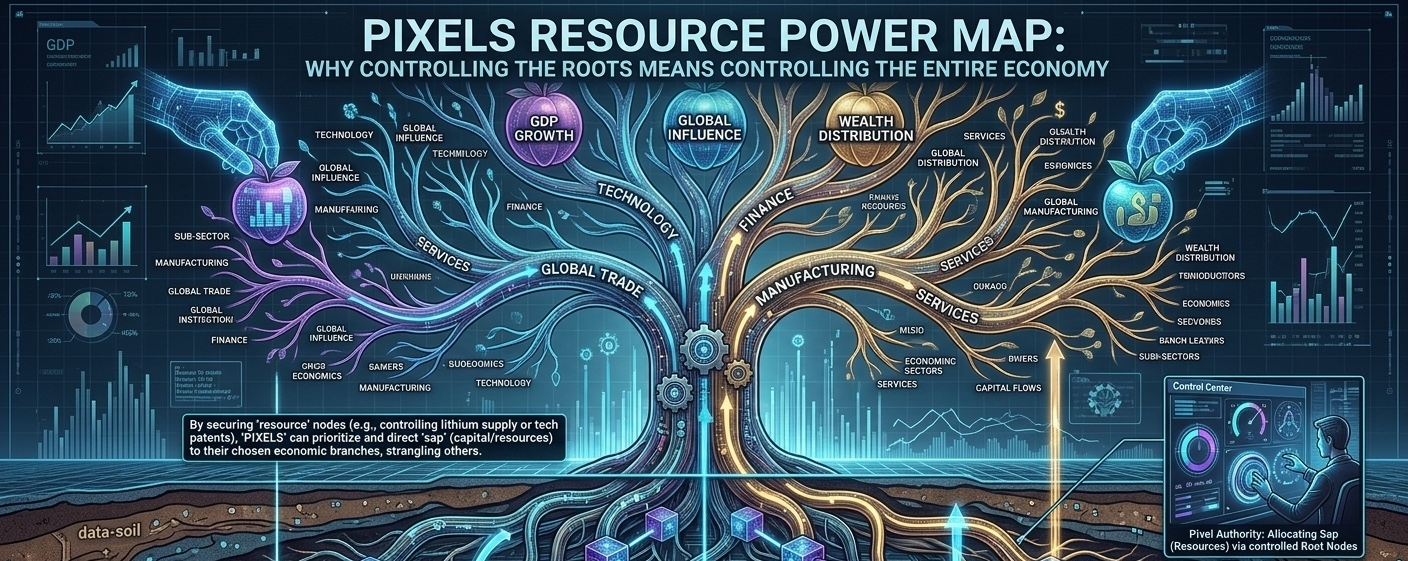
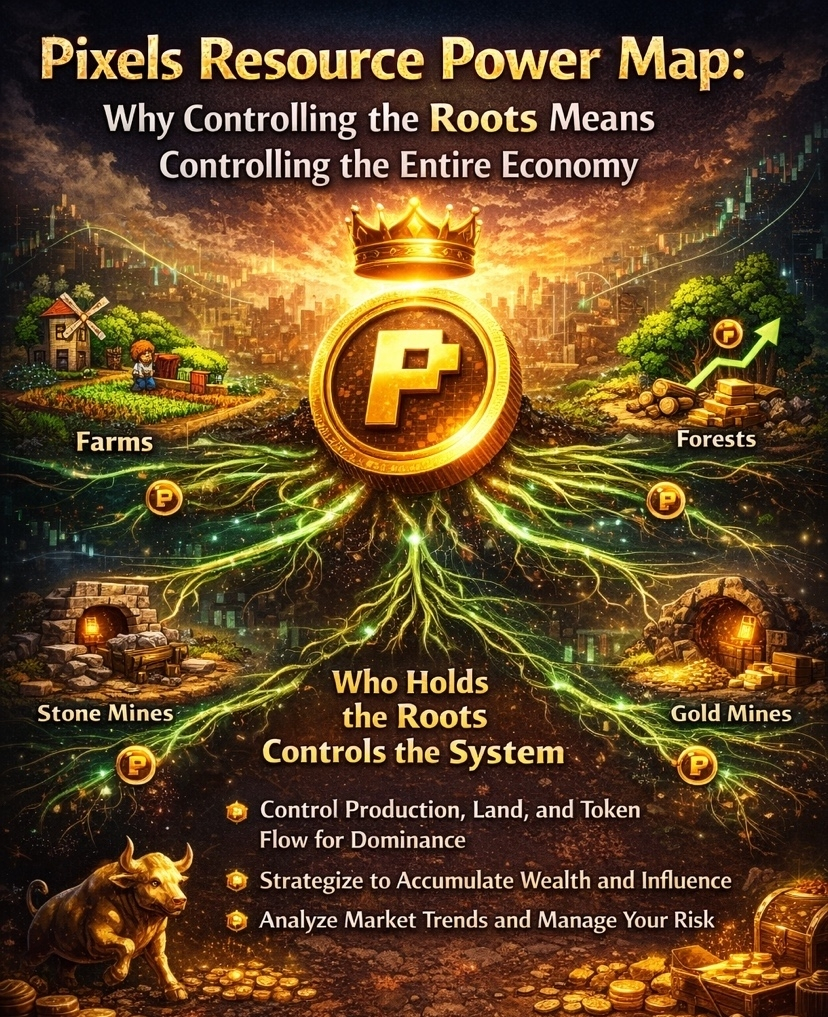
In the evolving world of Web3 gaming, Pixels is quietly building something far more powerful than a simple play-to-earn experience—it is constructing a layered economic system where control of resources directly translates into influence, wealth, and long-term dominance. At the heart of this system lies a concept that many overlook: the “resource power map.” In Pixels, those who control the roots—land, assets, production chains, and token flow—ultimately control the ecosystem itself. This dynamic transforms gameplay into strategy, where ownership and positioning matter more than short-term rewards. Unlike traditional games, Pixels integrates blockchain-backed ownership, allowing players to farm, trade, mint NFTs, and participate in guilds, all powered by the PIXEL token, which serves as the backbone of this digital economy . This creates a system where economic control is decentralized but highly competitive, rewarding those who understand the deeper mechanics of resource accumulation.
From a market perspective, PIXEL is currently navigating a phase of consolidation, reflecting both the broader uncertainty in the crypto market and the transition phase within the GameFi sector. Recent price data shows PIXEL trading in a relatively tight range between approximately $0.006 and $0.008, indicating a period of accumulation rather than aggressive speculation . Market sentiment appears mixed but stable, with equal portions of the community leaning bullish and cautious, suggesting that investors are waiting for stronger catalysts such as ecosystem updates or increased player adoption . This phase is particularly important because it often determines whether a token will break into a new trend or remain stuck in a prolonged range. In the case of Pixels, the ongoing shift toward a more sustainable economic model, including reducing inflationary pressures and enhancing in-game utility, is gradually strengthening investor confidence .
Technically, PIXEL presents a structure that reflects neutrality with underlying potential. The Relative Strength Index (RSI) is currently hovering around 40, indicating that the asset is neither overbought nor oversold but leaning slightly toward the lower side of momentum . This suggests that selling pressure has cooled, and the market may be preparing for a directional move. Moving Averages further clarify this picture, with the 50-day MA acting as a key dynamic level that traders are watching closely. If the price manages to reclaim and hold above this level, it could signal a shift toward bullish momentum. On the downside, failure to maintain support could lead to further consolidation. Key support levels are forming around $0.0060, with stronger support near $0.0056, while resistance zones are identified between $0.0065 and $0.0070 . These levels define the current battlefield where buyers and sellers are competing for control, mirroring the in-game dynamic where resource control determines power.
Looking forward, the future of PIXEL depends heavily on how effectively the ecosystem continues to evolve and retain players. In the short term, a breakout above resistance could trigger a momentum-driven rally, potentially pushing the price toward higher liquidity zones as traders re-enter the market. However, this will require strong volume and positive sentiment across the broader crypto space. In the long term, the outlook becomes more compelling. Pixels is actively restructuring its economy by reducing inflation, phasing out inefficient reward systems, and introducing new gameplay features such as guilds and exploration, all designed to increase engagement and create sustainable demand for the token . If these developments succeed, PIXEL could transition from a speculative asset into a utility-driven token with consistent demand, positioning it as a leader in the Web3 gaming sector. The key factor will be whether the ecosystem can maintain a balance between earning and spending, ensuring that value circulates rather than drains out.
Risk management remains a critical component for anyone engaging with PIXEL, especially given the volatility associated with GameFi tokens. While the project shows strong potential, it is still classified as a high-risk asset due to its dependence on user growth and market sentiment . Traders should implement strict stop-loss strategies, ideally placing them just below key support levels to limit downside exposure. Position sizing is equally important; allocating only a portion of capital to PIXEL can help mitigate risk while allowing participation in potential upside. Diversification across multiple assets can further reduce overall portfolio volatility. Emotional discipline is another key factor—markets driven by hype and narrative shifts can lead to impulsive decisions, so maintaining a clear strategy is essential. Investors should also monitor in-game economic metrics, such as player activity and token usage, as these often provide early signals of long-term sustainability.
Ultimately, Pixels is not just a game—it is a living economic system where power is distributed based on resource control. The concept of a resource power map highlights a fundamental truth: those who control production, land, and token flow are not just participants but architects of the ecosystem. This creates a dynamic environment where strategy extends beyond gameplay into economic positioning, making Pixels one of the most intriguing experiments in Web3. As the project continues to evolve, its success will depend on its ability to maintain balance, incentivize participation, and adapt to market conditions.