

The industry has spent years treating game economies like static, hardcoded loops where every update requires a full redeployment of the core logic. I keep noticing that this model is failing because it cannot react to the speed of live player behavior.
We are seeing a shift toward programmable coordination layers where game parameters are no longer fixed, but exist as variables that react to verified on-chain conditions.
In the case of the Stacked engine and its integration with $PIXEL, the architecture is moving away from being a single-use currency toward becoming a shared resource layer that flows through different "plug-and-play" modules. This isn't about a coin being a prize, its about $PIXEL acting as the connective tissue between the Stacked LiveOps engine and the actual gameplay experience.
The difference is subtle, but it changes everything about how we view digital assets.
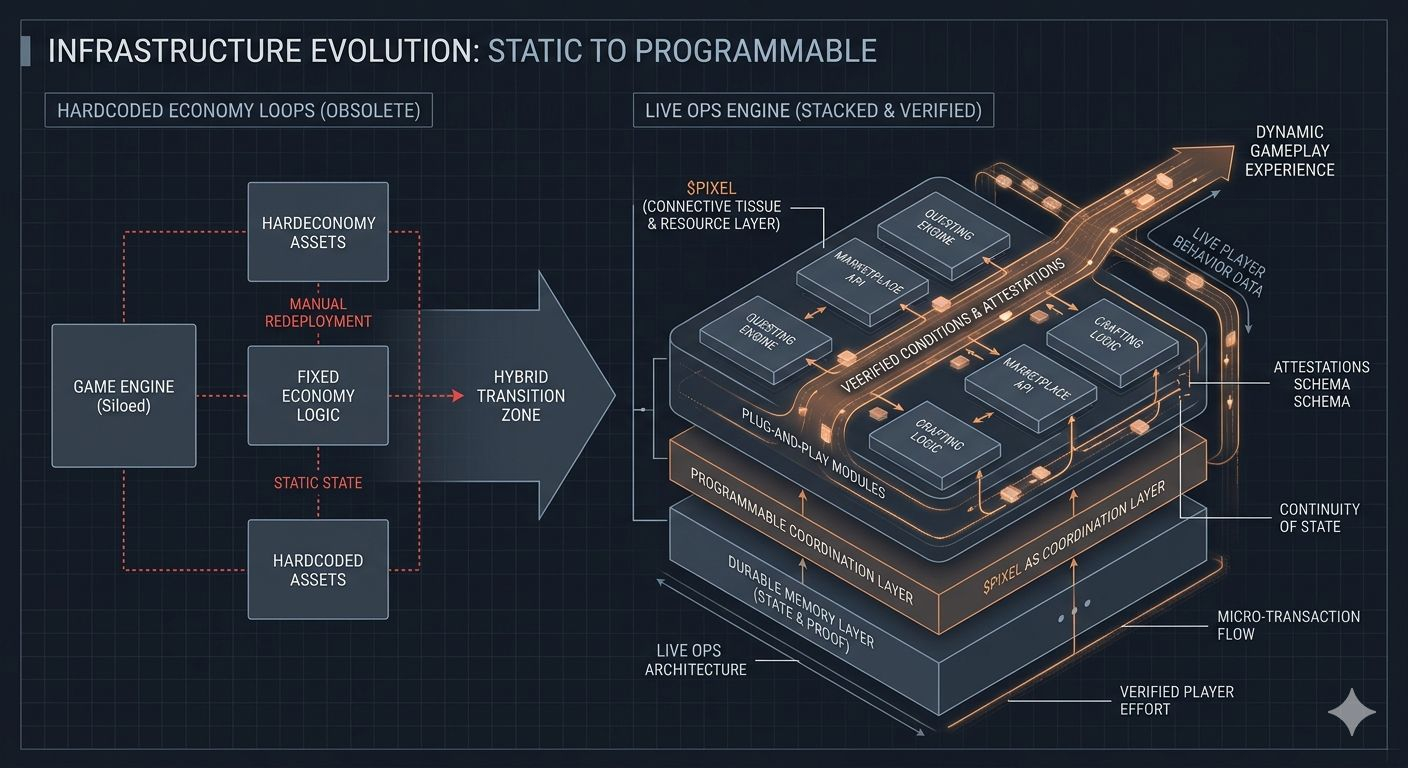
Shipping a functional economy under pressure is significantly harder than the hype narratives suggest. Most projects fail because they build for the best-case scenario, but the Stacked engine is designed to handle the friction of millions of micro-transactions without breaking the game loop.
When PIXEL ed its utility across titles like Pixel Dungeons and Chubkins, the shipping reality became a question of infrastructure rather than marketing. It requires a backend that can verify player attestations across different schemas without creating a bottleneck in the user experience.
Building tech that actually works means admitting that most on-chain gaming is currently broken.
the Gap between a "played" game and a "recorded" game is larger than it looks. For $PIXEL to maintain long-term value, the data generated during gameplay must preserve its meaning across different systems and over time.
durable memory in this context means that an attestation earned in one corner of the ecosystem remains legible to a completely different game engine five years from now. If the proof of effort is lost when the server resets, the asset is effectively useless. We are building systems that ensure the continuity of state, where the logic of the game is stored as a permanent record of coordination.
That gap in digital memory is where most "play-to-earn" models eventually bleed out.
The architecture of Stacked is less about gaming and more about the unglamorous plumbing of verifiable digital work.
Scalability is not a throughput problem, it is a legibility problem.