I didn’t notice it at first. It just felt like the game was getting easier the more I played. Not in a rewarding way, more like certain annoyances quietly stopped mattering. Shorter waits here, smoother loops there. But then something else stayed stubbornly slow, almost like it was meant to. That imbalance kept bothering me more than it should have.
Pixels gets described as a simple farming economy, and honestly, that’s how it feels in the first few hours. You click, you harvest, you repeat. Nothing unusual. But after a while, the simplicity starts to crack a bit. Not everything improves at the same pace. Some parts of the experience feel almost optimized for comfort, while others hold their friction like it’s intentional. That contrast doesn’t behave like a fully optimized system. It behaves like something picking its priorities.
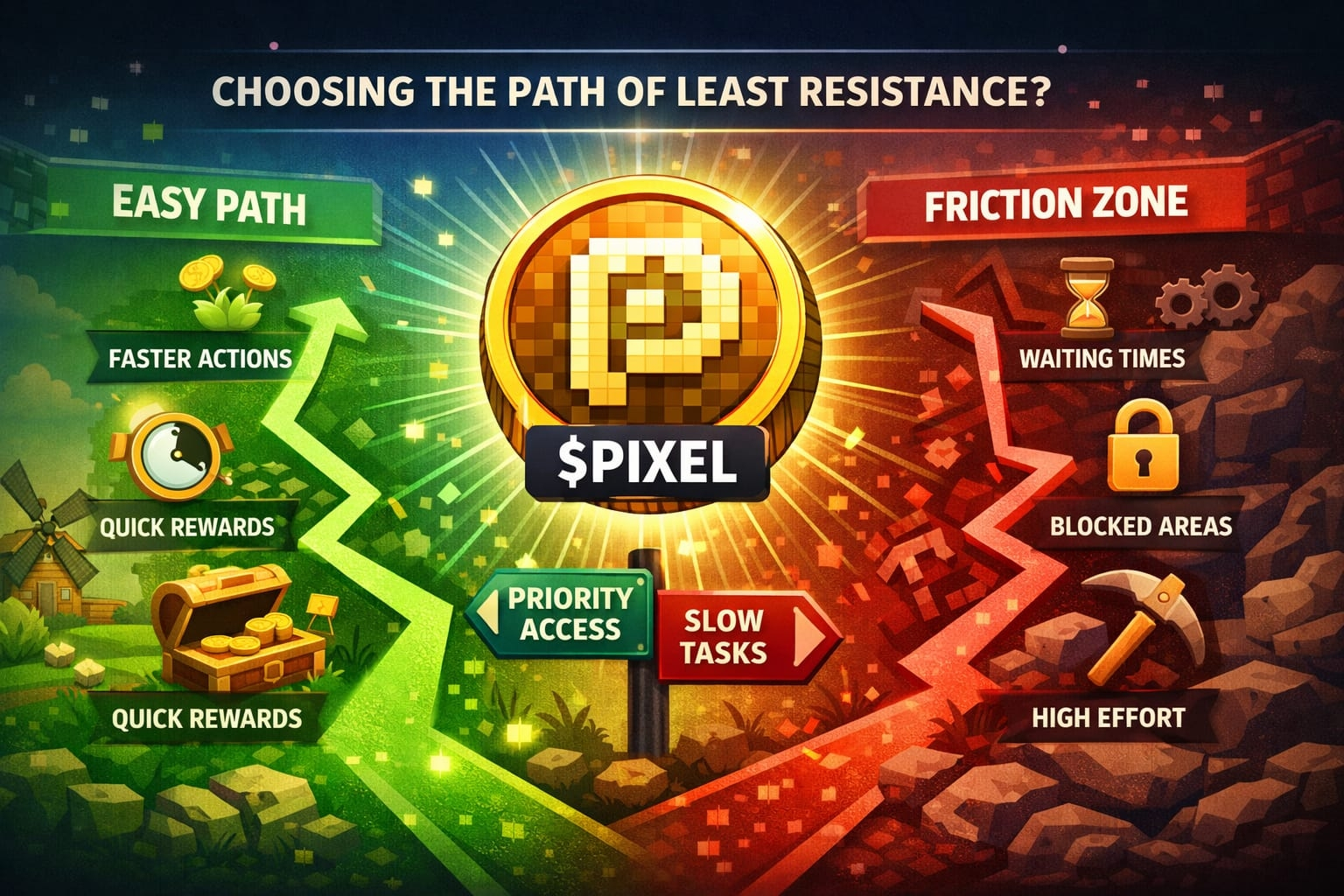
I used to think $PIXEL just sat on top of that loop. Earn token, spend token, move forward. Pretty standard. But the more I watch how the system reacts, the less it feels like a passive reward. It’s closer to a switchboard. Not turning things on or off completely, just deciding which parts of the game deserve to become easier first. And which ones should stay slightly inconvenient.
That shift is small, but it changes how you read the whole economy. Because now it’s not about removing friction everywhere. It’s about ranking friction. Deciding what gets smoothed out and what stays visible. In practice, that creates a kind of silent hierarchy between players. Not just based on how much they play, but on how closely they align with the system’s preferred paths.
I keep thinking about gas fees when I try to make sense of it. On a blockchain, you don’t remove friction, you price it. You decide which transactions move faster based on what someone is willing to pay. Pixels feels like a softer version of that. Instead of explicit fees, you get selective ease. Some actions become fluid. Others keep reminding you they exist.
And it doesn’t hit immediately. Early on, you can brute-force your way through most things. Just play more. Grind harder. But over time, that stops working as cleanly. You start noticing that certain behaviors scale better than others. Not because they pay more directly, but because they cost less effort to maintain. Less waiting, fewer interruptions, smoother loops.
That’s where I think the system quietly shifts from rewarding activity to shaping behavior. Activity is cheap. You can always push users to do more if the incentives are strong enough. But behavior that repeats on its own, without constant rewards, that’s harder. That’s where systems usually fail. Pixels doesn’t seem to push everything equally toward that state. It nudges specific loops until they become natural, almost automatic.
And once something becomes automatic, you don’t question it anymore. You just keep doing it. That’s where friction removal becomes more than a quality-of-life improvement. It becomes a signal. This is the behavior that fits. This is the path the system is willing to support long term.
I’m not sure most players even notice this happening. It doesn’t feel like control. It feels like convenience. Things getting smoother as you “progress.” But progress here might not just be about level or rewards. It might be about how predictable your behavior becomes from the system’s perspective.
That creates an odd tension. Because on one side, the game feels open. Play how you want, explore, experiment. On the other side, the parts that scale — the ones that become easier over time — feel more constrained. Like the system is slowly guiding players toward a narrower set of efficient actions.
And I don’t think this is fully about extracting value in a direct way. It’s more subtle than that. It’s about structuring time. Deciding which actions deserve to feel light enough to repeat indefinitely, and which ones should remain just heavy enough to discourage overuse.
If that’s true, then $PIXEL isn’t just tied to rewards or purchases. It’s tied to experience design at a deeper level. It influences how effort gets distributed across the game. Where players feel friction, and where they don’t.
I’m still trying to figure out what that means long term. Because if a system starts deciding which friction disappears first, it’s also deciding which behaviors get a future inside it. And that choice might matter more than anything the token is explicitly used for.