
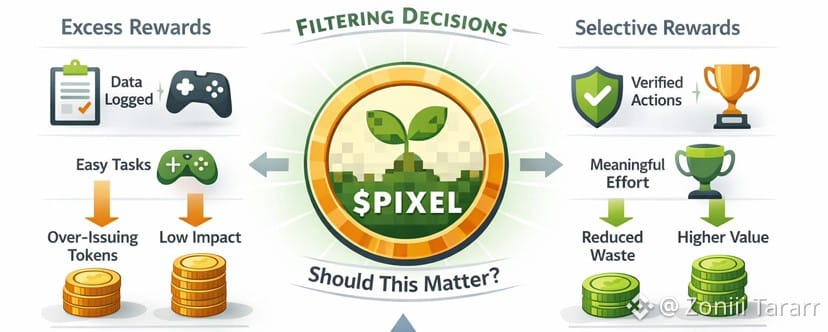
I was watching how rewards get distributed in a few games recently, and something felt slightly off. Not broken, just… loose. Players were active, tasks were being completed, tokens were moving. But a lot of it didn’t seem to matter in any lasting way. It looked like a system working. I’m not sure it actually was.
At first glance, $PIXEL still feels tied to gameplay expansion. More players, more loops, more activity. That’s the obvious path. But the more I look at it, the more it seems like expansion creates a different problem. Not growth, but excess. Too many actions being recorded, too many rewards being issued, without a clear sense of which ones should actually count.
And that’s where things start to shift a bit. Because recording activity is easy. Systems are good at that. They log everything. But deciding which activity deserves a reward… that’s different. That’s where the system stops being passive and starts making choices, even if those choices are hidden behind formulas.
In simple terms, verification is just checking if something happened. A player completed a task. A wallet interacted. That part scales easily. But distribution, the act of giving rewards, is not just a follow-up step. It’s a decision. And decisions carry weight, especially when money is involved.
The gap between those two steps is where things get messy. Data exists everywhere, but usable data is surprisingly rare. A system might know that a player logged in every day, but does that mean they contributed anything meaningful? It might track actions, but not intent, not consistency, not whether those actions should influence future rewards.
So what happens instead is a kind of leakage. Rewards flow, but not always to the right places. Some players optimize for extraction. Others get overlooked because their behavior doesn’t fit clean patterns. The system keeps distributing anyway, because it has to. That’s how it’s designed.
This is where $PIXEL starts to feel less like a simple in-game currency and more like a filter. Not a perfect one. Maybe not even a fair one. But still, a mechanism that slowly tries to reduce waste by deciding which behaviors should continue receiving rewards and which ones should fade out.
It doesn’t announce these decisions clearly. Most systems don’t. From the outside, it still looks like participation equals reward. But under pressure, when budgets tighten or when too many players start gaming the system, something has to give. Not everything can be rewarded equally.
That’s when verification turns into something heavier. It’s no longer just about confirming that an action happened. It starts asking a quieter question: should this action matter going forward? And that’s not a purely technical question. It involves judgment, even if it’s embedded in code.
Credentials, in this context, are not just pieces of data. They are claims. A record that says, “this player did something worth remembering.” But claims only matter if other parts of the system accept them. If a player’s history doesn’t travel well between games or systems, then the credential loses weight. It becomes isolated, almost decorative.
And this is where things tend to break at scale. One system might accept a player’s past behavior as meaningful, while another ignores it completely. So the player ends up repeating the same actions, proving the same things, over and over. Not because the data doesn’t exist, but because it isn’t trusted in the same way everywhere.
Trust, it turns out, doesn’t move as easily as data. You can copy records across systems, but you can’t guarantee that the interpretation stays consistent. And when interpretation shifts, so do rewards.
So if Pixel is trying to reduce reward waste, it’s not just about tightening distribution. It’s about making sure that decisions made in one place can still make sense somewhere else. That a verified behavior here doesn’t become meaningless there.
Which sounds simple until you think about how many small judgments are involved. What counts as consistent behavior. What counts as valuable contribution. These are not fixed definitions. They evolve. And systems have to keep up, or they start misallocating again.
From a player’s side, this shows up in quieter ways. Repeating tasks that don’t seem to carry forward. Being eligible one day, then not the next, without a clear explanation. It creates a kind of low-level uncertainty. Not enough to stop playing, but enough to notice.
And maybe that’s the part that feels underexplored. The value of Pixel might not come from making the game bigger, but from making these decisions tighter. More defensible. Less wasteful. Not perfectly fair, just more consistent under pressure.
But even that raises another question. If rewards become more selective, more filtered, does the system become harder to trust or easier? I’m not sure. It probably depends on how visible those decisions are. And right now, most of them aren’t.