
Let me admit something first: I spend more time in Pixels every day than I do playing any AAA game.
I quit Elden Ring after completing it, and I got tired of Stardew Valley after a month. But I actually stuck with Pixels, this pixelated farming game with its rough graphics, monotonous controls, and frequent lag, for almost half a year. The first thing I did every morning wasn't check my social media, but log in to harvest my crops. The last thing I did before bed wasn't read, but check if my task board had refreshed—it sounds a bit absurd even to myself 😅.
This made me start to reflect on a question: What exactly am I being held hostage by?
I. From "playing" to "grinding," I slid down this slide step by step.
When I first entered @Pixels , my mindset was pure: farming, chopping trees, doing quests, and relaxing. Back then, Coins were skyrocketing in value; although they weren't worth much, the sound of the numbers ticking away was pleasing. You clicked, and there was a response; you did something, and you gained something. No need to use your brain, just your fingers. It was simply enjoyable.
But after playing for a week, my mindset changed.
I started paying attention to the task board, calculating the most efficient way to allocate energy, and researching which crops had higher exchange rates in the market. I was no longer "playing," but "optimizing." It's a subtle feeling—you think you're improving, but you're actually sliding into another state: treating the game like work. And the funniest thing is, you don't even realize you're sliding down, and by the time you realize it, it's too late to go back 🙃.
The developers clearly understand this. The task board, reputation points, and guild system in Chapter 2 are all designed to guide you to play "more efficiently." But the opposite of efficiency is the loss of fun. You are no longer surprised to find a hidden Easter egg, but relieved to get a high-value task—"Finally, it's worth the half hour I spent grinding."
II. The two sources of dopamine, which it has thoroughly explored.
Neuroscience tells us that dopamine has two release pathways.
The first type is "want." When you see a potential reward, dopamine spikes, driving you to pursue it. Pixels' taskboard is a typical "want" trigger—the task box says "Reward 15 PIXEL," and you start calculating: just ten more trees to chop down, five more waterings, and it's done. You're driven by "want" to perform repetitive tasks, like a donkey chasing a carrot.
The second type is "receiving." When you actually receive a reward, dopamine is released, but it lasts only a short time. You receive the reward, feel satisfied for a few seconds, and then immediately start looking for the next goal. There will never be a day when you feel "enough."
@Pixels You've mastered these two dopamine cycles to an extreme degree. There's always another order on the quest board, your reputation points are always just a little short of a level up, and your guild ranking is always just a few places away from entering the prize pool. You're perpetually in a state of "almost enough, but not quite enough." This isn't game design; it's an addiction mechanism. I'm not saying this to criticize; I myself am one of those trapped in it.
But what makes Pixels special is that its rewards have real market value—$PIXEL they can be sold for money. This combines the "dopamine cycle" and the "economic incentive," creating double the motivation. You tell yourself, "I'm not wasting time, I'm making money"—even if the money you earn can't even buy a cup of milk tea.
Third, the boundary between work and play has become completely blurred for me.
I've observed changes in my behavior within Pixels, which can be divided into three phases.
Phase One: The Exploration Period. Everything was new and exciting, and profits weren't a concern. This was true "play." Unfortunately, it only lasted three or four days.
Phase Two: Optimization Period. We started calculating costs, pursuing efficiency, and repeating the optimal path. This was a "part-time" approach, lasting approximately two weeks.
Phase Three: The Maintenance Period. Logging in daily, completing tasks, and collecting rewards at the same time—it's as mechanical as brushing your teeth. This is "pure labor." And I've stayed in this phase ever since.
The most terrifying thing is that after entering the third stage, I didn't feel any pain. Instead, I felt a sense of accomplishment from "completing a task." This feeling was exactly the same as when I used to clock in at work, finish reports, shut down my computer, and go home. I even started to enjoy the sense of order that came with "completing the daily routine."
Pixels disguised "work" as "games," and I willingly accepted it. Thinking about it sends a chill down my spine.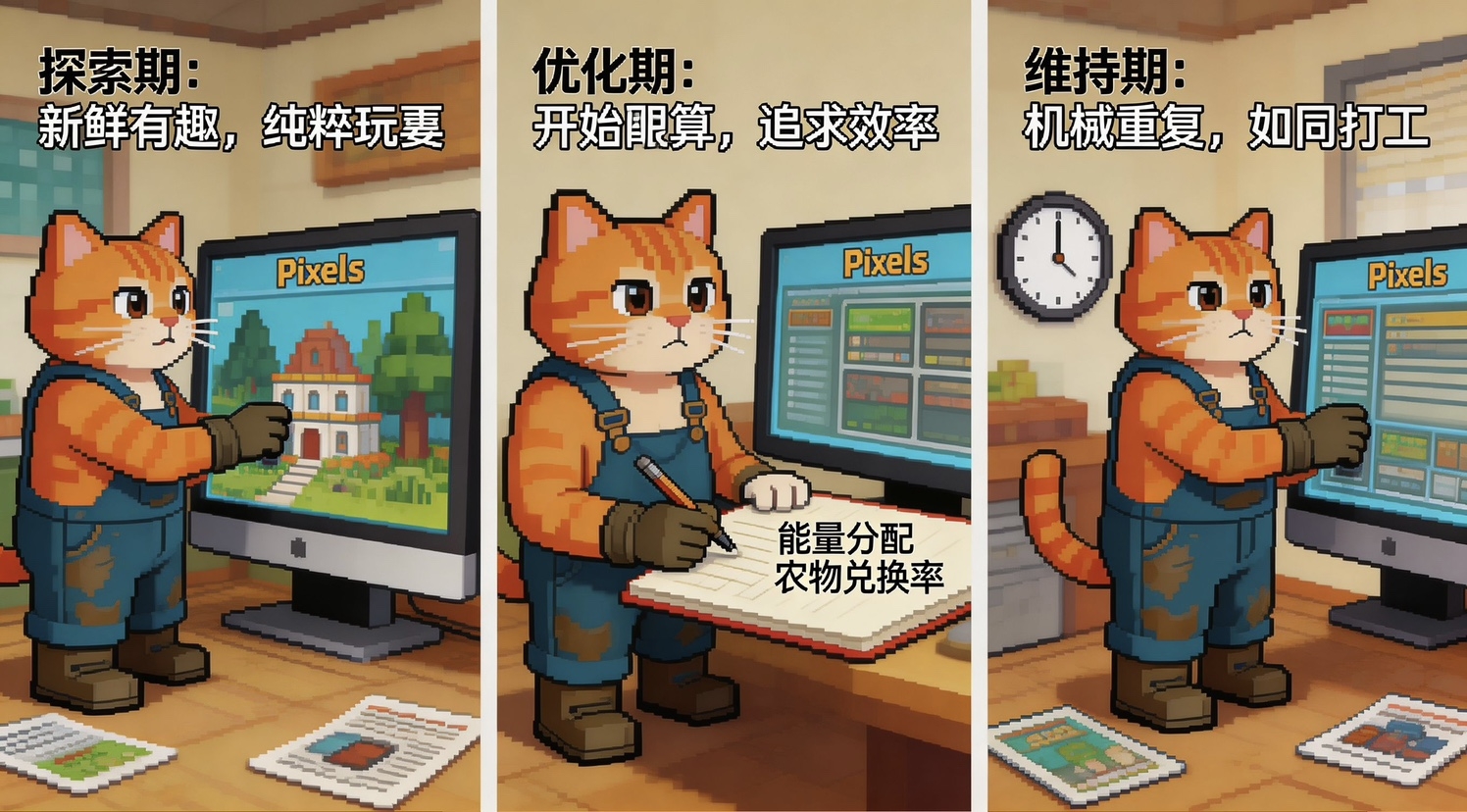
IV. So why haven't I uninstalled it yet? I've come up with four reasons.
Logically speaking, when something changes from entertainment to obligation, a normal person should run away. But I didn't, and there are quite a few people in the community like me. I thought about it for a long time and came up with a few reasons.
First, there's the sunk cost. I've already accumulated reputation points, pets, land, and even some pledged dividends. While these aren't huge sums, giving them up means losing everything. Humans are inherently averse to loss, so they'd rather continue "working" than "quit." Simply put: I've already invested so much; leaving now would be a huge loss.
Secondly, there was the social connection. I met a few people in the guild, and we'd greet each other every day and chat occasionally. This weak social relationship became the "soft nail" that kept me there. It wasn't that I couldn't leave, but that I was too embarrassed to. One day, the guild leader said in the group chat, "Everyone has worked hard," and I suddenly felt—isn't this just workplace PUA? But I still stayed.
Third, intermittent rewards. Pixels won't let you earn a lot every day, but occasionally you'll get a big order, a rare item, or a guild ranking reward. This unpredictable "surprise" is more addictive than a stable salary. Casino slot machines work on the same principle. You know there's a high probability you won't win, but you can't help thinking, "What if?"
Fourth, identity. After playing for half a year, I started to feel like a "veteran Pixels player," not the kind of person who just grabs a quick buck and runs. This identity gave me a false sense of superiority. To maintain this identity, I was willing to continue spending time. Sometimes it's kind of funny, what's so great about being a "veteran player" in the pixel world? But I just can't help it.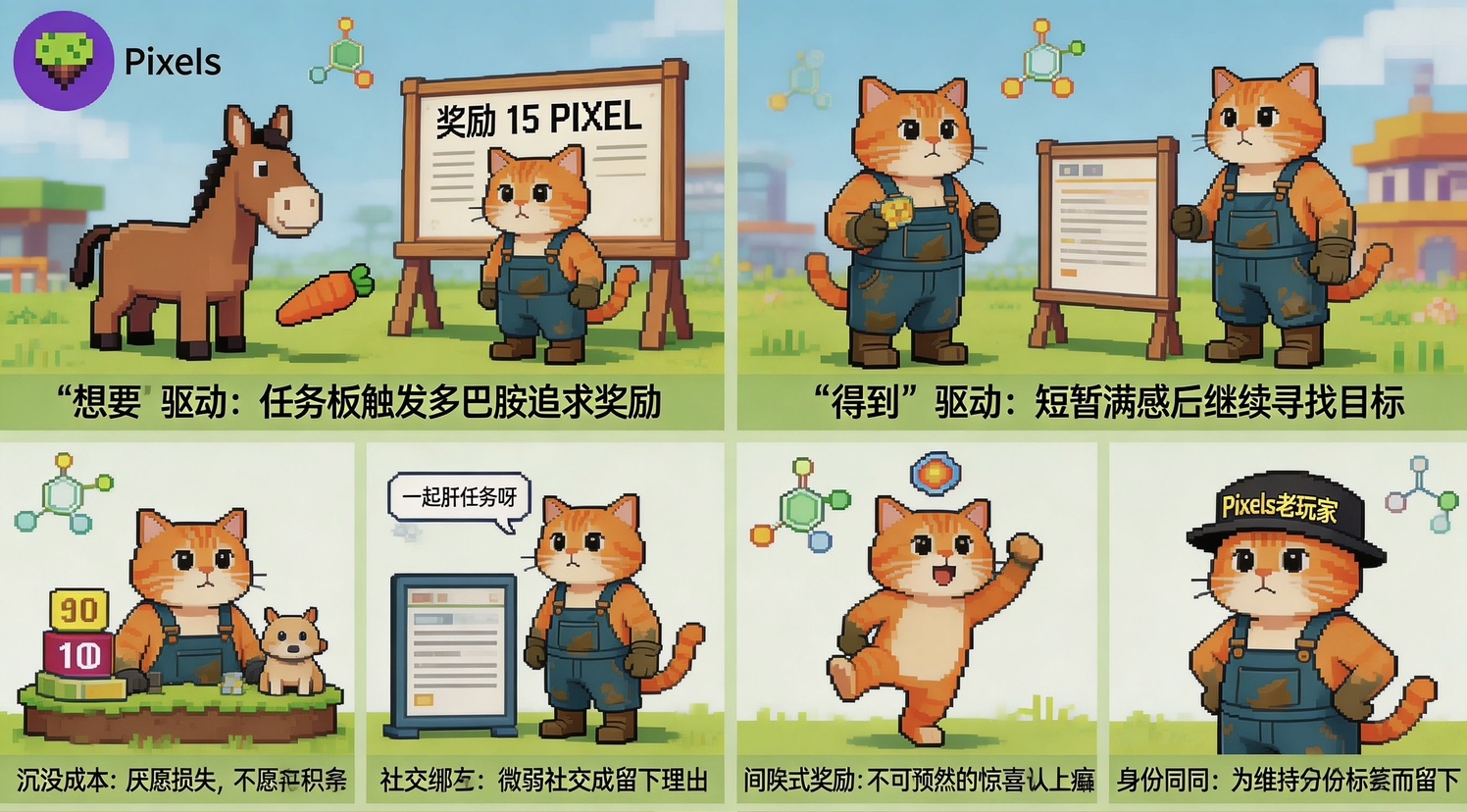
Fifth, this isn't Pixels' fault; it's a disease of our times.
At this point, I must clarify: I'm not criticizing the Pixels for their poor design. On the contrary, I think they're so well-designed that it frightens me.
It precisely targets several weaknesses of modern people: the desire for instant gratification, the reluctance to relinquish sunk costs, the need for social belonging, and the addiction to intermittent rewards. Short videos, mobile games, e-commerce, and Pixels are all leveraging these weaknesses. The only difference is that Pixels transforms earnings into quantifiable tokens, making you feel like you're not wasting time, but rather "investing."
You tell yourself, "I can earn a few dollars by spending an hour a day, which is better than scrolling through Douyin." But what you're ignoring is that that hour could have been used to read, exercise, or spend time with family. I've done the math; the time I've spent on Pixels over the past six months, if I had used it to learn a skill, I might already be able to take on some jobs. But I don't want to do the math because it makes me feel bad 😶.
I'm not advising you to uninstall Pixels. I haven't uninstalled it myself, so what right do I have to advise others?
I just want to say, occasionally stop and think: while you're sweating buckets in the pixelated world every day, aren't you, in the real world, also mechanically repeating the same tasks in front of some kind of "taskboard"? #pixel
VI. My current approach to the game can be considered a form of "self-rescue."
After going through these three stages, I set a few rules for myself. They may not be correct, but at least they made me less anxious.
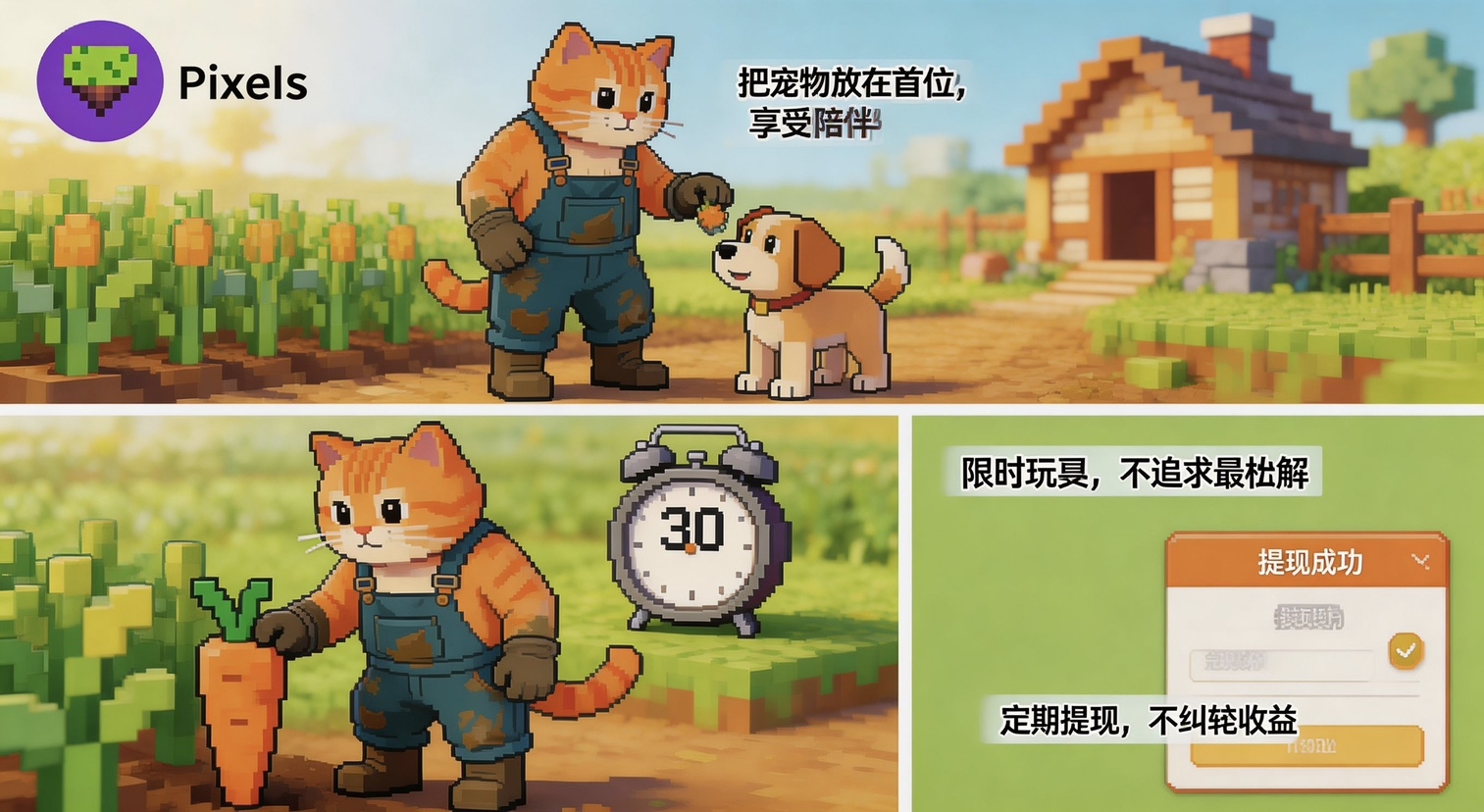
First, limit online time to no more than 30 minutes per day. Set an alarm and turn it off when it rings. If you've exceeded the time limit, do something else, even something as simple as going downstairs to take out the trash.
Second, I'll stop pursuing the "optimal solution" and plant whatever I want, even if the returns are low. The difference between planting radishes and ginseng isn't worth me agonizing over for ten minutes.
Third, prioritize pets and decorations over the quest board. The little dog that waits for me to feed it every day is far more important than the few cents reward on the quest board.
Fourth, withdraw your money once a week, no matter how much, and don't save it up to "wait for the peak." Because I've never been right about waiting for the peak.
After doing this, my profits decreased, but my mood improved. I no longer felt anxious about missing a task, nor did I lose sleep over price fluctuations. Every morning, I would open the game, greet the puppy, and then leisurely harvest my crops, harvesting as much as I wanted.
Pixels can be a game or a workspace. The choice is yours, not the taskboard.
At least for now, I choose the former.