
Pixels has been floating around for a while now. Not loudly not with the usual crypto theatrics but steadily enough that people who track the Ronin ecosystem have started paying closer attention. That alone is interesting. Ronin after all is still trying to rebuild credibility after the Axie Infinity saga one of the most expensive lessons in crypto gaming history. So when a new project begins to gain traction on that same network the question is not just what it is but why anyone is taking it seriously this time.
Look the pitch sounds harmless. A casual farming game. Social mechanics. A pixel art world you can wander through at your own pace. Nothing revolutionary on the surface. In fact it almost feels deliberately understated like it is trying to avoid triggering the usual skepticism that comes with anything labeled Web3. But the attention it is getting now is not about nostalgia or aesthetics. It is about whether this is the next attempt to fix something the industry has repeatedly failed to solve making blockchain gaming actually work for normal people.
Because that is the real problem here and it is not new. For years crypto games have promised ownership player driven economies and financial upside. What they have delivered instead is friction. Wallet setups. Token volatility. Gameplay designed around extraction rather than enjoyment. Axie Infinity showed how quickly a play to earn model can collapse once the flow of new money slows down. Players were not really playing a game. They were working a system. And when the economics broke so did the illusion.
Pixels claims to move away from that. At least on the surface. The focus is on play and own rather than play to earn which is a subtle but important shift in language. The idea is that players are not there primarily to make money but to participate in a world where digital assets have persistence and value. That sounds more sustainable. It also sounds familiar. I have heard variations of this argument for over a decade from MMO gold farming to NFT land sales.
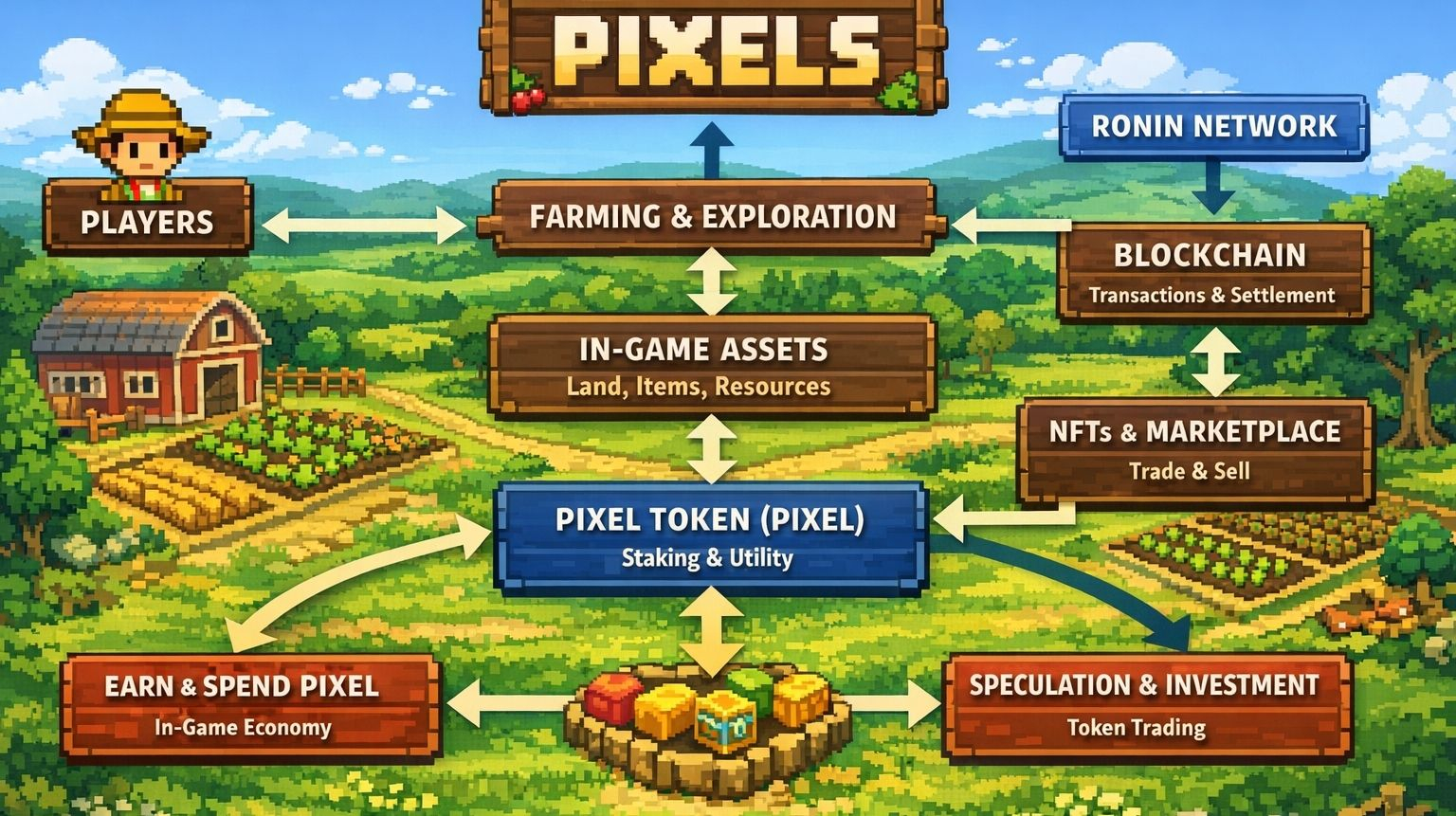
What most people miss is that Pixels is not really about farming. That is just the wrapper. The deeper idea is about building a lightweight economic layer inside a casual game environment one that does not immediately scare off mainstream users. It is trying to answer a quiet question can you smuggle crypto mechanics into a game without making the game feel like crypto
That is harder than it sounds.
Under the hood Pixels runs on the Ronin Network which is designed to handle high throughput transactions at relatively low cost. This matters because games generate a lot of small frequent interactions far more than typical financial applications. Every crop harvested every item traded every upgrade applied potentially touches the blockchain. In earlier systems this would have been prohibitively expensive or painfully slow. Ronin tries to smooth that out by acting as a more controlled environment with faster settlement and lower fees but at the cost of being less decentralized than the Ethereum mainnet purists would prefer.
Identity in Pixels is tied to wallets but abstracted enough that users do not have to think about it constantly. That is the goal anyway. The game handles much of the interaction layer while the blockchain sits quietly in the background recording ownership and transactions. Assets land items resources can exist as tokens tradable outside the game if players choose to do so. Coordination happens through the game social systems but verification and settlement ultimately rely on the network.
It sounds tidy. On paper at least. But every layer you add introduces new points of failure.
Then there is the token. Because there is always a token. In Pixels the economic model revolves around in game resources and a broader token layer that ties into the Ronin ecosystem. The token acts partly as fuel for transactions partly as a store of value for in game activity and quietly as a speculative asset for those looking to get in early. That last role is the one nobody advertises too loudly but it is always there.
Let us be honest. Tokens are not neutral tools. They create incentives and those incentives shape behavior. If players believe the token will appreciate the game becomes a financial instrument. If it does not engagement can drop off quickly. The system walks a tightrope between being a game and being a market. And markets are ruthless.
Where Pixels gets interesting is in how it tries to slow things down. Unlike earlier crypto games that pushed aggressive earning mechanics this one leans into time based progression and social interaction. Farming takes time. Exploration is incremental. The pace is intentionally measured almost mundane. It is an attempt to anchor the economy in activity rather than speculation to make the system feel more like Animal Crossing than a yield farm.
I have seen this movie before.
The problem is that once real money is involved player behavior changes. It always does. Systems that are designed for fun get optimized for profit. Players look for shortcuts. Bots appear. Secondary markets distort the intended balance. What starts as a gentle social experience can quickly turn into an arms race of efficiency.
And that is where the hard problem sits. Not in the graphics or the onboarding flow but in maintaining a stable meaningful economy over time. It is one thing to design a system that works for a few thousand users. It is another to sustain it at scale without either inflating the currency or choking off incentives.
There is also the uncomfortable question of centralization. Ronin is not a neutral infrastructure layer in the way public blockchains claim to be. It is closely tied to a specific company with its own governance and control points. That can make the system more efficient but it also concentrates risk. The Axie Infinity hack was not just a technical failure. It was a structural one. Fewer validators. Fewer checks. Faster decisions. Until something breaks.
Pixels inherits that environment. Whether it can avoid the same pitfalls is still an open question.
And then there is the human reality. What happens when the novelty wears off. When the early adopters move on. When the token stops trending on social media. At that point what is left has to stand on its own as a game. Not as an investment. Not as a narrative. Just as something people want to spend time on.
That is a much higher bar than most Web3 projects are willing to admit.