
Last night, after work, I hurried into Pixels just to finish harvesting. At that moment, I thought this would be a very short session, just to handle a few tasks and then exit. But in reality, it did not provide me with a clear stopping point like that.
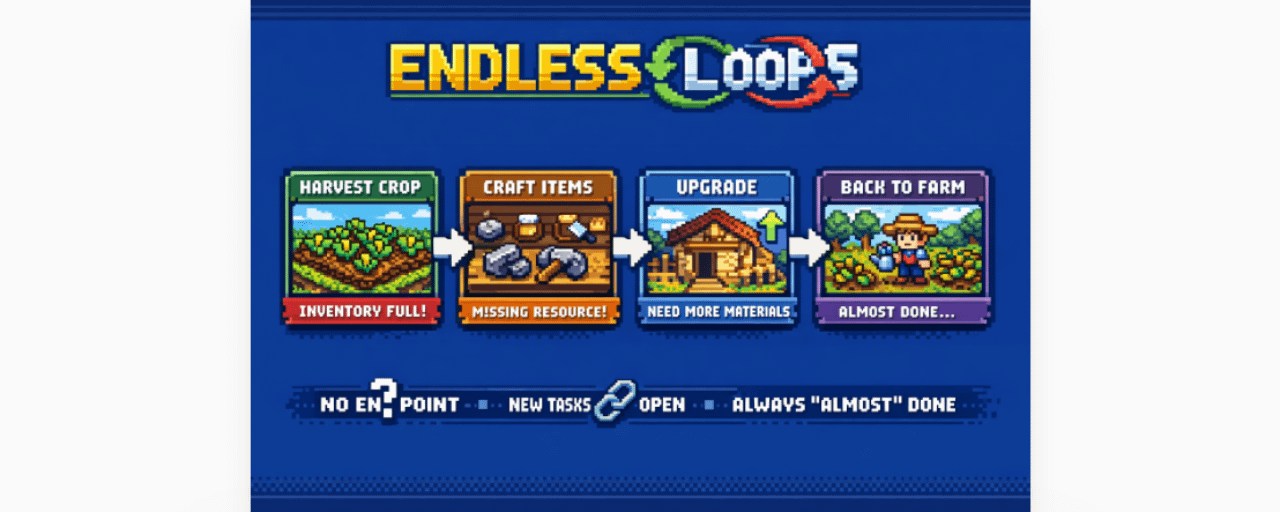
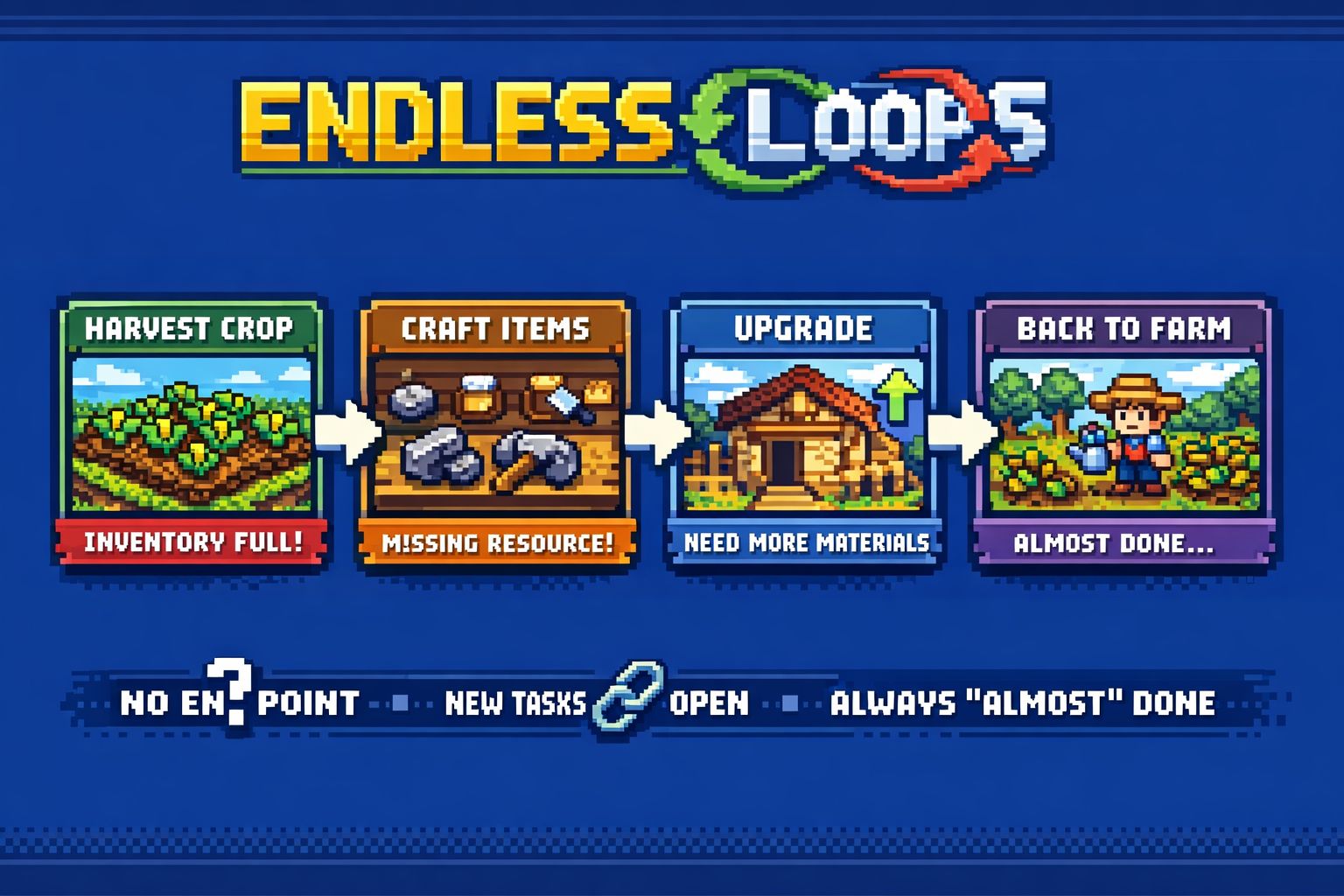
Harvested crops do not bring me to a 'done' state, but push me to the inventory. A full inventory is not an end, but a constraint that requires crafting. Crafting then opens upgrades, and upgrades require resources from another branch. The deeper I go, I find that nodes do not maintain the end state long enough, as there is always a subsequent dependency opening up.
I once tried to measure a very simple pattern: entering the game just to handle a few tasks and then exit, without optimizing or expanding gameplay. A session that seemed to last only 5-10 minutes often stretched beyond 20 minutes, because each action does not end in an idle state but usually opens up 1-2 more steps that need to be processed before being able to stop.
Harvesting is not enough to store, and when stored, it lacks materials, and when materials are sufficient, it goes back to the farm. Not every loop is truly 'not closing', but rather small loops continuously lead to the next state instead of creating a clear stopping point.
I used to think that GameFi keeps players engaged through incentives. Tokens, yields, reward curves, all revolve around profit optimization logic. But after looking at Pixels long enough, I began to see another mechanism that is more important: players do not stay for ROI, but because they are continuously in a state of unfinishedness of many chains of actions at once.
The inventory in Pixels is not just a simple storage, but a constraint layer. When the inventory is full, the system does not create a stopping state, but forces crafting or upgrading and each choice creates a new demand. 'Full' is therefore not an endpoint, but a trigger to transition to another processing round.
If we look more broadly in GameFi, this pattern is not entirely new. Staking has a lock period, liquidity has an epoch, and quest chains have sequential tasks. But Pixels pushes the logic down to a more micro level: each small action is rarely the endpoint of the entire flow, but usually just an intermediate step in a longer chain.
The important point is that the session boundary no longer depends on completion, but on the number of unresolved states remaining at the moment the player stops. When there are not enough 'clean exit points', players leave due to exhaustion, not because they have finished.
A session of 5-10 minutes can stretch to over 20 minutes not because of more content, but because there is no action that returns the system to the end state, with each step usually creating at least one additional state that needs further processing.
From a system design perspective, Pixels does not optimize 'what players do', but optimizes 'what players continue doing'. Completion is not eliminated, but fragmented into many small steps instead of a clear endpoint.
At least for me, this creates a somewhat hard-to-define state. It's not being forced, nor is it complete freedom. It's just always close to finishing but without the feeling of being 'fully done'. And that state makes leaving work a conscious decision, rather than a natural endpoint of the session.
This may not be the optimal behavior in a negative sense, but simply the way the system is designed around dependency chaining and resource flow. But the clearest thing is: when completion is no longer a stable point, the experience will automatically turn into a continuous transition between unfinished states.
