


Let me take you back to 2023 for a second....
Web3 gaming was in ruins. Axie Infinity had collapsed from a $9 billion market cap. StepN went from revolutionary to cautionary tale in six months. Every play-to-earn game launched in the bull market was either dead or dying. The common wisdom was clear: play-to-earn doesn't work. It was a Ponzi disguised as gaming. The idea that you could pay players to play and somehow make money was fundamentally broken.
And honestly? They were mostly right.
The first generation of P2E was built on wrong assumptions. @Pixels founder Luke Barwikowski wrote a candid breakdown about this earlier this year that's worth reading in full. But the core mistakes were simple:
Assumption 1: Putting assets on blockchain automatically makes a game better. Reality: It makes your game economy into real-money gaming, attracting exploiters and bots that scale faster than your content team can build.
Assumption 2: High daily active users means success. Reality: Most "users" were bots or multi-accounters farming rewards. Vanity metrics hid a broken system.
Assumption 3: Token rewards drive sustainable growth. Reality: Undifferentiated rewards attracted extraction players who dumped everything, creating death spirals.
Assumption 4: Every player deserves equal rewards. Reality: A bot running 50 accounts generating zero value got the same rewards as a genuine player spending real money. Studios were literally paying attackers.
Every single P2E game made some combination of these mistakes. The ones that survived were the ones that learned fastest.
@Pixels survived. And what they built in response might be the most important piece of infrastructure in Web3 gaming....
The breakthrough was simple but profound. Separate the game from the reward layer.
The game itself should be fun on its own merit. Players should want to play it regardless of whether tokens are involved. That's why Pixels is a genuinely enjoyable farming and exploration experience. The pixel art. The social elements. The crafting and mining. The seasonal events. People play it because they like it. Not because they're farming rewards.
The reward layer sits on top through Stacked. It's separate infrastructure that uses AI to solve all four problems at once:
Targeting: The AI identifies which players are bots, which are farmers, and which are genuine valuable users. It segments them by quality and only rewards the players who actually contribute to ecosystem health.
Pricing: Instead of blanket generic payouts, Stacked calibrates reward amounts to generate positive ROI. The 131% return on reward spend number means they're not losing money on rewards. They're making money.
Attribution: Every reward is tracked end-to-end. Studios can see exactly which incentive drove which behavior. No more throwing money into the void and hoping it works.
Fraud resistance: Stacked's AI has been trained on data from 5 million players over four years. It's seen every exploit, every bot pattern, every multi-account scheme. The fraud detection isn't theoretical. It's battle-tested at scale.
The results speak for themselves. $25 million in real revenue not from token inflation. One million daily active users at peak. $200 million in rewards paid out. 178% lift in conversion from targeted re-engagement campaigns. More tokens deposited than withdrawn for the first time in the game's history.
And now Stacked is open to every game studio in the world. Web3 or Web2. The infrastructure that fixed play-to-earn for Pixels is available for anyone to integrate through a simple SDK.
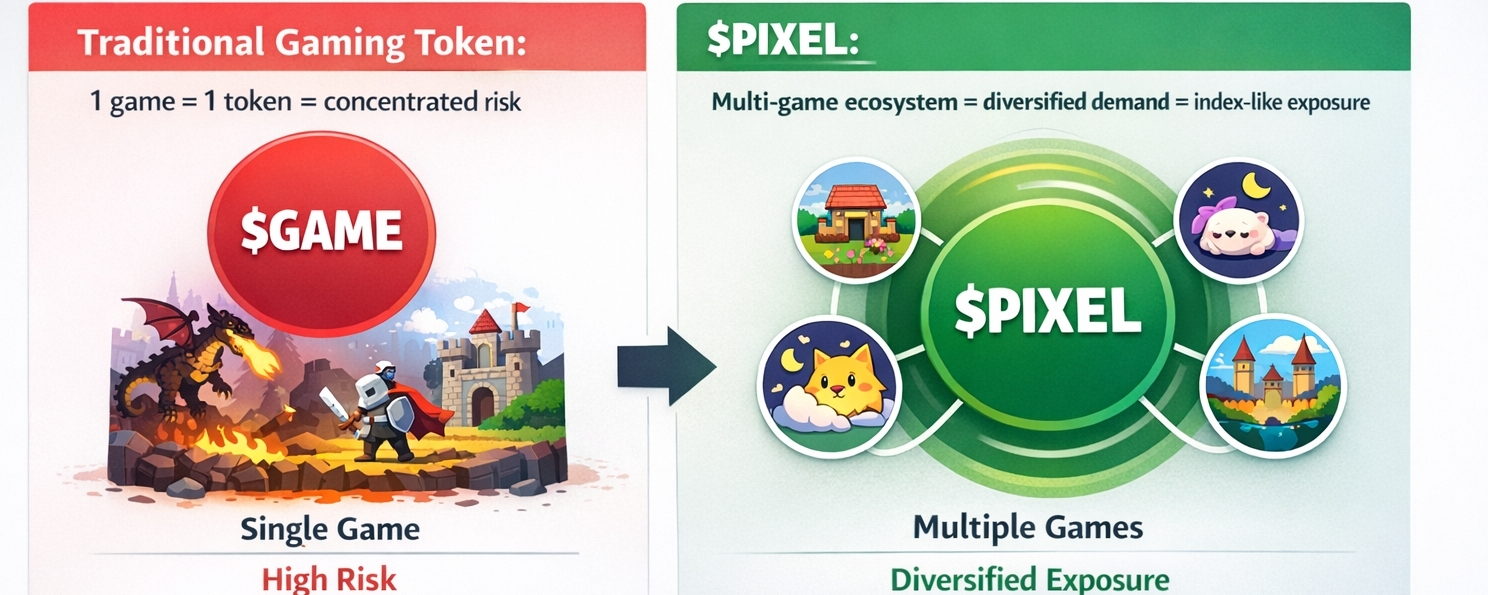
For PIXEL holders the implication is significant. Every studio that integrates Stacked potentially becomes another source of organic demand for the token. The more games in the network, the more diverse the demand, the less dependent the token is on any single game's performance.
PIXEL sitting at $0.00827 with a $5.2M market cap. 99.3% down from ATH. Gaming tokens out of favor. Vesting unlocks continuing. Everything on the surface screams "stay away."
But underneath that surface there's a team that generated $25M in revenue, solved the fundamental problems that killed every other P2E game, built AI-powered infrastructure that other studios are actively adopting, expanded into a multi-game ecosystem with new titles in development, and has real players sharing real stories about how gameplay earnings improved their lives.
Either Web3 gaming is permanently dead and nothing will revive it. Or the infrastructure being built right now by the teams that survived the crash will form the foundation of the next wave.
I know which one I believe. But make your own call fam. DYOR always.