
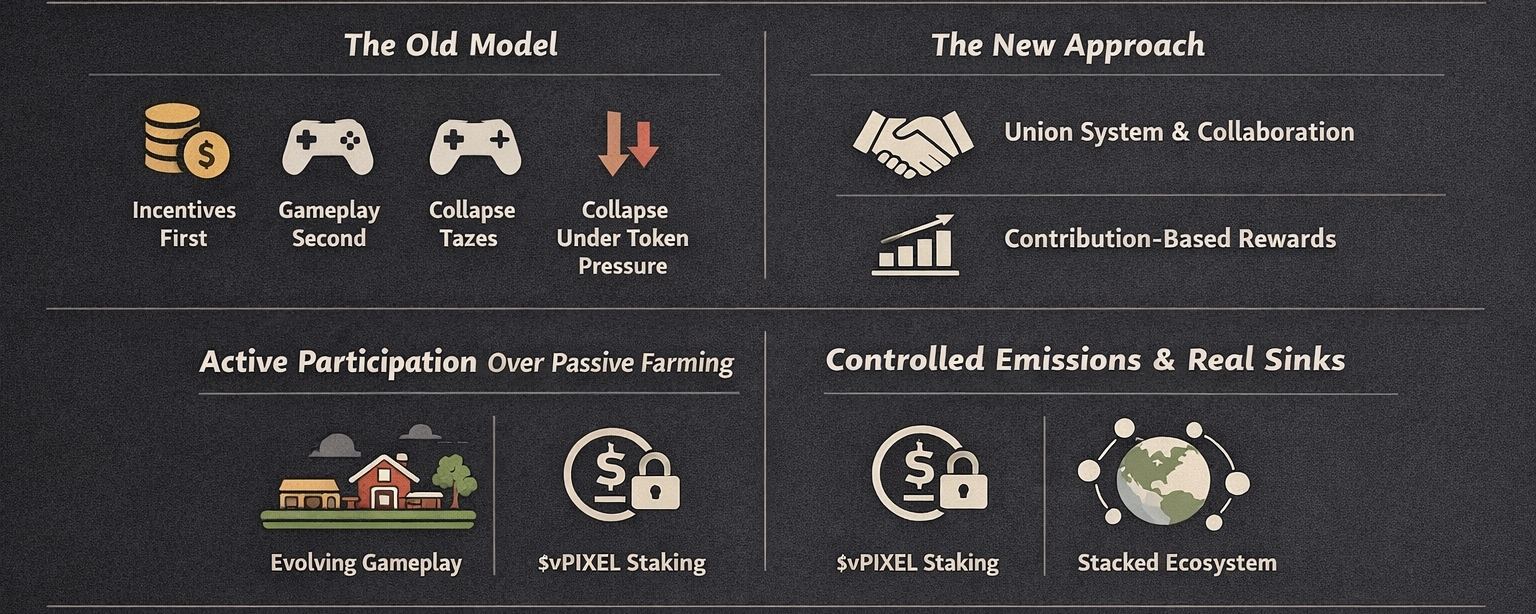
For years, most blockchain games followed the same fragile loop. Incentives came first, gameplay came second, and everything eventually collapsed under its own token pressure. What makes @Pixels different today is not just that it learned from that phase, but that it actively redesigned itself around sustainability instead of short-term attraction.
The shift becomes obvious the moment you look at Chapter 3. This is where Pixels stopped being a solo farming loop and turned into a coordinated system. The introduction of Unions changed the entire structure of the game. Instead of isolated grinding, players now operate inside competitive groups, contributing resources, sabotaging rivals, and earning based on actual participation. Rewards are no longer flat distributions. They scale with contribution, which quietly removes one of the biggest flaws early GameFi had.
That one design choice matters more than it looks. It transforms behavior. You are not just farming anymore. You are part of a system that values effort, coordination, and timing.
Then comes the second layer, and this is where the project gets interesting from an economic perspective. Pixels is actively restructuring how value flows inside the ecosystem. Instead of pushing constant token emissions, the game is leaning into controlled distribution and real sinks. The introduction of mechanics like $vPIXEL and staking penalties reduces immediate sell pressure and keeps value circulating inside the system longer.
Even more important is how staking has evolved. This is not passive yield farming in the traditional sense. Pixels allows players to stake into specific games within its ecosystem, effectively turning users into capital allocators. That means attention and liquidity are directed toward experiences that actually retain players, not just those that promise the highest emissions.
That is a subtle but critical shift. It aligns incentives between players, developers, and the platform itself.
The recent updates reinforce this direction. Chapter 3 added new lands, deeper production loops, and external studio integrations through the Stacked ecosystem, which opens the door for multiple games to plug into the same economy.
At the same time, the tokenomics side is stabilizing. With roughly two thirds of the supply already in circulation, the project is moving past the phase where constant unlocks dominate the narrative.
This combination matters. Gameplay depth on one side, controlled supply on the other. That is how you move from a speculative loop to something that resembles an actual economy.
But the project is not perfect, and that is part of why it is worth paying attention to. The industrial layer of the game is getting heavier. Efficiency, land positioning, and production chains are starting to matter more, which introduces a level of complexity that can push casual players out. The balance between accessibility and depth is still being tested in real time.
That tension is real. If Pixels leans too far into optimization, it risks becoming another system that favors capital over play. If it keeps refining the balance, it has a chance to define what sustainable Web3 gaming actually looks like.
My view is simple. Pixels is one of the few projects that recognized its own structural flaws early and adjusted before the model broke completely. It moved away from extraction and toward retention. It replaced passive rewards with contribution-based systems. It started treating its economy as something that needs to be managed, not just inflated.
That is not flashy. It does not create instant hype cycles. But it is exactly what this space has been missing.
Pixels is not trying to be the biggest GameFi project anymore. It is trying to be one of the first that actually works long term.
And right now, it is closer than most.
