Recently, Claude banned a large number of Chinese users, and another foreign company's 60 Claude accounts were banned with no way to appeal, which makes me think about a question: centralized AI has not achieved good decentralization in its usage.
Just at this time, I am collaborating with @OpenGradient and have seriously looked into its related information.
Before the TGE on 4/21, I want to detail how top institutions like A16Z raised $9.5 million through its building strategy and landing products in this tweet.
@OpenGradient is addressing several AI pain points.
First, let me introduce this project and what it is doing
OpenGradient is a decentralized AI computing network. It is not an independent blockchain but acts like an AI-specific assistant, helping other applications, blockchains, or agents offload complex AI computing tasks to specialized GPU nodes. Each AI run generates a cryptographic proof (such as TEE proof or zkML proof), allowing results to be publicly verified.
In simple terms, it addresses two major pain points of AI:
1. Centralized AI is opaque and prone to issues;
2. Ordinary blockchain computing power is not strong enough.
Essentially, OpenGradient makes AI computation open, verifiable, and securely settled like on-chain transactions
I believe a set of data better illustrates the success of this project:
1. User and usage scale: Over 2 million cumulative users across the network and related products, handling over 2 million verifiable inferences, generating over 500,000 cryptographic proofs
2. Model Hub activity: Over 4000+ models contributed by 100+ developers, forming an active model market.
3. Income diversification: The platform has generated 6 active revenue streams, proving the business model is viable
If OpenGradient has built a strong ecological closed loop, providing a better environment for developers' AI models, then after the TGE of token $OPG, it officially provides network fuel for this link.
✍️ $OPG has a fixed total supply of 1 billion tokens, with 10% airdropped to the community fully unlocked at TGE (including 6% liquidity and launch)
Here, it is important to focus on the main uses of $OPG, which will be fully launched on TGE day, including:
1. Pay for each AI inference fee (no API key, no credit card, use wallet directly)
2. Model creators automatically earn income each time they are called
3. Staking to validators helps maintain network security while earning rewards
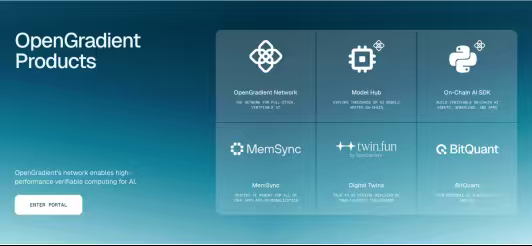
4. Unlock advanced features of popular applications like BitQuant and MemSync (lower fees, higher limits)
5. Participate in governance (voting on hardware, gas fees, treasury usage, etc.)
The six major products in the ecosystem are all connected through $OPG. I summarized a general positive feedback loop process: Token TGE increases incentives → more users → more inference requests → more proofs generated → model repository becomes more active → income naturally increases → network becomes stronger.
I believe that for OpenGradient, TGE represents a new starting point. With backing from top institutions like a16z crypto, Coinbase Ventures, SV Angel, Foresight Ventures, NEAR, Celestia, it has realized product landing; real data proves it is not a conceptual project, and I am increasingly looking forward to its performance.