


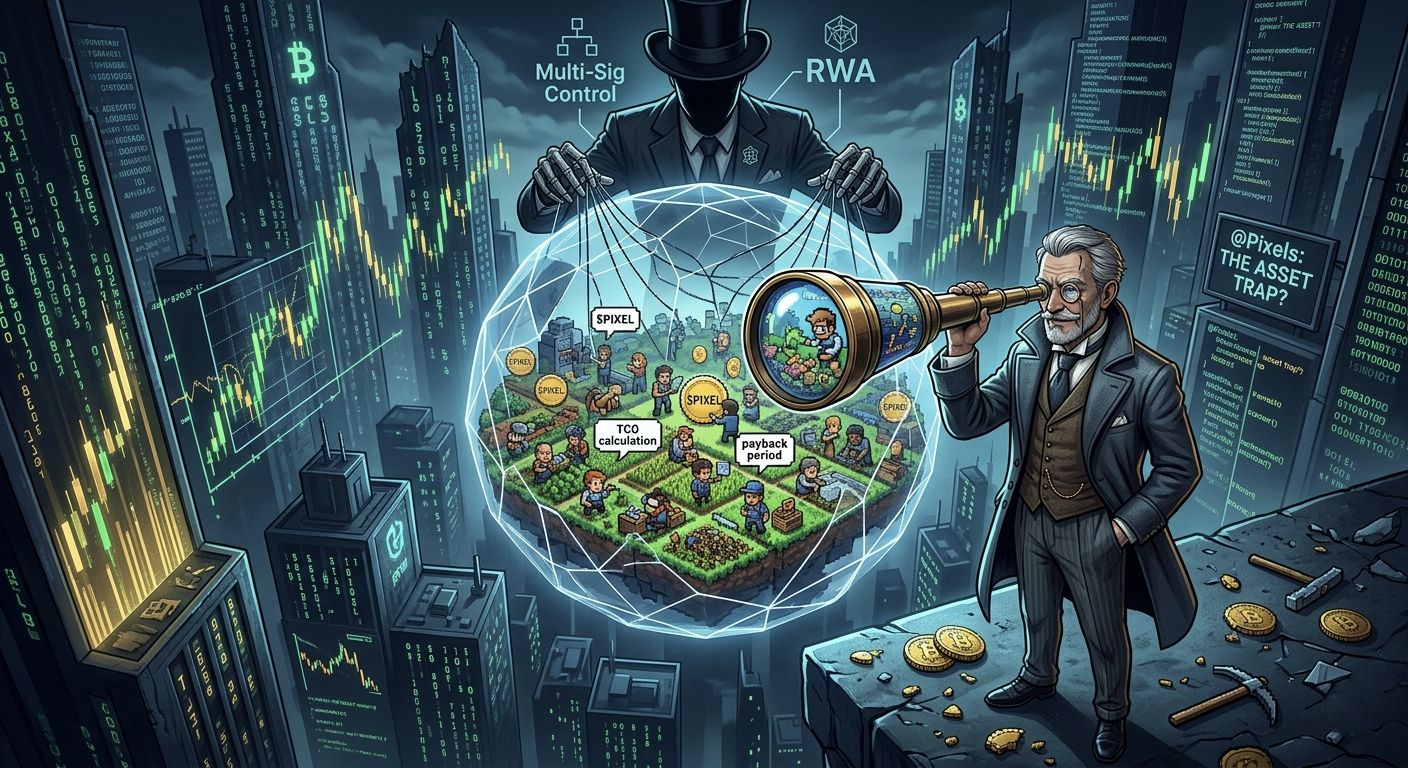
 Watching the community recently complain every day about @Pixels the revenue adjustments of the Order Board and the VIP threshold, a group of people is struggling with Excel sheets analyzing the input-output ratio of various crops and the so-called optimal solutions. As someone who is used to viewing the market from the perspective of macro liquidity and monetary policy, I can only feel a wave of emotion. Having been in this circle for a long time, I have seen too many funding schemes disguised in Web3 clothing. Everyone is complaining about low explosion rates and slow returns, but if you shift your gaze away from those pixelated carrots and cabbages and delve into the evolution of the economic models behind them, you will find that there is no “pastoral idyll” here; the core competition has long shifted from “who has the harder liver” to “who can see through the macro control of the project party.”
I still use the framework of 'pain points, breaking points, and dimensional analysis' to dissect this situation. Let's start with the pain points. The biggest pain point in Pixels and even the entire blockchain gaming sector is that 'the soft landing of a Ponzi structure' is packaged as 'game value balance'. You see, the energy system and task refresh mechanism in Pixels seem to be aimed at preventing scripts and extending game longevity, but what is it essentially? It is a blatant capital entry barrier and time exploitation. Many retail investors naively think that as long as they spend time, they can achieve 'Play to Earn', but in a stage where there is no abundant external incremental funds entering the market and relying purely on stock mutual cuts, your 'time' is precisely the most inexpensive and worthless sunk cost in this system. When you are still setting alarms to wake up at midnight for a few dollars’ worth of token gains, industrialized script studios have already maximized profits through a scaled account matrix.
So where is the breaking point? The real breaking point is absolutely not to delve into what higher-level gold-earning routes to take, but to view Pixels' task and output system as an 'algorithmic central bank'. You see, those who are truly making profits in Pixels, the 'flippers' and operators, they stockpile basic materials and hype high-level tools—this logic is fundamentally identical to the speculation on commodity cycles in traditional finance. The project side adjusts task board outputs and material demands, which actually executes the 'interest rate hikes and cuts' of the Web3 world. When inflationary pressures are high and tokens face sell pressure, they raise task thresholds and increase consumption—this is called 'tightening'; when new users need to be attracted and beautiful active data needs to be presented to VCs, they release low-threshold high-yield tasks—this is called 'quantitative easing'. Here, those who can truly traverse cycles are those who can anticipate the turning points of 'central bank monetary policy' and hit the inventory cycle precisely, not those who can only lower their heads and farm, being led by the system like a workhorse.
If we conduct a dimensional analysis and extract Pixels from its shell as a 'simulation management game', you will find that it is actually an extremely brutal 'micro commodity high-frequency trading market'. In this dimension, the 'energy' players consume daily is not game stamina but the 'premium' in options trading. Buying energy (or holding assets to exchange for energy) is equivalent to buying a call option, betting that the materials you plant can be exchanged for premium tokens on future task boards. The complex synthesis recipes and cumbersome processing chains are merely 'financial friction' artificially created by the project side to prolong the capital turnover cycle and lock liquidity. The real big players watch the overall inventory data from behind the scenes, precisely adjusting the leverage between various material pools. They do not need to personally go into the field; they only need to adjust a line of code for drop rates, and they can shepherd the funds, attention, and labor of all players in the server to where they need it.
Many players still playing the 'stamina monetization' game are completely unaware that they are trapped on a meticulously designed treadmill. In the past few days, I pulled up the on-chain material flow data and the trading depth of DEX, and those massive sell pressures disguised as normal consumption cannot fool the chip structure. If in an economy, the underlying participants are crazily monetizing for meager profits while intermediaries and project sides are continuously extracting without providing real value empowerment, then the collapse of this deflationary model is just a matter of time. Especially in the current market environment, where liquidity is already tight, if the economic gears within the game cannot mesh with real social or consumption demands, once algorithmic control fails, the reversal of player expectations will directly trigger a stampede.
So, to draw the most pragmatic conclusion. Faced with such a highly controlled economy, where the rules can be modified at any time by the 'hand of God', my first reaction is always restraint: at the current macro level, am I making money on the cycle, or have I already become liquidity in someone else's eyes? If you are a retail investor, do not develop any 'cyber nostalgia' for a certain game, do not be brainwashed by those social attributes; treat every interaction as a cold-blooded arbitrage transaction, strictly set stop-loss lines and profit drawdown warnings. If you are a participant with a larger capital volume, do not stubbornly clash with numerical mechanisms, but pay more attention to the net inflow of funds on the Ronin chain and the chip movements of leading protocols.
Ultimately, the prosperity of GameFi is always built on information asymmetry and the overdraft of expectations for latecomers. Listen less to those KOLs who paint big pictures for commissions, and review those who died in the last round of bull-bear transitions among leading blockchain games. In this cyber slaughterhouse filled with algorithmic calculations and code hegemony, compared to being obsessed with building a five-star virtual farm, understanding when to pull the plug and converting chips back to stablecoins is the only trump card for us veterans to survive to the next cycle. After all, when the Federal Reserve's printing machine slows down, no virtual farmland can grow real gold.