
I’ll be straight with you I misread Pixels the first time.
I saw crops, timers, token rewards mentally tagged it as another emissions treadmill with better pixel art and the same exit liquidity arc. Plant, wait, harvest, dump, repeat until the chart looks like a ski slope. I didn’t even bother opening half the systems because I assumed I already knew the ending.
Then I actually played it. Not theoretically. Not from a token dashboard. Inside the loops.
And it doesn’t behave like something that wants to be drained. 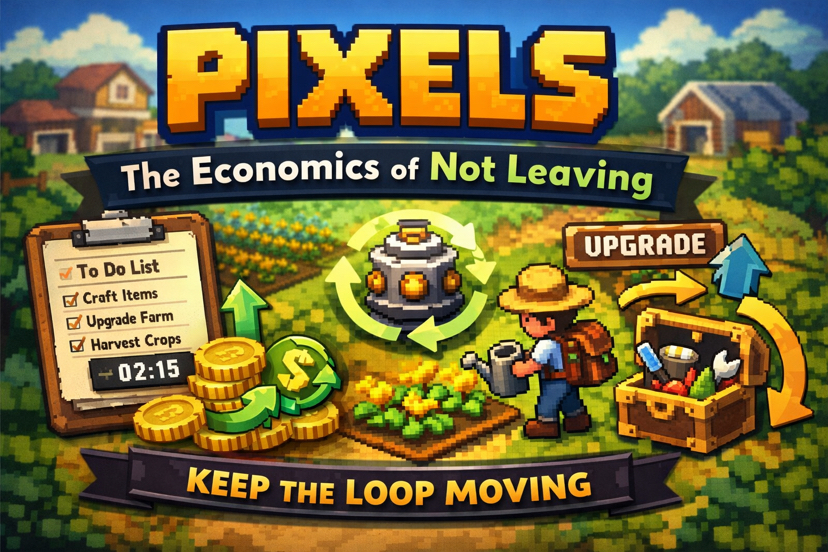
It behaves like something that resists clean exits.
You feel it almost immediately in the small annoyances. The task board isn’t smooth it’s deliberately a bit of a grind to optimize. Crafting chains aren’t elegant they eat your inventory in these slightly irritating increments where you keep thinking “okay one more batch and I’ll be done”and you’re not. Ever. Upgrades look optional until you realize you’re kneecapping your own efficiency without them, so now you’re reinvesting whether you planned to or not
That’s not sloppy design. That’s economic pressure disguised as friction.
And that’s where the whole ROAS vs RORS thing actually clicks, not as a concept but as a lived experience.
Because typical GameFi is obsessed with ROAS whether they admit it or not. Acquire users, emit tokens, hope the outflow is slower than the hype cycle. It’s basically user acquisition math duct-taped onto a token.
Pixels doesn’t care about that equation in the same way. It quietly swaps the objective function
It’s not trying to maximize how much value it extracts from you.
It’s trying to maximize how long your value refuses to leave.
That sounds like semantics until you sit in the loop long enough to notice what’s happening to your behavior.
You earn $PIXEL and it doesn’t feel like income. It feels like fuel.
Fuel you immediately need to spend if you want to maintain momentum.
And momentum is the real addiction here, not yield.
The “closed-loop” part isn’t some abstract tokenomics diagram. It’s enforced at the edges of every decision you make.
You don’t just accumulate you circulate.
You don’t just farm you convert, reinvest, reallocate, optimize, mess up, try again. (And yeah, sometimes you waste resources because the crafting ratios weren’t as clean as you thought that’s part of it.)
Extraction is always technically possible, but practically awkward.
Not blocked. Just suboptimal enough that you hesitate.
That hesitation is the system working.
What’s sneaky is how the game turns you from a player into something closer to a capital allocator without ever saying it out loud.
You start asking different questions.
Not “how much did I earn today?”
More like “where should this go so I don’t stall tomorrow?”
And once that shift happens, you’re no longer interacting with a yield farm. You’re participating in a circulating economy where your decisions affect your own future efficiency inside the loop.
That’s RORS in plain terms your “returns” are tied to how effectively you keep value moving within the system, not how fast you can extract it out.
There’s also this messy, human layer on top (the Tastemakerz dynamic, even if people don’t label it that way when they’re playing).
The meta isn’t fixed. It leaks through Discord chats, player experiments, random strategies that suddenly become “the thing” for a week.
So now optimization isn’t just math. It’s social.
Which makes it harder to min-max purely for extraction, because the target keeps moving.
And that instability? It’s actually stabilizing the economy.
Counterintuitive, but real.
I keep coming back to this one observation: Pixels doesn’t punish you for leaving.
It just makes staying feel like the smarter move one more time.
One more upgrade.
One more production tweak.
One more cycle to “lock in efficiency.”
And that “one more” stacks.
Most GameFi dies because it answers the wrong question too well: “How do we get users in and monetize them quickly?”
Pixels is answering a more uncomfortable one: “How do we make leaving feel economically premature?”
Not impossible. Just inefficient enough that you delay it
Again and again.
So yeah, if you walk into Pixels expecting a clean farm-and-dump loop, you’ll either get frustrated or bored.
Because it keeps interrupting that loop.
But if you treat it like a system where capital wants to stay in motion instead of escaping, the design starts to feel almost annoyingly clever
I don’t say that lightly. I’m usually the first person to call this stuff out as recycled Ponzinomics with better UI.
This one’s different in a very specific way:
It doesn’t rely on you being greedy.
It relies on you being reluctant to break your own momentum.
And that’s a much stickier lever.