
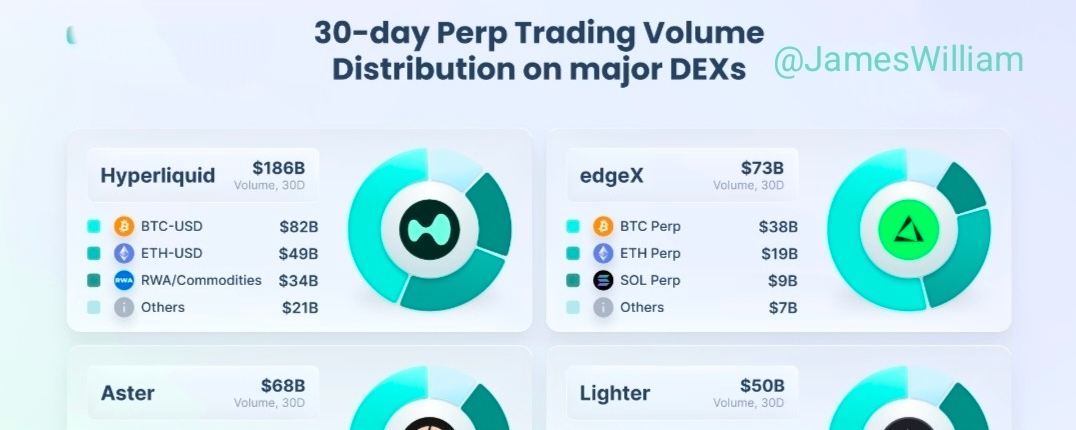
The latest 30-day distribution of perpetual trading volume across major decentralized exchanges (DEXs) reveals a market that is both maturing and evolving. While Hyperliquid continues to dominate the space with a commanding $186B in volume, the broader picture tells a more nuanced story one of rising competition, shifting liquidity flows, and a gradual cooling in overall activity since the late-2025 peak.
Hyperliquid’s lead remains significant, largely driven by its deep liquidity in BTC and ETH pairs, alongside growing exposure to real-world asset (RWA) derivatives. This diversified structure has helped it maintain stability even as market-wide volumes soften. However, dominance no longer means uncontested control.
Platforms like edgeX ($73B), Aster ($68B), and Lighter ($50B) are steadily carving out their own market share. Each of these venues is showing consistent traction, particularly in core perpetual pairs such as BTC and ETH, while selectively expanding into altcoin exposure like SOL and niche derivatives. GRVT and Apex, though smaller in comparison, are also contributing to a more distributed competitive environment.
What stands out is not just the growth of individual platforms, but the fragmentation of liquidity. Unlike previous cycles where one or two players absorbed the majority of activity, the current structure suggests traders are increasingly exploring alternatives likely driven by factors such as fee structures, execution quality, incentive programs, and platform UX.
At the same time, total perpetual trading activity appears to be cooling from its October 2025 highs. This decline does not necessarily signal ضعف in the sector, but rather a normalization phase following an overheated period. Lower volatility, reduced speculative intensity, and broader macro stability may all be contributing factors.
From a structural perspective, this environment could be healthy. A more competitive DEX landscape encourages innovation, improves user conditions, and reduces systemic reliance on a single platform. It also suggests that the perpetual trading narrative is evolving beyond simple volume dominance toward sustainability and ecosystem depth.
Looking ahead, the key question is whether emerging platforms can continue to scale without compromising liquidity efficiency. If they succeed, the market may transition into a multi-polar structure where several DEXs coexist with meaningful share reshaping how traders interact with decentralized derivatives.
In short, Hyperliquid still leads but the gap is narrowing, and the race is becoming far more interesting.