
I keep catching myself thinking,okay this looks simple, every time I open Pixels and then a few minutes later, I realize it’s not that simple at all.
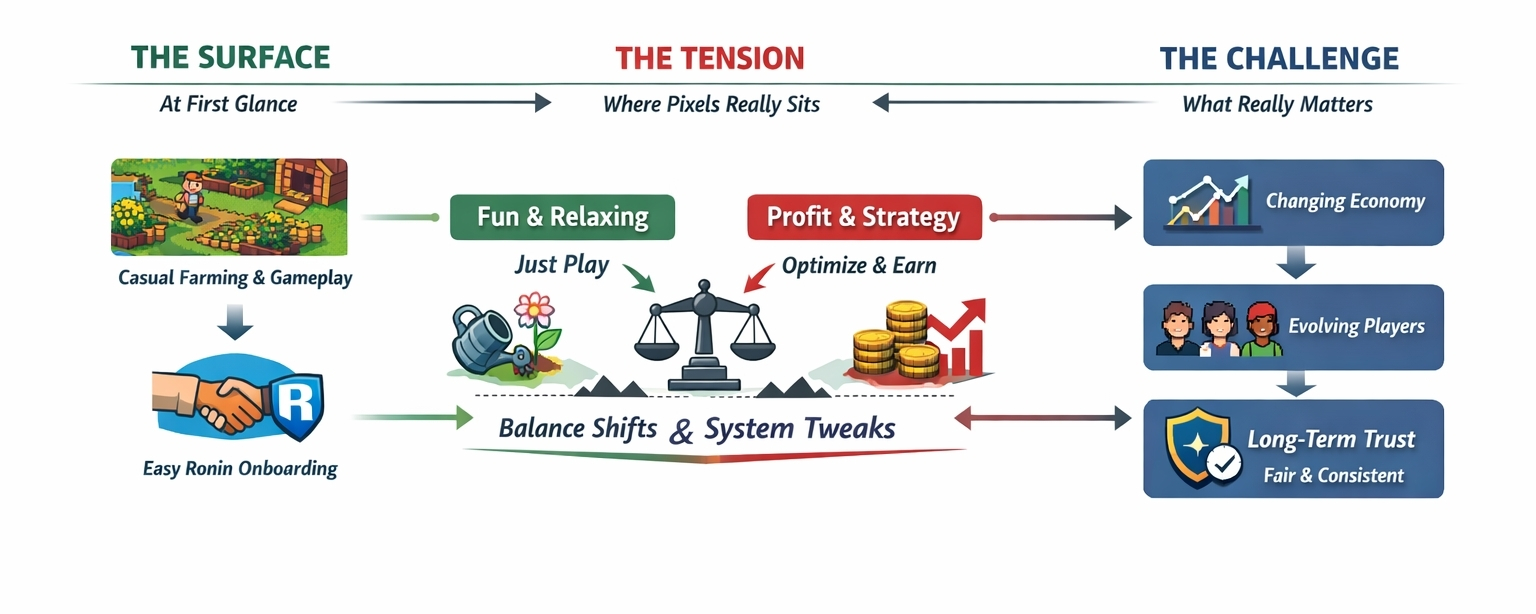
At first glance, it feels like a calm little farming game. You plant crops, walk around, gather resources, maybe chat with a few players. Nothing intense. It reminds me of those casual games people play to relax after a long day. And honestly, that’s what pulls people in. It doesn’t scream “Web3,” it just feels like a game.
That’s the story most people tell: Pixels proves blockchain games can finally feel normal. No heavy setup, no complicated steps just play and earn something on the side. And since moving to Ronin, things got smoother too. Transactions feel lighter, onboarding is easier, and more players keep joining.
But here’s where it gets interesting. The moment you stay a bit longer, you start noticing a quiet tension.
Is this a game you enjoy… or a system you optimize?
I’ve seen players log in just to chill plant crops, decorate their land, take it slow. At the same time, others are running it like a strategy loop, calculating the best crops, the fastest crafting cycles, the most efficient way to earn tokens. Same world, completely different mindsets.
And that’s where the simple narrative breaks.
If you treat Pixels only as a game, the economy starts to feel distracting. Prices change, rewards shift, and suddenly your relaxing routine feels… less predictable. But if you treat it only as an economy, then everything becomes about output, and the “fun” part starts to fade into the background.
Neither view really works on its own.
The real story sits somewhere in between and you can feel it in small moments.
Like when you spend time growing something, expecting it to hold value… but then an update changes the balance. Or when crafting feels rewarding one week, and slightly off the next because more players discovered a faster method. Nothing breaks completely, but things shift just enough to make you pause.
That’s where trust quietly comes into play.
Not the technical kind yes, assets are on-chain, yes, ownership is verifiable. But that’s not what players feel day to day. What they feel is whether their time still makes sense. Whether effort today still means something tomorrow.
And honestly, that’s where most systems struggle.
I’ve seen this pattern before in different games and platforms. At the beginning, everything feels stable because not many people are pushing the system. Then more players arrive, smarter strategies emerge, and suddenly the balance starts bending. Developers step in, adjust things, try to fix inflation or overpowered loops—and while that helps, it also changes the rules mid-journey.
Pixels is going through that phase right now, just more quietly.
You can see it in how they tweak resource sinks, crafting outputs, and reward systems. It’s not chaotic, but it’s active. The system isn’t static it’s being tuned in real time.
And that creates a subtle question in the background:
Are we trusting the system itself… or the team managing it?
Because if balance depends on constant adjustment, then stability isn’t coming from fixed rules it’s coming from ongoing decisions.
Now add Ronin into the picture, and things get even more layered.
Being part of a bigger ecosystem is powerful. More players, more liquidity, more visibility. But it also means Pixels isn’t isolated anymore. What happens in other games, or even the broader market, can ripple into it.
I’ve noticed days where activity spikes not because of something inside Pixels, but because of attention shifting across the ecosystem. It’s like the game is breathing with a larger environment now.
That’s great for growth but it makes control harder.
What stands out to me, though, is how Pixels doesn’t try to overcomplicate things despite all this. The core loop stays simple. Farming, crafting, exploring. No unnecessary layers. Almost like the design is intentionally holding back.
And that restraint feels important.
Because instead of chasing complexity, it’s testing something else: how much change can players absorb without losing their sense of direction?
You can feel this when new players join. They understand the basics quickly. But staying long-term? That depends on whether the system continues to feel fair and readable.
And that’s where the real “moat” starts forming not in tokens or features, but in consistency.
If a player logs in every day and things behave roughly how they expect, trust builds naturally. But if outcomes start feeling random or disconnected from effort, that trust fades fast no matter how strong the tech is underneath.
Looking ahead, the real challenge isn’t growth. Pixels already proved it can attract attention. The harder part is maintaining clarity as more players, strategies, and value enter the system.
Because over time, players split into different roles. Some optimize everything. Some just play casually. Some treat it like income. And these groups don’t always align. What’s “good” for one can quietly hurt another.
That’s when pressure builds.
And systems don’t usually break all at once. They bend slowly. Small imbalances stack up until something feels off even if you can’t point to a single reason.
Right now, Pixels feels like it’s in that middle phase. Not early anymore, but not fully settled either. It’s learning, adjusting, and honestly, exposing its process in real time.
And maybe that’s the most real part of it.
Because instead of pretending to be perfectly stable, it’s showing what it actually takes to keep something like this alive.
So I don’t really think of Pixels as “a finished game” or even “a perfect system.” It feels more like an ongoing experiment one where the real question isn’t whether it works today, but whether it can keep making sense tomorrow.
Because in the end, players don’t stay because something is new.
They stay because, over time, it continues to feel fair, predictable in the right ways, and worth their effort.
And that’s not something you build once.
It’s something you keep proving quietly, day after day.
