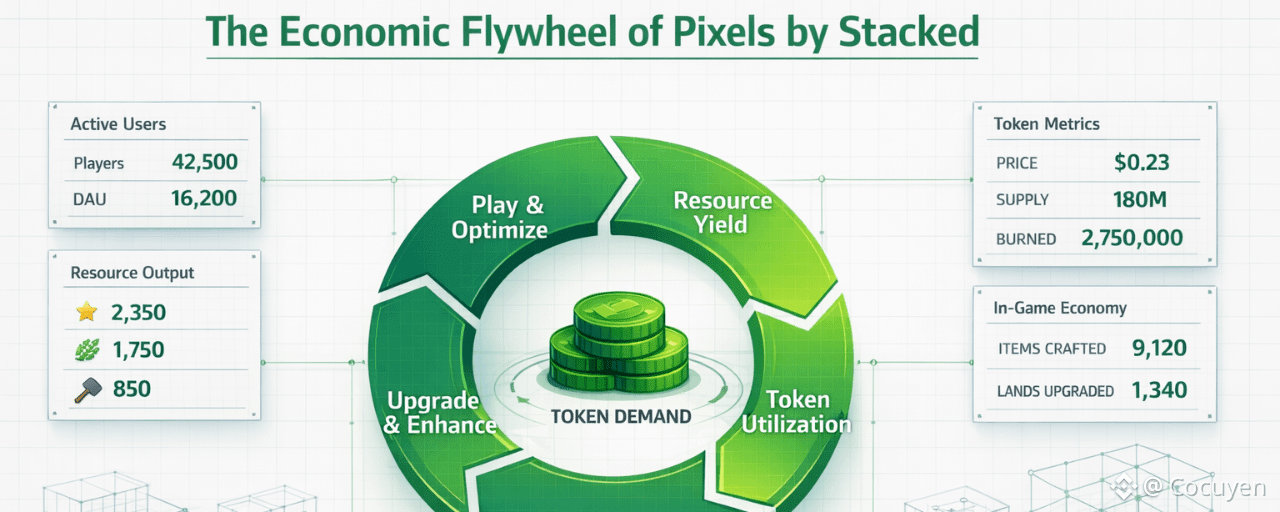
I've seen too many diagrams of this "cycle" drawn on slides. A nice circle, players participate → play games → create value → token supply increases → attract new players → repeat. It sounds reasonable, but in reality, it rarely spins by itself. Most of the time, it needs a push, a push through incentives, a push through rewards, and when the push stops... it will stop completely.
In GameFi, the problem is not a lack of ideas, but that everything is too familiar. Players participate for rewards and leave when the rewards decrease. A simple loop, almost mechanical but very hard to break.
Systems try to fix this by adding layers, adding staking mechanisms, adding NFT utilities, adding token burn mechanisms, adding token consumption mechanisms. They add a lot of things, but the more they add, the heavier the system becomes; players don't understand or understand... but don't care. They only care about how much money they can make today.
That's the part I've always come back to because behavior doesn't change but the system becomes increasingly complex.
In that context, Stacked in Pixels seems to be heading in a different direction. Not adding layers but changing the way layers interact with each other.
At least from my perspective, Stacked is not trying to create more "utility" for tokens. It tries to create an internal operational demand, a kind of demand that doesn't come from the story but from the fact that... if you don't use it, you won't play effectively.
It sounds simple but not every system can do it.
Old systems often separate these two things: gameplay is one thing, economics is another. Players can play without understanding the economics or exploit the economics without playing. These two layers exist in parallel and sometimes... negate each other.
Stacked seems to be trying to connect those two things.
Players are not merely "grinding" but must also optimize, must arrange, must decide how to use resources to increase efficiency, and here, tokens are no longer a reward at the end of the game but become part of the process.
It's not X: play to earn coins.
But Y: use coins to play better.
This difference may be small, but if true... the consequences will be significant because when tokens participate in behavioral loops, they are no longer entirely dependent on new players; they begin to have intrinsic demand and current players create demand for themselves.
If it exists, then the driving force does not start from attracting more users but from retaining current users, encouraging them to interact and continuously optimize.
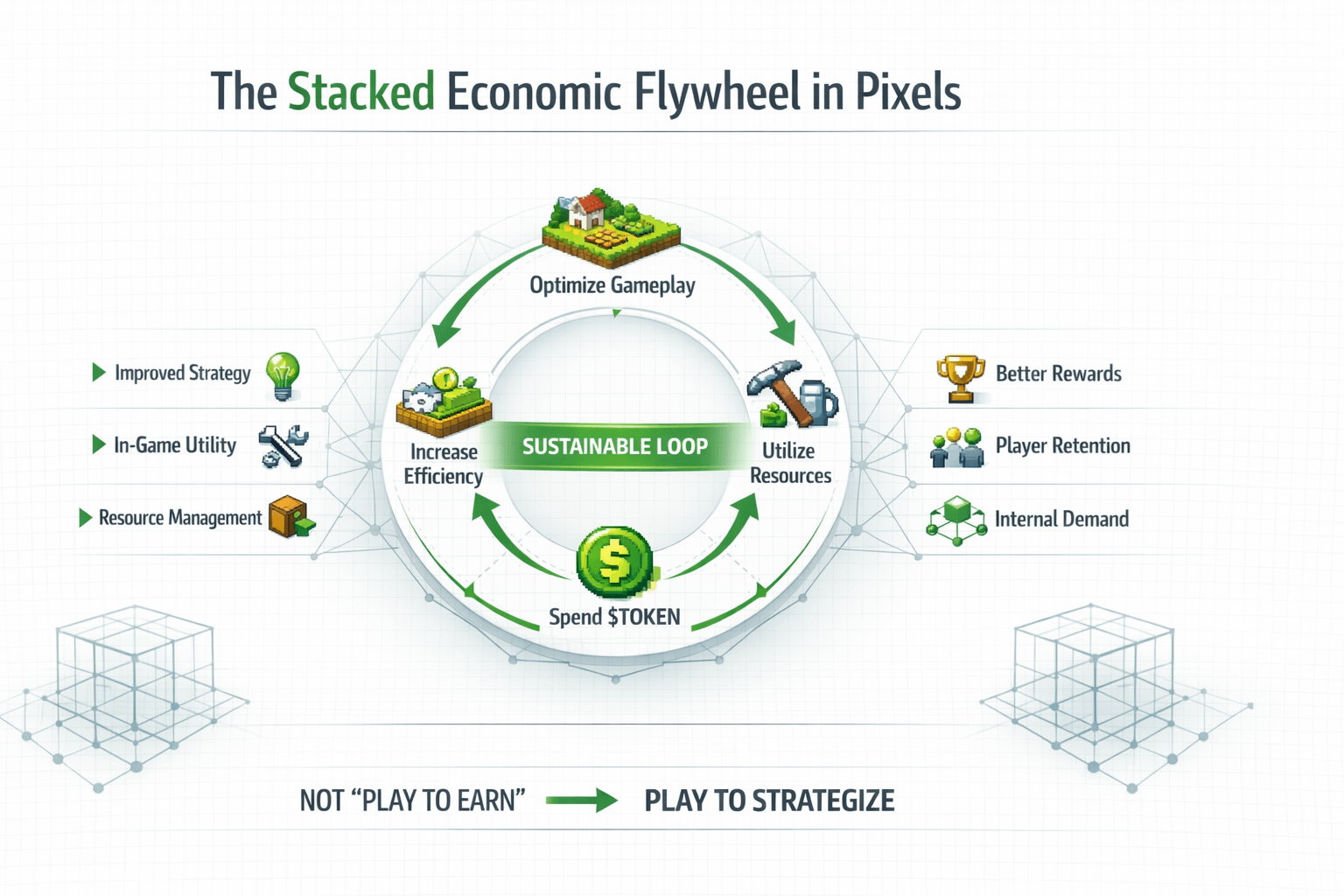
But I'm still quite cautious because most systems of this kind look very stable... until they scale up. As the number of players increases, optimization strategies begin to converge, meta forms, and when the meta is too clear, the system will revert to the old state of optimizing once and repeating multiple times.
At that stage, the flywheel no longer spins by decision-making but spins by "repetitive execution", and that's when it starts to wear down.
One more point I noticed is that Stacked seems to create a light pressure on resources. Not in a coercive way, but there's a feeling that if you don't optimize, you'll miss out on efficiency, and this is different from not earning anything; it's gentler but more sustainable.
It seems they are trying to keep players in a state of "not yet optimized", a state very familiar in traditional games but rare in GameFi.
However, all these are still just hypotheses.
The whitepaper may sound very nice, the story may be very logical, but in the end... the players are the ones who decide. Do they really feel the need to come back or only come back when there is new motivation?
That's the part I'm still waiting for.
Because if Stacked can actually create a loop where players create demand for themselves... then that's not just a feature but a structure; if not... it's just another layer of optimization and we've seen too many layers like that already.
I'm not rushing to conclusions; I'm just observing and noting that Stacked is trying a different approach, while whether it will become a sustainable cycle or just another leaky water wheel remains to be seen.
I'm still watching closely...! @Pixels $PIXEL