
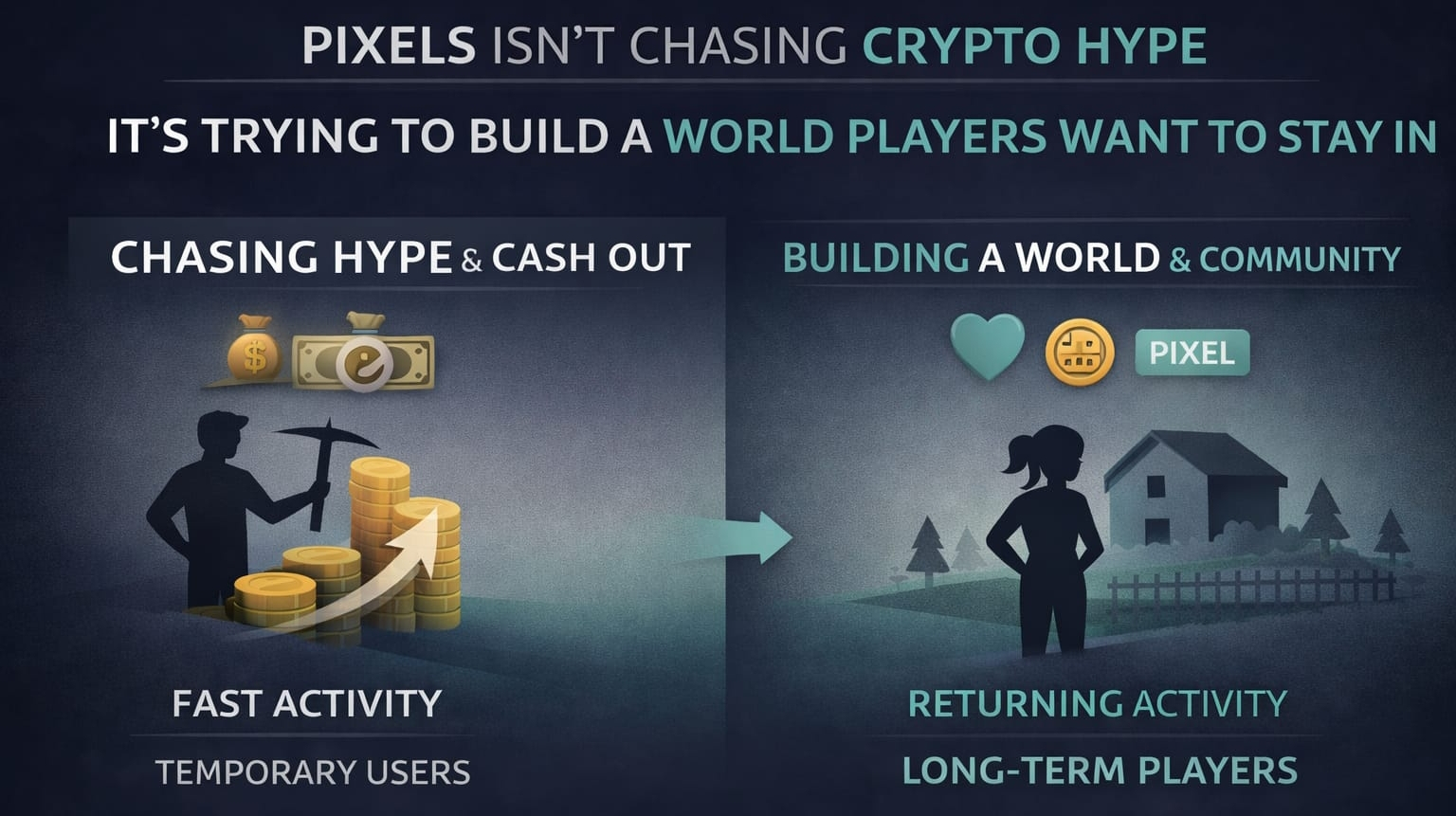
I’ve seen so many blockchain games come and go that, at some point, I stopped getting impressed by the usual promises. A new project shows up, people get excited, the trailers look great, the roadmap sounds ambitious, and suddenly everyone starts talking about how this one is going to change everything. Then the token launches, rewards start flowing, the hype peaks, and little by little the same thing happens again. People don’t stay because they love the game. They stay as long as the money makes sense. And once that weakens, the whole thing starts to feel empty.
That’s why Pixels caught my attention.
Not because it feels perfect. Not because I think it has everything figured out. But because it seems to understand something that a lot of Web3 games still don’t: if players are only here to extract value, they were never really part of the world to begin with.
That difference matters.
A lot of crypto games know how to attract people. Very few know how to keep them. It’s easy to create traffic when rewards are strong and speculation is high. It’s much harder to build something that people genuinely want to return to when the excitement cools down. That’s the part most projects struggle with. On the surface, numbers can look impressive. Wallet activity goes up, engagement appears strong, and everything looks healthy from a distance. But underneath that, the experience can still be fragile if people are only showing up to farm and leave.
Pixels feels like it is trying to deal with that problem more honestly than most.
One reason is its overall tone. It doesn’t come across like a project trying too hard to sound world-changing. It looks simple. It feels approachable. At first glance, it’s just a cozy social farming game, and I actually think that works in its favor. There’s something smart about not over-selling yourself in a space where almost everyone over-sells everything. Farming, crafting, decorating, exploring, meeting other players — none of this is revolutionary on its own, but together it creates something familiar. And familiarity is powerful. It gives people a reason to settle in instead of immediately thinking like extractors.
That might sound small, but I don’t think it is.
In blockchain gaming, a softer experience can actually be a stronger one. When a game feels like a game first, people engage differently. They’re more open to routine, more open to community, and more likely to build habits around the experience itself. That’s very different from projects where everything is designed around token incentives first and gameplay second.
Still, visuals and vibe alone are never enough. A lot of games look nice before the numbers start falling. What makes Pixels more interesting to me is that it seems to be moving toward a better question — not just how many people show up, but what kind of players are staying. That’s a much more important metric, even if it doesn’t create the same flashy headlines.
Because honestly, a big crowd doesn’t always mean much.
If most of that crowd is there for short-term rewards, then growth can be misleading. I’d take a smaller group of people who actually care about the game over a huge wave of temporary users any day. And from the outside, Pixels seems more aware of that trade-off than a lot of similar projects. It feels like the team understands that real strength comes from people who participate, spend time, and keep coming back — not just people who arrive when the incentives are high and disappear when they’re not.
That’s where the project starts to feel more meaningful.
To me, the most important thing a blockchain game can do is stop acting like an economy pretending to be a game. It has to become a place. A place with rhythm. A place with habits. A place people recognize, return to, and feel part of. That doesn’t happen through token design alone. It happens through comfort, repetition, social connection, and the feeling that being there matters for reasons that go beyond earning.
And that’s where Pixels feels different.
It seems less interested in just creating activity and more interested in creating attachment. That’s a rare instinct in this space. Most projects are built around momentum. Very few are built around staying power. But staying power is what matters if you actually want to build something that lasts.
At the same time, I don’t think it makes sense to ignore the risks. Pixels is still part of the blockchain gaming world, and that means it still carries the same pressure that hurts so many other projects. Speculation can still distort behavior. Rewards can still become the main reason people engage. Systems built around staking, gated access, or token-driven logic can still slowly pull attention away from the game itself. And when that happens, the experience starts to change. Players stop thinking like players. They start thinking like optimizers. The world becomes something to calculate instead of something to enjoy.
That’s always the danger.
So for me, the real test for Pixels isn’t whether it can create another spike in attention. Crypto has never had a problem creating spikes. The real question is whether it can keep turning casual users into regulars, regulars into community members, and community members into people who would still log in even when the reward layer feels quieter. That’s much harder. It takes patience, discipline, and a willingness to build for the long term instead of chasing easy numbers.
That’s why I keep coming back to Pixels as something worth watching.
Not because it has a token. Not because it can generate hype. Not because it once posted strong numbers. But because it seems to be trying to solve the part that actually matters. It seems to understand that a blockchain game cannot survive forever by giving people reasons to cash out. At some point, it has to give them a reason to stay.
#And in Web3 gaming, that still feels rare.