
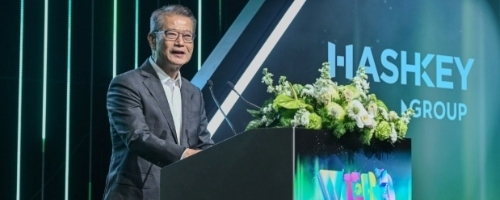

On April 20, 2026, the Financial Secretary of Hong Kong, Paul Chan, delivered the opening speech at the 2026 Hong Kong Web3 Carnival.
He pointed out that 2026 is an important turning point, as Web3 is maturing, and financial institutions are increasingly using digital assets and tokenization to enhance efficiency, reduce costs, and shorten settlement times. The rise of AI agents this year is another notable milestone, as the intersection of artificial intelligence and technologies like Web3 is changing the game. He further noted that the combination of the two will elevate transaction efficiency to a new level, covering multiple fields such as finance, trade, wealth management, supply chain operations, and logistics, creating vast new opportunities, but also bringing challenges that need to be addressed.
The three "hidden reefs" of AI + Web3 integration. Chen Maobo summarized the challenges brought by technological integration into three core issues.
Infrastructure: Unable to keep up with the speed of AI
Chen Maobo pointed out that if AI can complete complex operations in milliseconds, then the relevant financial infrastructures such as payment and settlement must also be upgraded in sync to match its high-speed pace. This relies on establishing common standards and cross-border cooperation. The action speed of AI agents is measured in milliseconds. Traditional payment systems—SWIFT and banking clearing networks—calculate settlement cycles in seconds or even days, creating a significant gap.
Control: How humans maintain dominance
Chen Maobo emphasized that as agents gain higher levels of autonomous decision-making capabilities, it is crucial to ensure that their actions are predictable, traceable, and subject to effective human interaction. Establishing clear "guardrails" to safeguard human dominance is essential to timely identify and stop any potential abuses, manipulation, or serious errors. The core question is: when AI agents can autonomously execute transactions and manage assets, who is responsible for their actions? When they make mistakes, is it due to a bug in the code, bias in the training data, or unclear instructions from users? The principle that "humans are always in control" needs to be translated from concept into actionable technical standards.
Accountability: How regulatory frameworks adapt
Chen Maobo pointed out that the regulatory and governance frameworks need to evolve in sync with technological development. He emphasized that decentralization and digital intelligence do not mean a reduction in accountability or a lowering of standards, but should enable smarter ways to integrate compliance and supervision mechanisms into the financial system. When AI agents become the main actors in economic activities, the traditional logic of "who operates, who is responsible" no longer applies. A new accountability system needs to be established so that decisions at the code level can map to legal responsibilities.
From regulation to practice: Hong Kong's problem-solving approach. In the face of these challenges, Hong Kong is not passively waiting but has formed a gradual response path.
Establish an AI committee to formulate industry development strategies
Chen Maobo revealed that Hong Kong will establish the "AI + Industry Development Strategy Committee," with the integration of Web3 and AI being one of the committee's key areas. This indicates that Hong Kong is not only passively responding to challenges but is actively participating in rule-making.
"Same business, same risk, same rules" principle
Chen Maobo reiterated that Hong Kong, as an international financial center, actively embraces innovation, adhering to the principle of "same activities, same risks, same regulation". Regulatory agencies have a dual mission of prudent regulation and market development. The core of this principle is: do not relax regulation due to the novelty of technology, and do not stifle innovation due to prudent regulation. The "small steps, quick wins" strategy and its practical implementation.
On April 10, 2026, Hong Kong issued the first two licenses for stablecoins (HSBC, D-Point). Chen Maobo described the licensing strategy as "small steps, quick wins": issuing a small number with specific scenarios, and summarizing experiences before issuing a second batch. Hong Kong has cumulatively issued over $2 billion in tokenized bonds, and the Monetary Authority is piloting tokenized deposits for money market fund transactions through the Ensemble project.
Data Governance: The common "key" to three major challenges These three types of challenges can be converged into a more fundamental variable: data governance capability. Infrastructure challenges correspond to data standardization. Different blockchains and between on-chain and off-chain systems require unified data formats, interface specifications, and protocol standards. Chen Maobo emphasized that "global common standards and cross-border cooperation need to be established." Only with unified data standards can financial infrastructures keep up with the speed of AI and achieve interconnectivity across systems and regions. Control challenges correspond to data traceability. Every decision and transaction made by AI agents needs to leave an immutable record on the chain. Chen Maobo emphasized the importance of ensuring AI actions are "predictable and traceable." This means that data must fully record decision paths, execution processes, and results, forming an auditable chain of evidence. This is the technical premise for the principle that "humans are always in control." Regulatory challenges correspond to data trustworthiness. When regulatory agencies need to review AI agents' actions, on-chain data must be trustworthy, immutable, and verifiable. Chen Maobo emphasized that "decentralization does not mean a reduction in accountability." Trustworthy data forms the basis for regulatory agencies to determine responsibility, assess risk exposure, and conduct compliance reviews. Without trustworthy data, there is no effective regulation. From infrastructure to control to regulatory systems, these three types of challenges constitute a complete structural constraint for the financial system. Data standardization addresses interconnectivity issues, data traceability addresses responsibility allocation issues, and data trustworthiness addresses compliance review issues. Together, these form the underlying infrastructure for the integration of AI and Web3.
Global Gap: Hong Kong's rule-makers currently face more regulation of AI or Web3 separately, rather than establishing a complete framework for the integration of the two.
The relevant global frameworks are still in the early stages of construction. In the United States, the long-standing jurisdictional dispute between the CFTC and SEC has not been fully resolved, but both sides signed a memorandum of understanding in 2026 and established a joint working group to resolve differences and establish a unified framework.
The EU's MiCA framework mainly regulates crypto assets themselves, and there is no specific design for AI agent payments yet; related payment activities remain in a regulatory gray area. Hong Kong's advantage lies in having both stablecoin licenses and regular issuance of tokenized bonds, along with a trial of tokenized deposits, clearly positioning "AI + Web3 integration" as a strategic direction. Chen Maobo explicitly stated in his speech that Hong Kong's goal is to become a global hub where "the next generation of technologies can be responsibly developed, applied, and scaled up."
If Hong Kong can take the lead in forming operational standards and rules on key issues such as data governance, algorithm transparency, and cross-border data flow, it will have the opportunity to export its institutional design as an "international standard."
Chen Maobo stated that Hong Kong will adopt an open and balanced attitude to encourage innovative applications while ensuring security, attracting outstanding global Web3 entrepreneurs and institutions to settle in Hong Kong. Rules precede scale, and guardrails precede speed. The intersection of Web3 and AI brings challenges that Hong Kong must face, which are both "hidden reefs" to be addressed and opportunities for Hong Kong to export the "Hong Kong standard" in global AI and Web3 governance.
When AI agents act at millisecond speeds, whoever sets the rules holds the initiative. What Hong Kong is doing is ensuring that before the machine economy truly erupts, the "guardrails" are in place, and then the "standards" are exported. Regulation needs to be approached with an open and balanced attitude, continuously summarizing practical experiences and adjusting strategies to keep pace with technological changes.
Hong Kong is committed to becoming a significant hub for the development, application, and promotion of the next generation of technologies to broader markets.
The endpoint of this transformation is not the replacement of humans by technology, but the definition of boundaries by rules. If the past financial system was based on "human decision-making + system execution," the next stage may evolve into a new structure of "humans set rules + machines execute rules".


