I remember there was a session when I tried using Binance AI Pro while the market was almost completely sideways. BTC had no clear trend, and there were no strong breaks to create conviction. But what caught my attention was not a specific order, but rather how the system continuously displayed statuses like 'setup is forming' or 'monitoring the latest breakout'.
If I just go by feeling, I might easily think this is a UX that keeps users in an active state. But when placed back in the context of the architecture of Binance AI Pro, I started to see that it is not merely an independent analysis layer, but rather a part of the exchange pipeline.
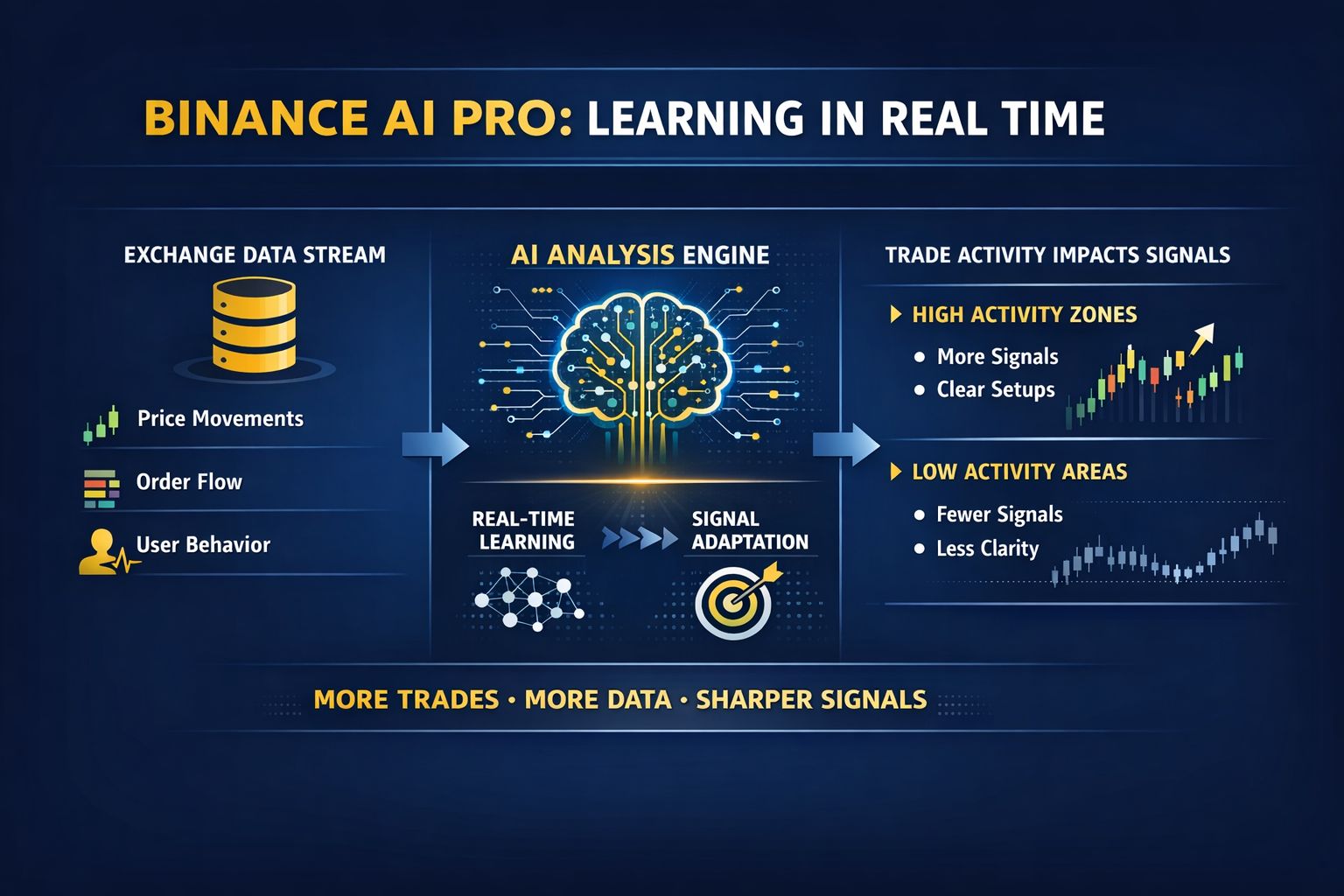
The key point here is that Binance AI Pro doesn't operate like an external market bot. It resides directly within the Binance ecosystem, where price data, order flow, execution, and user behavior are recorded within the same system. This creates a very short feedback loop: each trading behavior is not just an output, but simultaneously becomes almost real-time input for the system itself.
Technically, there's nothing mysterious about this. Modern AI trading systems rely on behavioral data streams. The more you trade, the denser the events, including entry, exit, order modifications, and reactions to price volatility. These events create training signals for the model to update the market distribution in real-time.
In other words, in Binance AI Pro, activity isn't a KPI but the primary source of data.
I've noticed a clear pattern in my own experience. During sessions where I trade more than usual, the feeling of 'having more setups' also appears more frequently. But when looking back at the chart, the market doesn't show corresponding volatility. What changes isn't the market, but how the system clarifies the areas related to the most recent behavior.
This isn't unique to Binance AI Pro. In actual trading automation systems, especially bots running on the Binance API or futures automation platforms, a similar phenomenon is often observed: when execution frequency increases, the system has more data to refine signals, and as a result, the state of 'tradeable' appears more densely in similar previous regions.
A clearer example is grid trading bots or momentum bots running on crypto exchanges. When the market has many order executions from bots or users, the system not only records price movement but also captures the distribution of the order placement behavior. This causes adaptive strategies to become 'more active' during periods of high trading, as that’s where there’s enough data to update the state.
Another easily observable example is copy trading platforms. Strategies marked 'popular' or 'most copied' tend to attract new copies not just because of performance but because the activity itself becomes a social signal. Here, activity isn't just the result of good decisions; it becomes a proxy for 'trustworthiness.' This is a behavioral pattern frequently observed in social trading systems.
Going back to Binance AI Pro, the key point to understand is that it doesn't need to optimize for higher trading frequency. There's no evidence that its objective function is 'trade more.' However, since it's part of an exchange-native architecture where behavioral data and execution are continuously collected, it naturally depends on activity density to improve model accuracy.
From a systems perspective, this leads to a fairly clear consequence: areas with more behavior are modeled with greater detail, while areas with less behavior are updated less frequently and thus clarified less in the UI suggestions.
It's not the system saying 'trade more,' but the system understanding better in areas with more trades.
And that's where I start to see insights becoming more important.
Binance AI Pro isn't a tool that creates a bias toward action in an active sense. It's simply a system that learns from real-time behavioral data, and within that structure, decision density becomes more clearly reflected than decision absence.
In other words, the issue isn't whether the system encourages trading, but whether it can model areas with action better than those without action.
And when that's true, the 'silence' doesn't disappear, but it doesn't show up as sharply in areas with activity.
Trading always carries risks. AI-generated suggestions are not financial advice. Past performance does not reflect future results. Please check the availability of products in your area.