

I used to think it was clear how games would change.
If players could own things have tokens and take part in economies then they would eventually control the game. That seemed like the next step. Ownership would lead to influence and influence would lead to control. It wasn't something I questioned much. It just seemed to make sense with Web3 games.
Lately I'm not so sure it's that simple.
I've been spending time in systems like Pixels. It doesn't feel as direct as I thought. Players can own things and trade tokens. The connection between owning and controlling feels weaker than I expected.
At first everything seems fine.
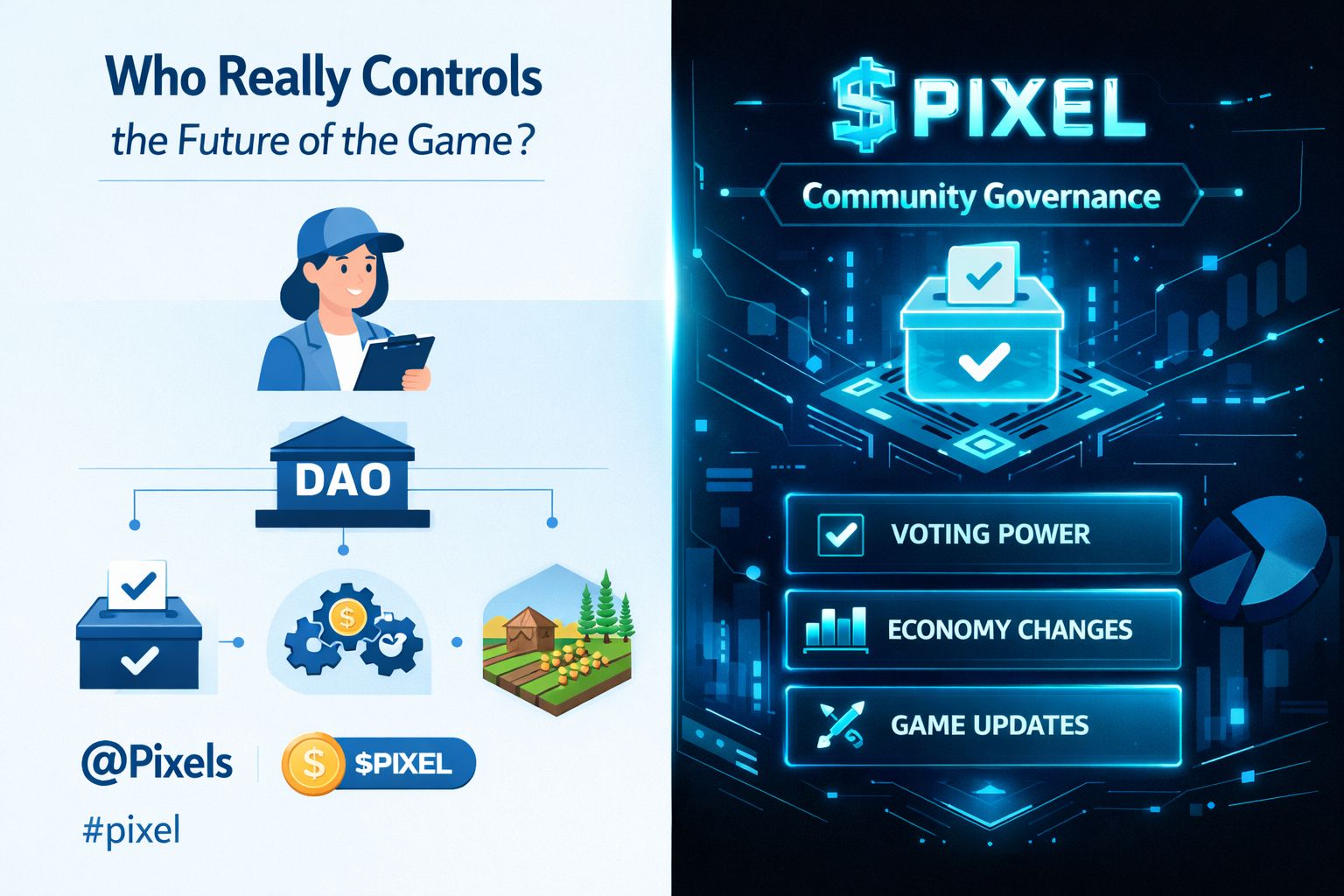
The game developers. Maintain the game. Players play, invest time and get resources. Then governance starts to appear. Through a token like $PIXEL. The idea is that players will have say in the game over time.
It sounds good.
Being inside the system it feels more complicated.
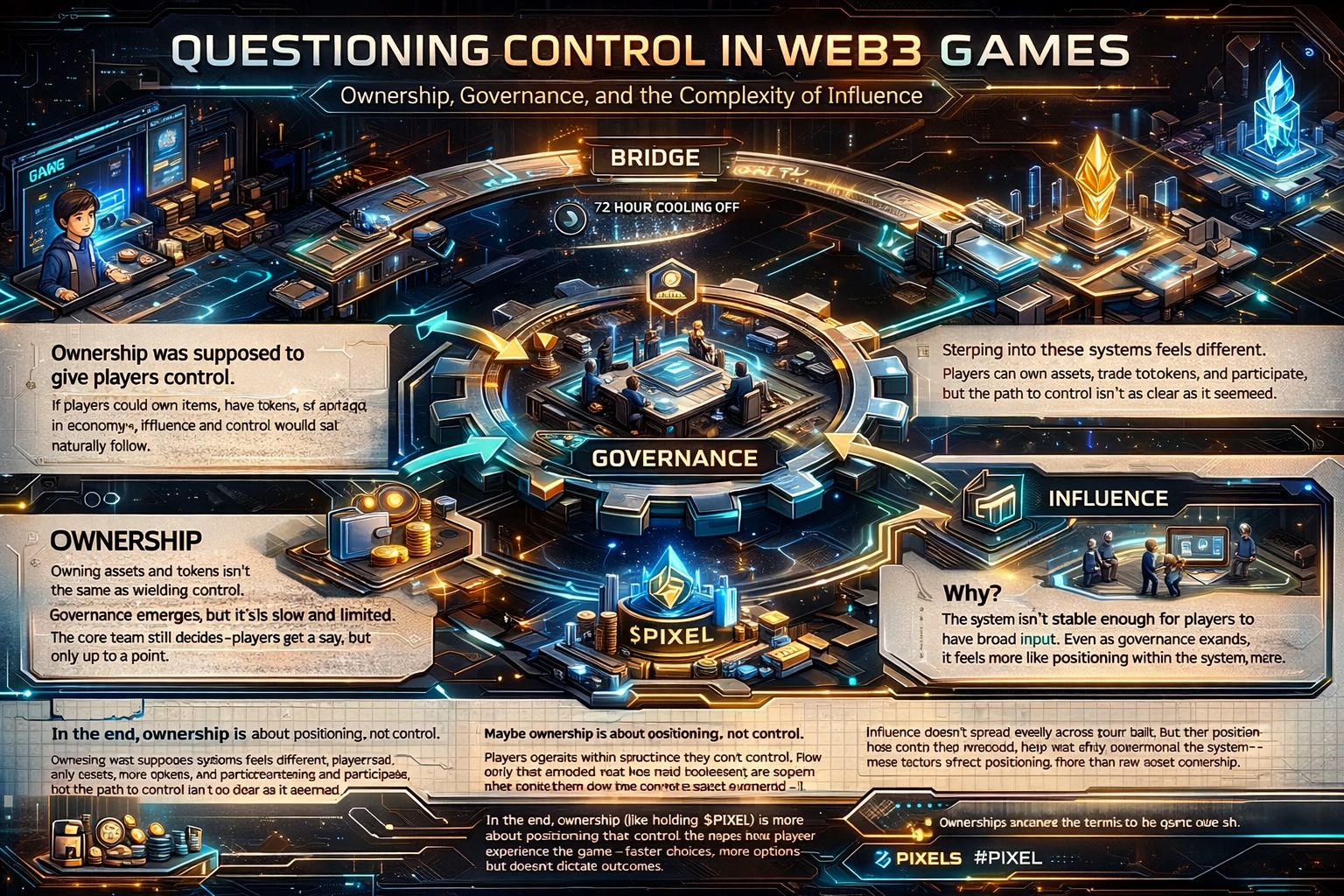
Governance doesn't just hand over power to players. It happens slowly with some decisions opening up to players but not the big ones. The core team still makes the decisions.
Not because they're trying to avoid decentralization but because the system isn't stable enough for players to have that input.
That's where something feels off.
The idea of governance is often talked about like its a transfer of power. What I'm seeing feels more like a controlled expansion of participation. Players can join in. Only up to a point.. That point isn't always clear.
It makes me wonder if ownership was ever meant to lead to control.
Maybe it's something
Maybe ownership is like positioning.
Having assets, tokens and participating in the economy doesn't necessarily give players power.. It does give them a place in the system. It affects how quickly they can move, what opportunities they have and how flexible they are when the system changes.
That feels like market dynamics.
In markets participation doesn't guarantee influence. People operate within structures they don't control. But their position. How money they have how early they got in how well they understand the system. Affects their outcomes.
The same thing seems to be happening
$PIXEL for example isn't a currency. It's like a way to move through the system with more flexibility. It gives players choices and makes some constraints feel lighter.
Players can still play without it.
Something changes if they don't have it.
It's not obvious. Its there.
Over time that difference starts to matter.
At first everyone seems to be on the level. The systems are simple and progression feels even.. As the economy grows and more layers are added small differences start to add up.
Players who are more efficient stay ahead. Those with positioning can adapt more quickly. Having access leads to access and flexibility creates more flexibility.
None of this is forced.
That's what makes it harder to notice.
There's no barrier to participation. No moment where the system splits. It just drifts, quietly and gradually until the experience of the game starts to differ depending on where playersre in the system.
It starts to feel like a two-speed system.
Not in a way that feels unfair. In a way that becomes more visible over time. Some players move through the game with ease while others move carefully and slowly.
Governance sits on top of this.
In theory token-based systems are meant to balance things out. Players who are invested get a say in how the system evolves. But in practice participation isn't evenly distributed. Most players focus on playing and progressing while a smaller group pays attention to governance.
Over time that group starts to shape outcomes.
Not because they're trying to dominate. Because they're present.
That's where the idea of control starts to blur.
Influence doesn't spread evenly across players. It concentrates around those who understand the system have the time to engage and hold tokens to matter.
Again it mirrors something
In systems the people who show up consistently end up shaping the direction.
That doesn't invalidate governance. It reframes it.
It's less about transferring control to everyone and more about creating a layer where influence can emerge.
The risk is that this layer becomes too limited or too abstract.
If governance feels symbolic players disengage. If it becomes too complex it loses relevance.
Either way the connection between ownership and influence weakens.
What remains is positioning.
Holding $P$PIXEL ning assets and participating in the economy still matter.. Not because they guarantee control. They matter because they shape how players experience the system.
That's a form of power.
Less visible,. More consistent.
It changes how ownership feels.
It's no longer about having something. It's about where that something places players in the system. Whether it aligns them with the games evolution. Leaves them slightly out of sync.
That alignment doesn't require participation in governance.
Sometimes it's enough to hold a position.
That alone can extend engagement. Create a sense of connection to the system.
It also introduces a different kind of pressure.
Not explicit,. Ambient.
The sense that staying still might mean falling. That not engaging might slowly reduce flexibility within the system.
Nothing forces players.
Something shifts.
Over time that shift becomes harder to ignore.
I keep thinking that Web3 games aren't just changing ownership. They're changing how players relate to systems. The expectation isn't just to play. To position themselves within something that evolves continuously.
Governance is part of that but not in the way I initially thought.
It's not a destination where players take control.
It's like an ongoing negotiation, between different layers. Developers, players, token holders. Each operating with different levels of influence, attention and understanding.
Where that balance settles isn't clear yet.
What feels clearer is that ownership alone doesn't resolve it.