
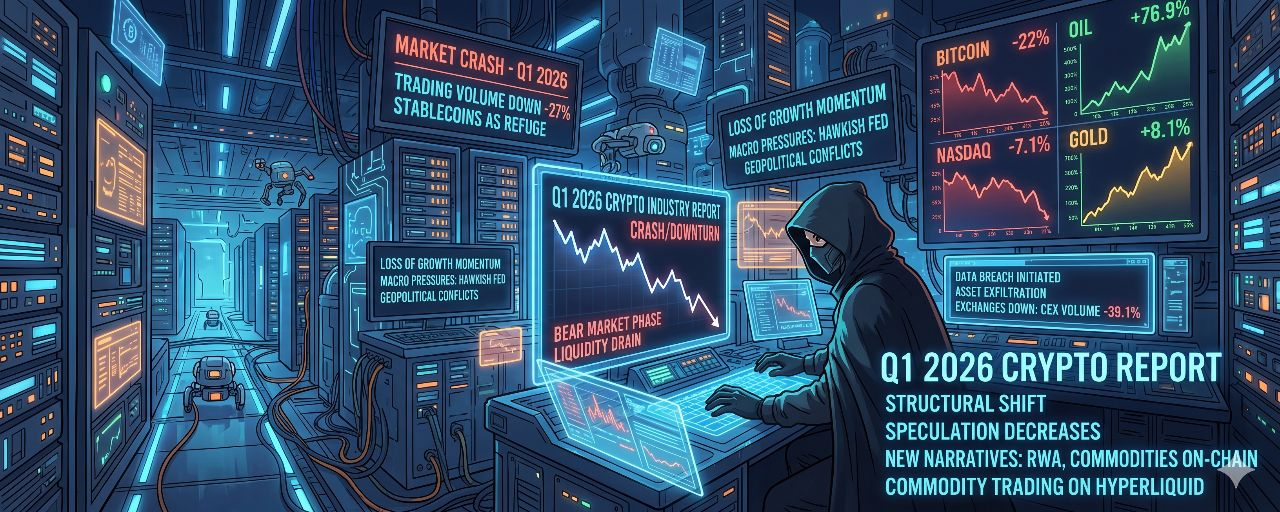

In the first quarter of 2026, the cryptocurrency market did not experience a rebound; instead, it further deteriorated amid the downward trend that began at the end of 2025, gradually entering a more defined 'bear market phase.' Under the dual influence of tightening macroeconomic conditions and geopolitical conflicts, the entire industry exhibits clear signs of contraction and restructuring.
If I had to summarize this quarter in one sentence: the market is not just declining; it is being reshuffled.
1. Overall market: the decline is just the surface; the key issue is the 'loss of growth momentum'
Q1 2026, the total market capitalization of the cryptocurrency market has significantly shrunk:
· Total market capitalization fell to $2.4 trillion
· Quarterly decrease of about 20%
· Compared to the peak in October 2025, the overall pullback is nearly 45%
This has already marked the second consecutive quarter of decline.
More importantly— the downturn was primarily concentrated in a short burst from mid-January to early February.
A significant trigger was Kevin Warsh's nomination as Fed Chair, which the market interpreted as: future monetary policy may lean more 'hawkish' (interest rate hikes/tightening liquidity).
Changes in market conditions
Then the entire quarter displayed a clear characteristic:
The market has entered a sideways trend; even with geopolitical conflicts (like the US-Iran war), there have been no wild fluctuations.
Indicates: panic selling has been released, but funds have not re-entered.
Trading activity is declining in tandem.
· Daily average trading volume has decreased to about $117.8 billion.
· Month-over-month decrease of 27%
This means: the market is not just falling, but becoming 'increasingly quiet.'
2) Stablecoins: 'liquidity anchors' in a bear market.
In the context of a clear market contraction, stablecoins exhibit completely different characteristics:
· Total scale remains around $309.9 billion
· Only a slight increase of about 0.5%.
The implications behind this are crucial:
Stablecoins have become the market's 'liquidity harbor' rather than risk assets.
Structural changes: funds are being reallocated.
1) Tether has first seen a contraction in supply.
· Down by about 1.6%
· Market share still stands at 59%
This is the first significant decline since 2022.
Indicates: some funds are withdrawing from the crypto system.
2) USD Coin is on a steady rise
· Growth of about 2.4%.
Indicates: more compliant and transparent stablecoins are gaining favor.
3) New players are rapidly expanding.
· USDS, USD1, etc., have seen over 30% growth
Essentially: the competition among stablecoins has entered the 'product + ecosystem-driven' phase.
3) Macro asset comparison: crypto assets are clearly losing ground
What’s most noteworthy this quarter is not just the internal dynamics of the crypto space but the cross-asset performance:
Commodities are surging strongly.
· Oil up by +76.9%
· Gold up by +8.1%
Reason: US-Iran conflict causing supply shocks, global risk aversion is rising.
Crypto assets are clearly lagging behind.
· Bitcoin down 22%
· Nasdaq has dropped about 7.1%
· S&P 500 dropped about 4.8%
The conclusion is very clear: in a risk-off environment, crypto assets are not treated as 'safe haven assets.'
At the same time: the US dollar index (DXY) has slightly risen.
Note: Funds are flowing back into 'traditional safe assets' rather than into crypto
4) Exchanges: overall activity is declining.
Centralized exchanges (CEX)
Total trading volume: $2.7 trillion
Month-over-month drop: 39.1%
Key phenomena:
January still maintained high levels.
Then continued to decline.
In March, it dropped to near two-year lows.
Exchange landscape
· Binance remains first (37%)
· MEXC second (10%)
· HTX had the largest drop.
Essentially: there are no winners in a bear market, only 'those who fall less and those who fall more.'
Decentralized exchanges (DEX)
Solana continues to lead.
· Market share: 30.6%; though trading volume has decreased, it still ranks first.
Changes in competitive landscape
BNB Smart Chain: second; Ethereum: third, but surpassed Solana in March.
Trend: competition among leading chains is intensifying rather than being one-sided.
New chains are coming into view.
Monad has entered the top ten, indicating: even in a bear market, competition in infrastructure continues.
5) The most interesting change: on-chain 'oil trading' is starting.
Hyperliquid
A very crucial but easily overlooked trend is: commodity trading is starting to go on-chain.
Data performance
· Commodity perpetual contracts account for about 30% of total positions.
· Oil trading demand has surged.
· Daily trading volume even surpassed Bitcoin at one point.
The mechanisms behind this.
Through the HIP-3 proposal: anyone staking funds can issue contracts, including: stocks, gold, and oil.
This means: the crypto market is evolving into a '24-hour global exchange.'
6) The real core conclusion
1) The market has entered 'defensive mode.'
Funds are flowing into stablecoins, investors are trading less, and risk appetite is decreasing.
2) Crypto has lost its 'independent market condition.'
No longer climbing independently, clearly influenced by macro factors.
Essentially: crypto has become part of the global financial system.
3) Trading behavior is changing.
Speculation is decreasing, while practical demand is increasing (such as commodity trading).
4) New narratives are forming
In the past: NFTs, memes, AI
Now: stablecoins, RWA, and commodity trading on-chain
Summary
In Q1 2026, the crypto market did not see a rebound but officially entered a 'structural bear market' under the combined pressures of macroeconomic conditions and geopolitical conflicts.
Funds are moving away from high-risk assets towards stablecoins and real asset mappings; trading activity continues to decline, while on-chain infrastructure is quietly evolving.
This isn't just a cyclical downturn; it feels more like a pivotal transition for the crypto industry from 'speculative market' to 'financial infrastructure.'
////////
Data source: coingecko
Disclaimer: This article is for informational purposes only and does not constitute any investment advice. The crypto market is highly volatile, and investments carry risks; please do your own research and bear the consequences independently.