
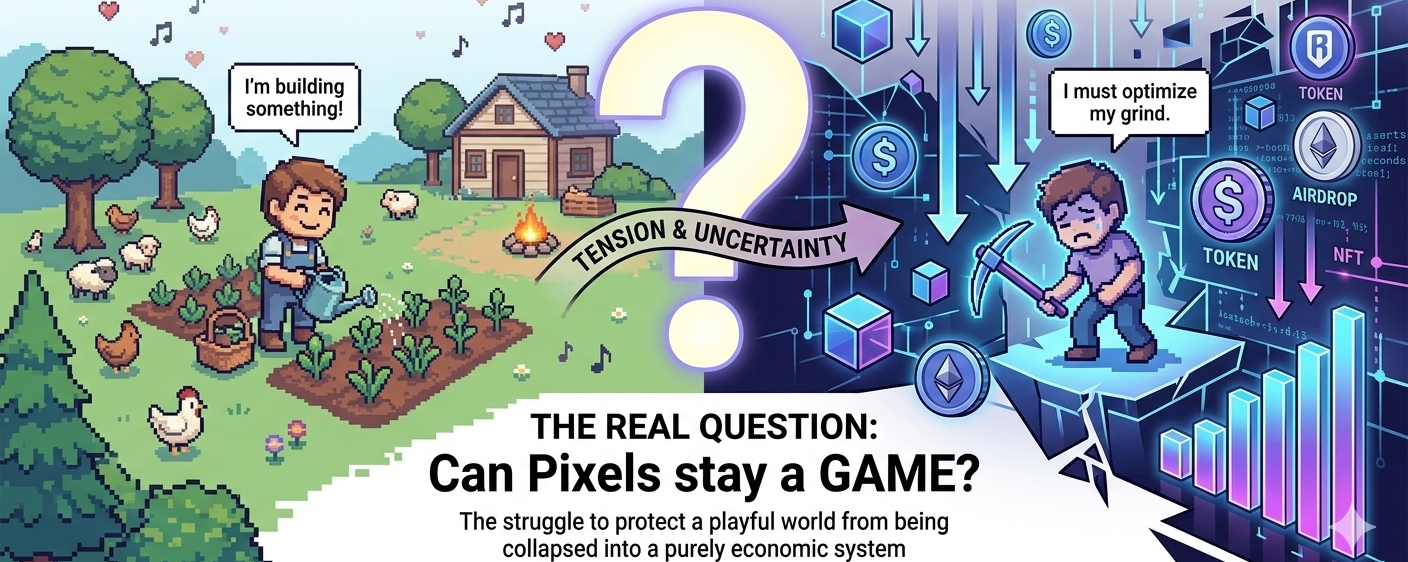

What keeps pulling people back to something like Pixels?
I do not mean the easy answer. Not the token, not the Ronin label, not the usual Web3 excitement that shows up around anything that looks active for a few weeks. I mean the deeper question. What is actually being built here that feels worth returning to?
Pixels is interesting because it does not arrive with the usual noise. It is a farming world, a social loop, a light open environment built around small actions people can repeat without thinking too hard. That sounds simple, maybe even too simple, but that simplicity might be the most serious part of it. Web3 has spent so much time trying to prove it can build bigger systems, louder economies, more complex mechanics. Meanwhile, most people still respond to something much more basic: rhythm, familiarity, presence, a world that feels easy to step back into.
That is where Pixels starts to matter.
Not because it somehow solves Web3 gaming overnight, and not because every active game deserves instant belief, but because it feels like a live experiment in what happens when builders stop chasing the grand narrative and just keep shipping. You can sense that this thing is being learned in real time. Adjustments, iteration, pressure, small corrections. It does not feel frozen inside a pitch deck. It feels like a project trying to understand itself while people are already inside it.
And honestly, that is more valuable than polished promises.
The hard part is not putting a game onchain. The hard part is protecting the game from the chain. Once incentives get too loud, behavior changes. Players begin to optimize everything. Every mechanic gets read as extraction. Fun becomes secondary. Community becomes transactional. The world starts to feel less like a place and more like a spreadsheet with better colors.
That tension sits right under Pixels, and that is exactly why it is worth watching.
Because the real question is not whether it looks charming or whether the activity is strong right now. The real question is whether something like this can keep its soul while carrying crypto on its back. Can it stay playful without becoming purely economic? Can it remain a world, instead of collapsing into a reward loop people eventually drain and leave behind?
I do not think the answer is fully clear yet. Maybe that uncertainty is the honest place to stand. But there is something refreshing about watching builders who are actually making something, testing it in public, learning where the friction is, and continuing anyway.
That is usually where the real signal is. Not in the loud claims, but in the projects that keep building, keep adjusting, and quietly show you what they are trying to figure out.