
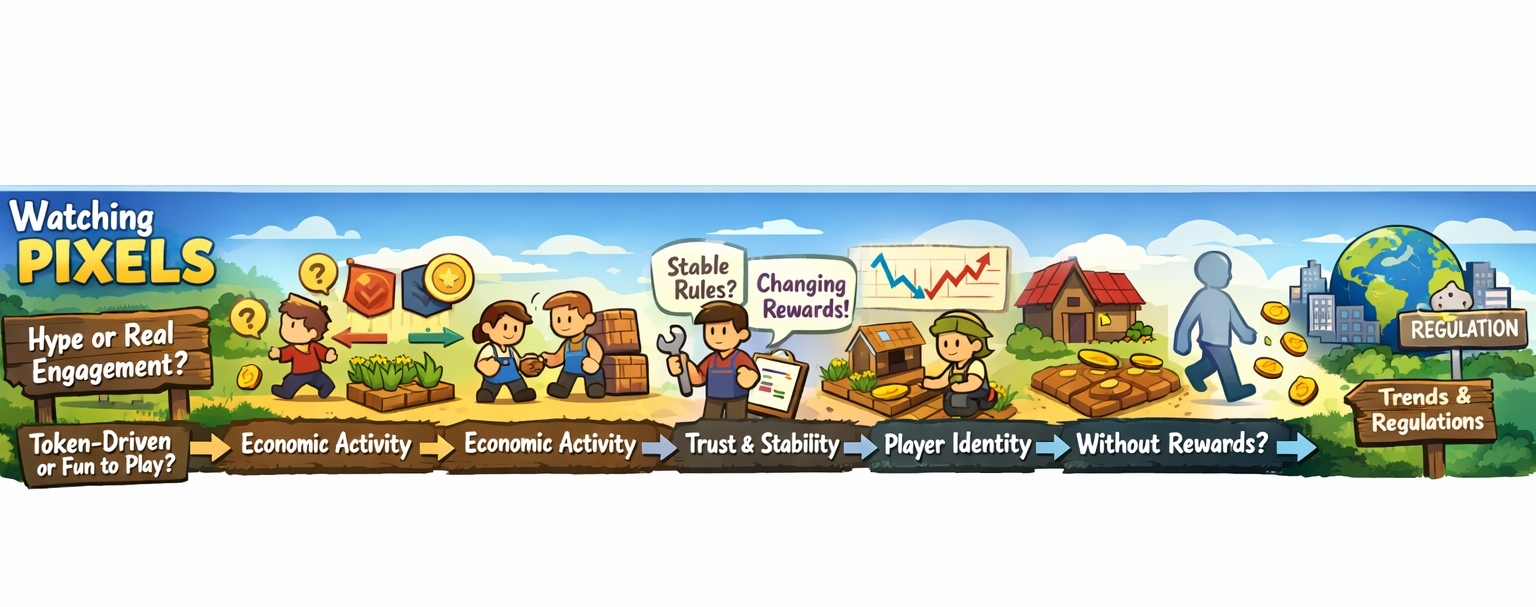
I’m watching Pixels closely, not just as a token but as a living system where people spend time, make decisions, and interact with each other. I’m waiting to see if Pixels can hold attention without constantly relying on rewards to keep people engaged. I’ve noticed that a lot of Web3 games look active on the surface, but when you slow down and really observe, the activity often comes from people chasing incentives rather than enjoying the experience. I focus on what players are actually doing inside Pixels, not what the numbers say. I stopped looking at narratives because they tend to exaggerate potential. I started paying attention to real usage, to whether this is something people would still open every day if there were no tokens involved. I remember when I thought differently, when I believed ownership alone could build strong games, but now I see that usage always comes first.
With Pixels, I keep coming back to the simplicity of it. Farming, collecting, interacting, it’s familiar and easy to understand. That’s a strength, but it also raises a question. Is the simplicity enough to keep people engaged long term, or is it only working because there’s something to earn? I try to imagine the game without rewards, just players logging in because they enjoy the loop. If that version feels weak, then the current activity might not be as strong as it looks.
When I observe the in-game economy, I’m not just thinking about tokens, I’m thinking about behavior. Are players trading with each other in meaningful ways, or are they just extracting value from the system? A healthy game economy should feel alive, where resources move, where players depend on each other, where actions have purpose. But if most players are just farming and selling, then the system becomes one-directional. I keep watching if Pixels creates real circulation or just temporary activity.
The fact that Pixels runs on the Ronin ecosystem gives it a head start. There’s already an audience that understands how these games work, which reduces friction. But I don’t see that as a guarantee of success. It’s easier to get users in, but keeping them is something else entirely. I think about how many of these players are actually there for Pixels itself and how many are just following opportunities within the ecosystem. That difference matters more over time.
Trust is something I don’t ignore either. In a game like Pixels, players are not just playing, they’re investing time and sometimes money. They need to feel that the system is stable, that changes won’t suddenly make their efforts meaningless. But in Web3, things can change quickly. Rewards can be adjusted, mechanics can shift, and that creates uncertainty. I keep watching how consistent Pixels feels over time, whether players can rely on it or if they’re always adapting to new conditions.
Liquidity tells another part of the story. I’m not too interested in short-term trading volume, I care about why people are buying and holding. Does the token have a real role inside Pixels, or is it mostly something people earn and sell? If the demand comes mainly from speculation, then it won’t hold up for long. But if players actually need the token to participate, then there’s something more solid underneath.
I also think about identity inside Pixels. Do players feel connected to what they’re building? Do they care about their progress, their land, their interactions? Or is it just another system where wallets come and go? Real games create identity naturally, but in Web3, that part often gets lost. If Pixels can build that sense of belonging, it changes everything. If not, then players remain temporary.
Adoption is something I approach carefully. Big numbers can be misleading, especially in crypto. What I look for is consistency. Are players still active when rewards slow down? Are they interacting without being pushed? That’s where real adoption shows itself, and it’s usually quieter than people expect.
Incentives are always in the background of everything I see in Pixels. They bring users in, but they also shape behavior. If most players are there to earn, then the system depends on continuous rewards. I keep thinking about what happens when those rewards are reduced. Does the activity hold, or does it drop quickly? That moment reveals the true strength of the project.
I pay attention to how Pixels is being developed too. Not just updates, but the direction of those updates. Are they making the game deeper and more engaging, or just finding new ways to distribute value? One builds something lasting, the other keeps things running for now. Over time, that difference becomes clear.
From a broader perspective, I think about where Pixels fits in the world. In some regions, especially where people look for extra income online, games like this can gain traction quickly. But that kind of adoption can be unstable, because it depends on external conditions. If better opportunities appear, people leave. If regulations change, access might become harder. These things don’t show up immediately, but they matter in the long run.
When I step back, I keep asking simple questions. Who really needs Pixels? What keeps players coming back? What happens when incentives are no longer the main driver? These questions don’t have clear answers yet, and that’s exactly why I keep watching.
I’m not rushing to judge it or to get involved. I’m just observing, trying to understand if Pixels can grow into something sustainable or if it’s still in a phase where incentives are doing most of the work. The difference takes time to reveal itself, and until then, I’d rather stay patient and keep paying attention.