
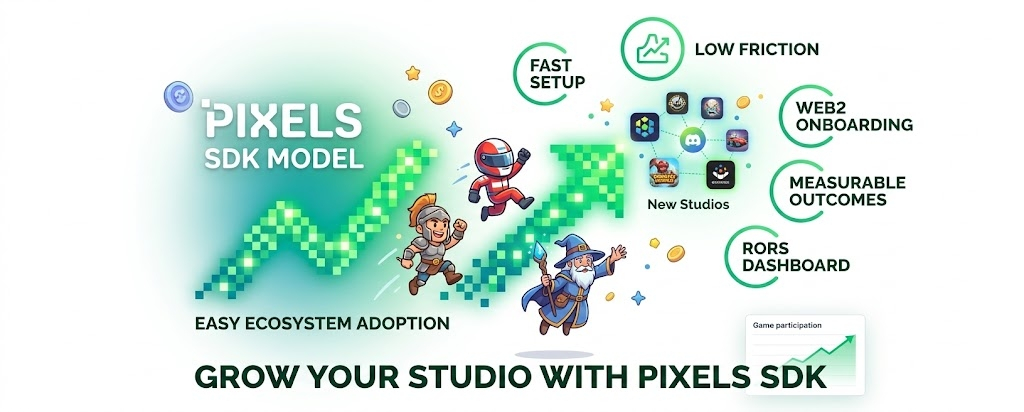
One thing I keep noticing in gaming is that a lot of good growth ideas never scale because integration feels too heavy at the start. A studio may like the model, but if setup takes too long, needs too much custom work, or feels risky, adoption slows down. That is why the Pixels SDK model stood out to me. It feels like Pixels is not only building tools for its own ecosystem, but also thinking seriously about how new studios can enter that system without too much friction.
What I found interesting is how simple the studio flow is meant to be. Pixels says studios can integrate through the Pixels Events API, which it describes as a straightforward REST endpoint for batch and real-time event logging. The process is presented in a very practical way: drop in the SDK, define the goals to reward, fund the pool, and then watch RORS through a live dashboard. The listed turnaround is also a big part of the story here, with API integration shown as taking under a day and goal setup around thirty minutes. For a new studio, that kind of simplicity can matter a lot.
To me, the real value of that model is that it lowers the gap between interest and action. A studio does not need to start with a huge technical rebuild just to test the Pixels system. It can plug in events, track actions like retention or purchases, and begin using rewards in a more measurable way. That makes the ecosystem feel more accessible. Instead of adoption depending only on big teams with big resources, the setup looks closer to something smaller and faster-moving studios could also explore.
One strong feature here is the broader data layer around the SDK model. Pixels says its system combines wallet, device, and social identifiers through an ID graph, which helps create smoother user experiences even for Web2 studios that do not yet support blockchain logins. I think that is an important detail because it shows Pixels is not building only for blockchain-native teams. It is trying to reduce the onboarding gap for more traditional studios as well. That makes the ecosystem feel wider and more practical.
In my view, this is where the SDK model becomes more than just a technical tool. What stood out to me is that Pixels is trying to make ecosystem participation easier without removing structure. Studios still define their goals, track live spend versus revenue, and keep full ownership of their own data, while also benefiting from cross-game model improvements. That balance feels important. It gives new studios a lighter entry point, but still keeps the system focused on measurable outcomes.
The market side also makes this worth watching. PIXEL is trading around $0.0071–$0.0073, with a live market cap around the mid-$20M range, 24-hour volume around $10M+, a circulating supply of 3.38B, and a max supply of 5B according to major trackers. For me, that shows the token is still active enough for ecosystem expansion to matter. If Pixels can make studio adoption easier through this SDK-style model, then the long-term story becomes bigger than one game. It starts looking more like infrastructure that other games may actually be able to use.
