I’ve been stuck on that question for a few weeks now.
And honestly… I kept waiting for it to follow the same predictable path. You know the cycle. We’ve all seen it.
I got into gamefi back when another one was everywhere. Everyone was talking about it. I jumped in, grinded like crazy, made some money… then slowly watched it fall apart. Not instantly. Just… slowly. Rewards dropped, players left, everything started feeling empty.
Then it happened again. And again.
New project. New hype. Same pattern.
Big token. Big promises. Sustainable economy.
And then 6 months later… it’s just people trying to exit.
So when I first heard about @Pixels and the whole Stacked ecosystem, I didn’t get excited. If anything, I rolled my eyes a bit.
Another farm game. Another token. Another loop.
But then I played it… and something felt off.
In a good way.
The loop doesn’t feel like a trap (this surprised me)
Most gamefi games don’t really hide what they are.
You’re there to farm. That’s it.
Gameplay is just… a wrapper for emissions. You log in, optimize your route, maximize output, log out. It’s not really playing, it’s more like maintaining a system.
I’ve done that too. Way too many times tbh.
But in PIXELS, I noticed something kinda weird.
I kept playing even when I wasn’t thinking about the rewards.
I was organizing my farm… doing random quests… even just walking around and checking what others were doing. At one point I was just fixing my layout for like 20 minutes for no reason 😅
That almost never happens in gamefi.
So I started wondering…
is that intentional design? or am I just getting distracted easily?
Honestly… probably both.
But I think PIXELS flipped something here. It feels like:
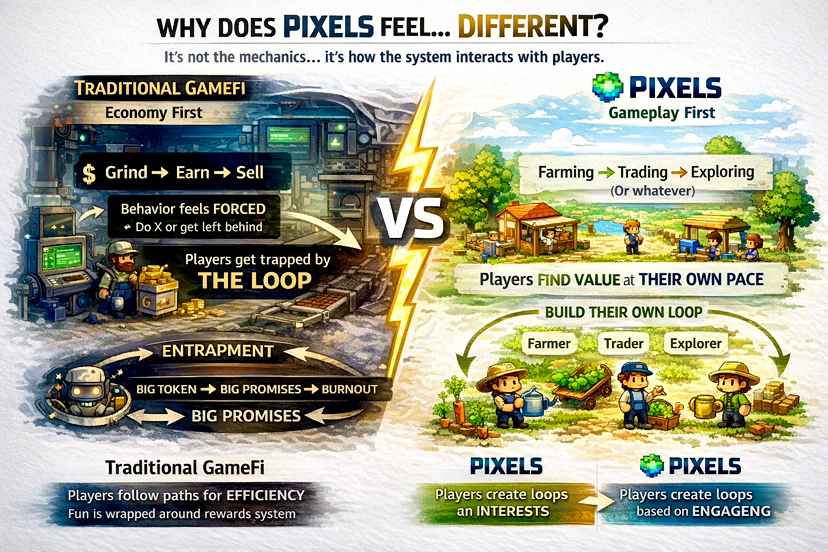
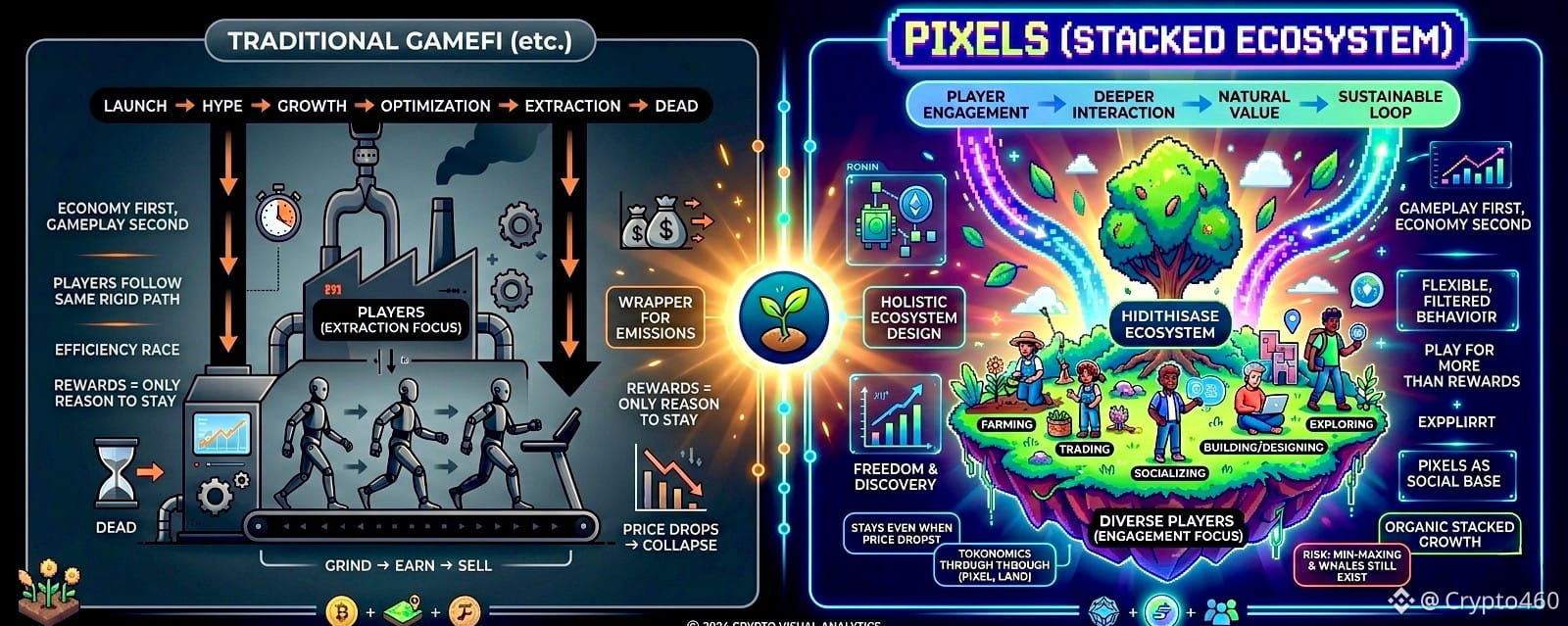
Traditional GameFi → economy first, gameplay second.
PIXELS → gameplay first, economy built around it…
At least from my side, that’s how it feels inside the game.
Behavior feels filtered… not forced…
This part is harder to explain, but it matters.
In most gamefi, everyone follows the same path:
Grind → earn → sell
There’s no real difference in how you play. Efficiency wins. Always.
In PIXELS, it doesn’t feel that rigid.
Yes, people still optimize. That never goes away. But it’s not the only way to exist in the game. Some people farm differently, some focus on trading, some just build and socialize.
It’s like the system doesn’t force behavior… it kind of filters it.
The players who engage deeper seem to naturally get more value over time.
But I’m not fully convinced yet.
What happens when everyone figures out the best loop?
Does it turn into the same efficiency race again?
Because let’s be real… crypto players will always min max eventually.
The Stacked ecosystem feels more… organic than usual.
This is where it gets interesting.
Stacked isn’t just PIXELS. It’s supposed to be this connected ecosystem of games and systems.
Normally when I hear that, I kinda tune out. Metaverse, multi game economy… we’ve heard it all before.
Usually it just means:
Same wallet. Different games. No real connection.
But here, it feels a bit different.
PIXELS acts like a base layer. Social hub, land, economy, daily activity. And other experiences can plug into that over time.
It doesn’t feel forced (at least not yet).
Players already have routines inside PIXELS. Farms, neighbors, trading habits. That creates a kind of gravity.
So when other layers come in, they’re not starting from zero.
But again… big question:
Can this stay organic when money flows harder into the system?
Or does it slowly become another designed ecosystem instead of a natural one?
I don’t want to ignore this part.
PIXELS still has:
a token ($PIXEL ).
NFTs (land).
supply/demand pressure.
whales, speculation… all of it…
We’ve seen these mechanics break games before.
From what I’ve seen, the structure here is more thought through. Utility is tied into daily actions. Land actually matters. And the team doesn’t seem obsessed with short term price pumps.
That’s good.
But it doesn’t guarantee anything.
I’ve personally held tokens before thinking this one is different…. and yeah, that didn’t always end well 😅
The real test is simple:
If the price drops… do people still log in?
Because that’s where most GameFi dies.
One moment that made me pause…
There was a day I opened PIXELS before checking the chart.
That sounds small… but for me it’s not.
Usually I check price first. Always. It kind of controls the mood.
But that day I didn’t.
I just logged in and started playing.
Later I realized it and thought… okay, that’s actually new.
Not saying it means everything. But it stuck with me.
Bigger problem with GameFi (that no one really says out loud)…
Most GameFi doesn’t fail because of tokenomics.
It fails because the game is not fun.
It was built for extraction, not for players.
So when rewards slow down, there’s no reason to stay.
That’s why the cycle keeps repeating:
Launch → hype → growth → optimization → extraction → dead
What PIXELS might be doing differently is slowing that down.
Not breaking it completely… but stretching it.
Because if players are there for more than just rewards, the system doesn’t collapse instantly under pressure.
So what actually feels different?
In my view… it’s not really the mechanics.
It’s how the system interacts with people.
Traditional GameFi tells you what to do.
PIXELS kind of lets you figure it out.
That freedom… small thing, but it changes behavior a lot.