When I first entered the scene, I also blindly believed in daily active users, thinking that more users meant a stable plate. Later, I was taught a lesson by two projects — one claimed to have 500,000 daily active users, but upon checking the blockchain, 60% of the wallets had identical interaction patterns within 24 hours, all were clones from a studio. The other was even worse; the daily active data looked textbook perfect, but as soon as the unlock day arrived, the tokens were halved and then halved again.
So when I saw this batch of data from @Pixels, my first reaction was not to rush, but to analyze.
First of all, let's be clear. The Stacked LiveOps really has something to offer. I ran tests for three days with both my old and new accounts, and the old account (which has a history of spending) received task rewards nearly 40% higher than the new account. Additionally, the types of tasks pushed were clearly filtered — the new account had all introductory tasks, while the old account was directly given high-value output tasks. This shows that their player segmentation model is genuinely in operation, not just for show.
On-chain data can also support this. The Ronin browser shows that Pixels' average daily transaction volume is stable around 1.2 million, peaking at over 2 million. At this level, most chain games from last year would have crashed the server already. Stacked can hold up; the underlying architecture has indeed been well-developed.
But don't forget, no matter how strong the technology is, it can't surpass the fundamentals of the token economy.
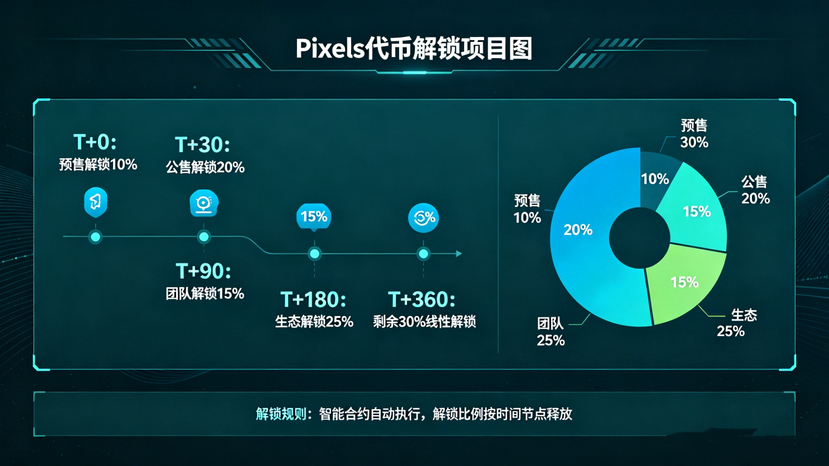
I reviewed the data from Token Unlocks; on April 28th, a total of 400 million $PIXEL will be unlocked, which is a significant proportion of the circulating supply. More critically, the destination of these tokens—ecosystem funds, teams, private placements—needs to be understood: which categories are holders and which are the main sellers. I pulled up historical unlock records, and after several rounds of small-scale unlocks, there was a noticeable pulse in the number of on-chain transfers to exchanges. This is not a conspiracy theory; it's a traceable fact of on-chain behavior.
So can this project still be viewed? Yes, but with conditions.
The value of Stacked lies in its ability to transfer the refined operations of Web2 onto the blockchain. For example, their RORS model theoretically can achieve 'for every dollar rewarded, the ecosystem at least recovers one dollar.' However, whether this model runs smoothly depends on two variables: first, whether the project team has the motivation to maintain it long-term, and second, whether real consumption can continuously cover reward expenditures. Pixels supported 25 million in revenue through land royalties and freemium items; this path is currently viable, but whether it can last until the end of the year depends on how Chapter 3 is designed.
My strategy is simple. Before April 28th, do not increase my position. Wait for the unlock to take place and observe three things: on-chain net outflow, off-market premium, and whether Stacked has adjusted output parameters in sync. If the selling pressure is completely absorbed and the RORS quarterly report can maintain above 1, then it shows that the fundamentals are holding strong. At that time, I will take action, not late.
Now? Let the bullets fly for a while!$PIXEL @Pixels #pixel