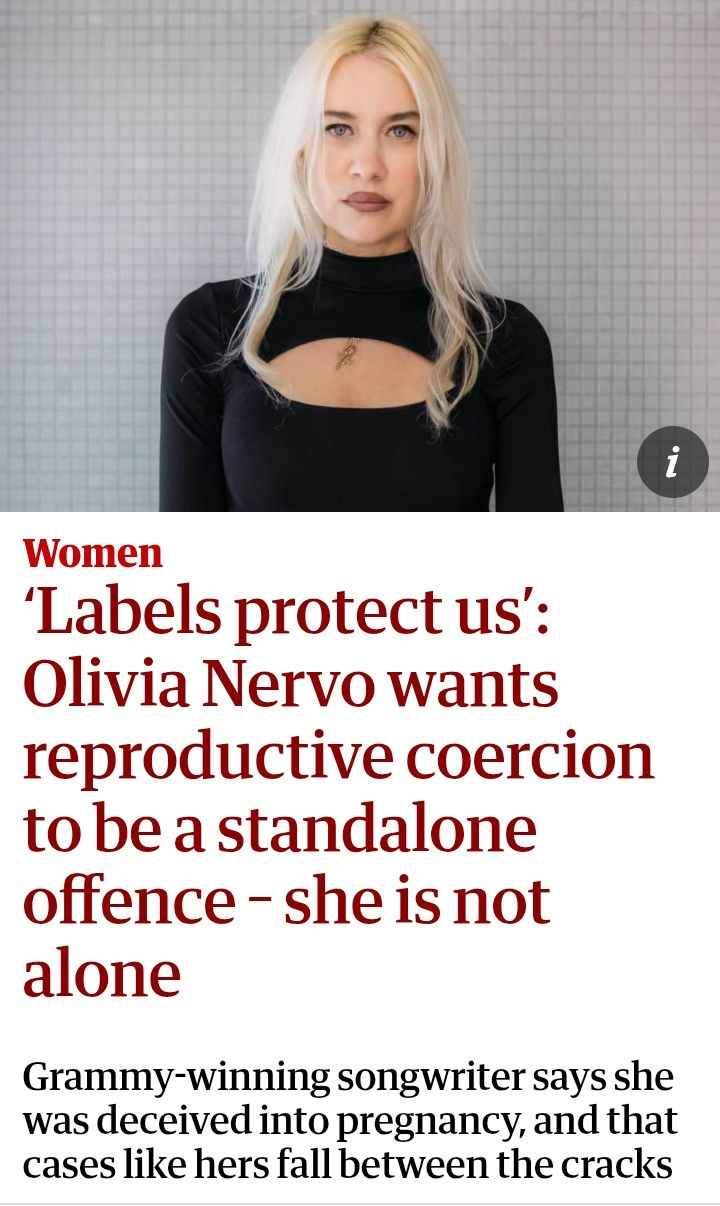
When the Grammy award winning songwriter, Olivia Nervo, agreed to start a family with her partner she believed she was in “a monogamous, committed relationship leading to a future”, and had never heard of reproductive coercion.
Her world came crashing down when she was six months pregnant and she found out that her partner was in a relationship with another woman who was also pregnant, and with whom he already had a child.
It was a discovery that led her to learn about reproductive coercion, a form of controlling behaviour in which someone interferes with an individual’s ability to make decisions about their own body. The Labour MP, Natalie Fleet, led a debate in parliament on the issue last month in which she said it was “so important – in the public interest, even – that the story of Olivia Nervo is heard”.
The court declined to make any finding as to whether there had been reproductive coercion in Nervo’s case, with Fleet describing the doctrine as something the legal system in England and Wales “still struggles to recognise”.
Nervo, one half of the DJ and songwriting duo of the same name with her twin sister Miriam, fought a lengthy, expensive and ultimately dispiriting court battle in London against her former partner, the wealthy New Zealand businessman, Matthew Pringle, sometimes known as the “honey king” because of his ownership of businesses including Manuka Honey.
She said: “If you have sex with someone and you don’t disclose the fact that you have an STD (sexually transmitted disease), that’s assault [if you are infected they can be charged with grievous bodily harm] and that’s criminally chargeable. And if you remove a condom covertly that’s considered rape. But if you deceive someone into having a child, or just even having sex, you just fall between the cracks.
“I can’t get over it, I don’t think I’ll ever get over it. And I just feel like reproductive coercion needs to be considered properly within family courts, at the very least. I would love it to be a standalone offence, but I understand that’s a big wish.”
A 2022 poll of 1,000 women aged 18 to 44 found 50% believed they had experienced reproductive coercion of some form, including pressure around pregnancy, abortion, sex and contraception.
Reproductive coercion is recognised in England and Wales as a form of coercive control under the Serious Crime Act. But Prof Sonja Ayeb-Karlsson, professor of intersectional justice at UCL, said that coercive control has itself “taken almost 10 years to understand” and, without its own standalone offence, reproductive coercion gets overlooked in the criminal justice system and criminal courts. She added: “I have tons of women who contact me who say: ‘This happened to me but I never spoke about it because I was so ashamed. Or, I couldn’t really put my finger on what it was or if it was wrong’.”