

I’ve spent enough time around projects like Pixels to notice how they gently pull you in before you realize what you’ve signed up for.
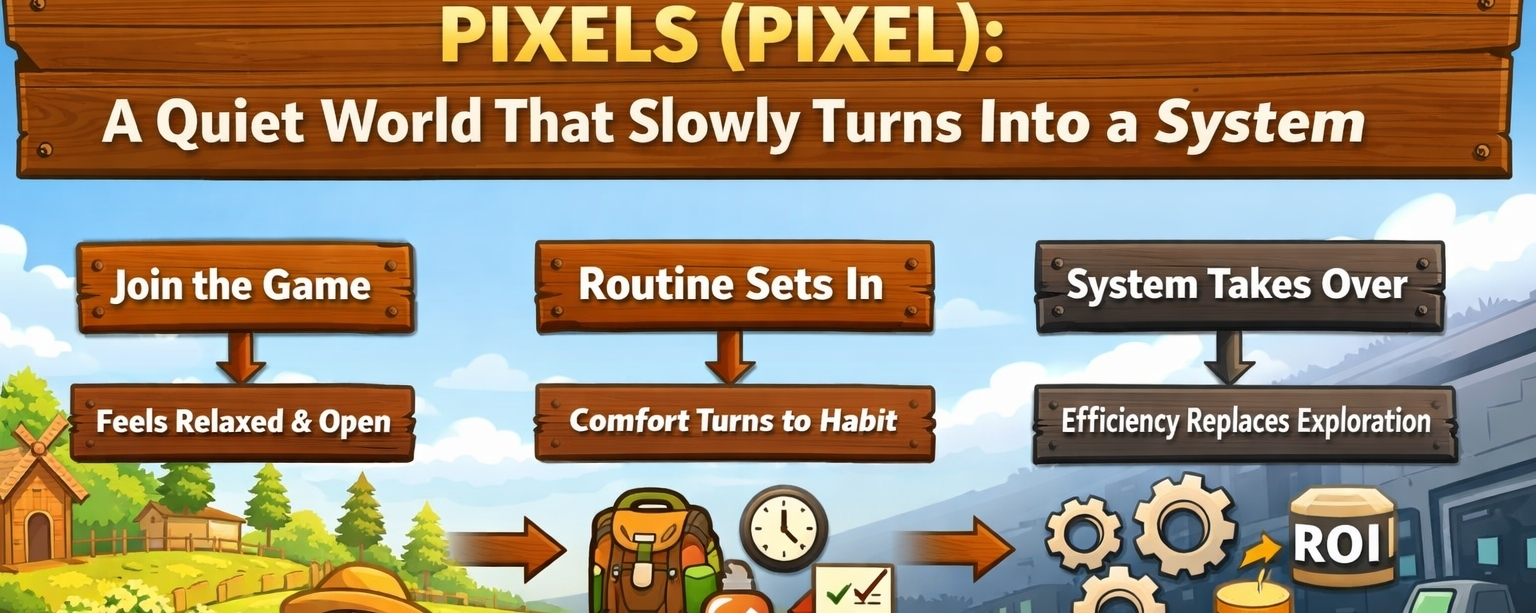
At the beginning, it feels harmless. You log in, plant a few crops, walk around, maybe bump into other players doing the same thing. It’s calm in a way that doesn’t ask much from you. That’s what makes it easy to stay. Nothing feels forced. Nothing feels urgent. It gives the impression that you can take it slow, that you’re just part of a small, growing world.
But that feeling doesn’t stay untouched for long.
After a while, the calm starts to feel structured. You’re not just planting because you want to—you’re planting because that’s what keeps things moving. You come back at certain times, check the same things, repeat the same steps. It’s still simple, but it’s no longer entirely casual. There’s a quiet expectation behind it, like the system is gently nudging you to stay consistent.
And you notice that everyone else has settled into that same rhythm too.
What looked like an open world starts to feel smaller, not because of size, but because of behavior. People move in similar ways, follow similar routines, and focus on the same outcomes. It’s not coordinated in an obvious sense—it just naturally drifts there. Efficiency takes over without anyone really talking about it.
That’s when the cracks start to show, but not in a dramatic way.
It’s more like a slow realization that the world isn’t really reacting to you—it’s just continuing whether you’re there or not, as long as enough people keep doing their part. The activity is there, but it feels maintained rather than alive. Like something that needs constant input to keep its shape.
There are moments where it almost breaks out of that. You forget the routine for a bit, wander without a goal, interact without thinking about what you’ll get back. Those moments feel different. Lighter. Closer to what you thought the game might be when you first joined.
But they’re hard to hold onto.
Because the structure is always there, quietly pulling you back. The longer you stay, the harder it is to ignore. What started as something relaxing slowly becomes something you manage. You don’t always notice the shift when it happens—it just settles in.
And once it does, it changes how everything feels.
You start seeing less of a world and more of a system. The farming, the interactions, even the sense of progress—it all begins to feel connected to something that exists outside the experience itself. Not in a way that breaks it, but in a way that makes it harder to fully sink into.
What’s interesting is that Pixels doesn’t fall apart. It keeps going. People keep showing up. The loop holds.
But it doesn’t really deepen either.
It stays in this middle space where it’s engaging enough to return to, but not quite meaningful enough to disappear into. And over time, that difference becomes more noticeable. You’re not really exploring anymore—you’re maintaining. Not really discovering—just continuing.
I keep coming back to that feeling, more than anything else. Not that it’s failing, but that it’s hovering. Like it’s waiting to become something more grounded, something that doesn’t rely so heavily on people repeating the same patterns to keep it alive.
Maybe it gets there, or maybe it doesn’t.
Right now, it feels like something that almost works the way you want it to—but not quite in the way that lasts.