
I wrote Pixels off twice. Once in 2023 when someone in my group chat shared a screenshot of a pixelated farm and called it the next big thing in Web3 gaming. I scrolled past it without a second thought. Then again after the PIXEL token launched on Binance and followed the exact same arc as every other GameFi token from that cycle. Big pump, slow fade, crickets.
Both times I was wrong. And honestly I am glad I kept paying attention anyway.
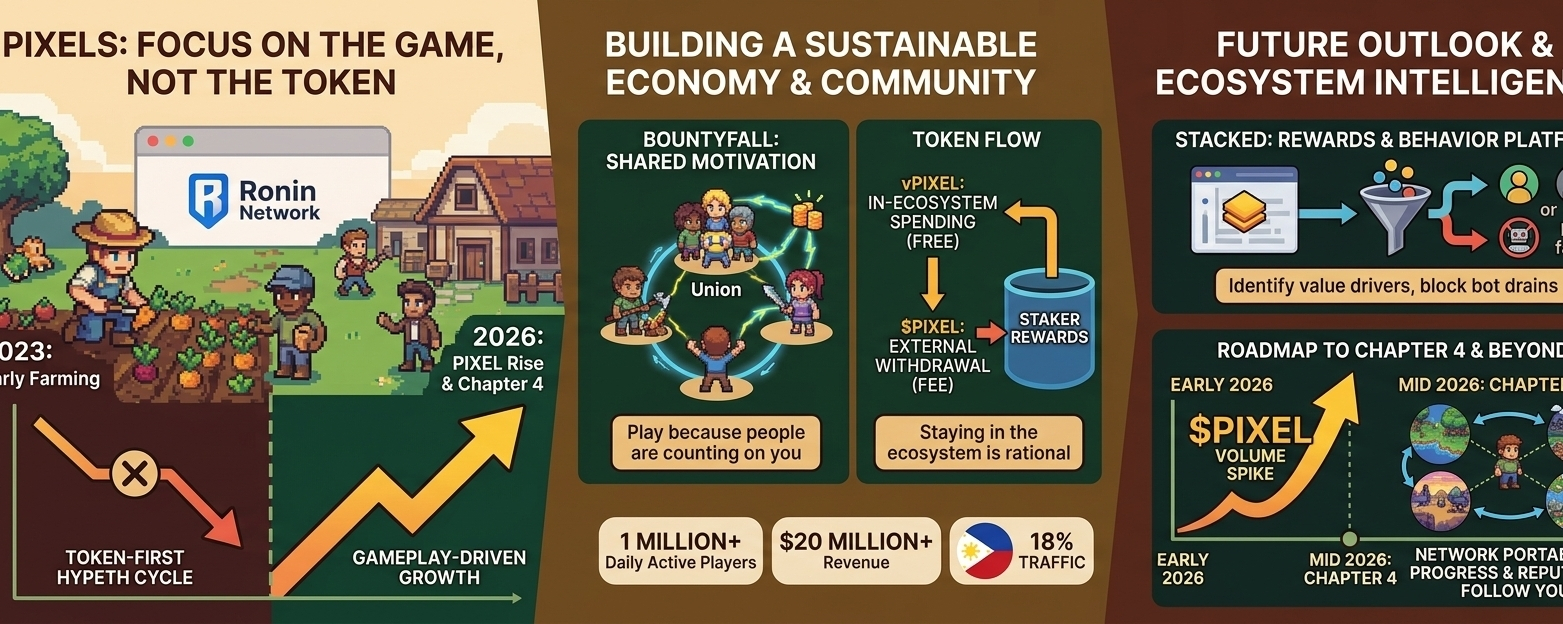
Here is what separates Pixels from the graveyard of Web3 games most of us have watched die. They never let the token become the product. The game was always the product. That one decision, made early and stuck to consistently, explains why they are still here while projects with bigger launches and louder communities are not.
The core of Pixels is simple. You farm, you explore, you build, you trade. It runs in your browser on the Ronin Network, which means transactions are fast and cheap enough that you actually forget you are playing a blockchain game most of the time. That frictionless feeling is intentional and it matters more than people give it credit for.
What started as a casual farming game has quietly grown into something much bigger. Over 1 million daily active players. More than $20 million in total revenue. A community spread across Southeast Asia, Latin America, and beyond, with the Philippines alone accounting for nearly 18 percent of traffic at one point. These are not numbers you manufacture with hype. You build them by making something people genuinely want to log back into every day.
The latest major update was Chapter 3, called Bountyfall. On the surface it added Unions, which are player groups that farm and compete together with rewards tied to collective performance rather than individual grinding. My honest first reaction was "okay, guilds, we have been here before." Every Web3 game eventually adds some version of this. But after watching how players actually engaged with it I changed my mind pretty quickly.
When your earnings depend on how your group performs, the whole motivation for logging in shifts. You stop playing to check a number. You start playing because people are counting on you. That sounds like a small psychological detail but it is actually the thing that keeps games alive past the first six months. Solo grind economies always hollow out eventually. Shared economies give people a reason to stay even on slow days.
Every token game runs into the same wall eventually. Players earn rewards, players sell rewards, price drops, new players stop coming, the whole thing slowly deflates. Pixels introduced vPIXEL and solved it more cleanly than anyone I have seen. Spend vPIXEL inside the ecosystem and there is zero fee. Want to pull real $PIXEL out to your wallet? You pay a fee that goes directly back to stakers. No forced holding. No lectures about long term vision. Just a simple structure where staying in the ecosystem is always the cheaper and more rational option. I genuinely have not seen another Web3 game thread this needle as well.
Earlier this year Pixels also launched Stacked, a rewards platform that runs across multiple games on Ronin. It watches how individual players actually behave and builds personalized missions around those patterns. For studios using it, Stacked surfaces data on which rewards genuinely drive retention and which ones just attract bot farms that drain the reward pool and vanish. Anyone who was around during the Axie Infinity collapse knows exactly how destructive that pattern is once it takes hold. What surprised me is that other games on Ronin get access to it too. That is not the move of a team focused only on their own token price.
The PIXEL token had a serious run in early 2026, posting significant volume spikes that put it back on people's radar after a quiet stretch. Chapter 4 is expected sometime mid 2026 and the roadmap points toward single account portability across multiple games in the Pixels network, meaning your progress and reputation follow you wherever you play.
What I keep coming back to is how rare it is to watch a Web3 project make boring, unglamorous decisions consistently over two years and come out stronger for it. No pivots. No rebrand. No emergency tokenomics overhaul after a bad quarter. Just steady work on a game people actually enjoy playing.
Plenty of projects in this space are louder than Pixels. Very few of them are still growing.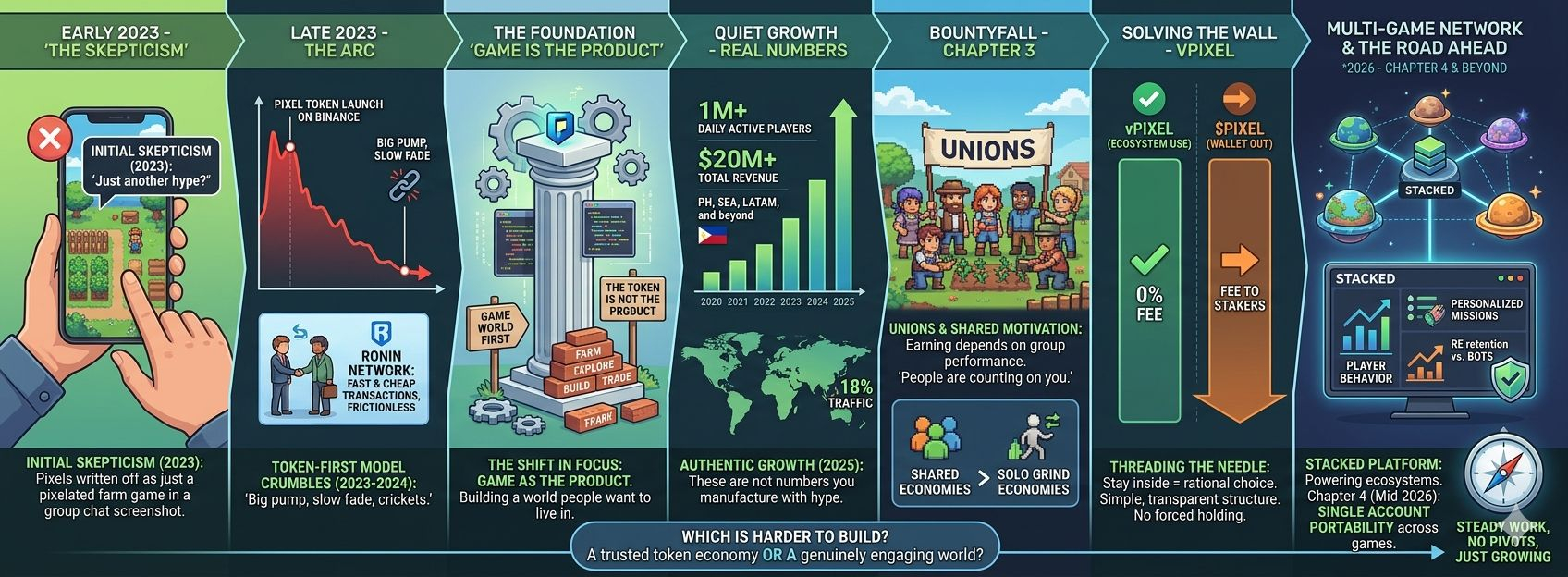
What do you think is harder to build in Web3 gaming, a token economy people trust or a game world people actually want to live in?