
I was looking at the stacked numbers this morning and one figure kept pulling my attention back 😂
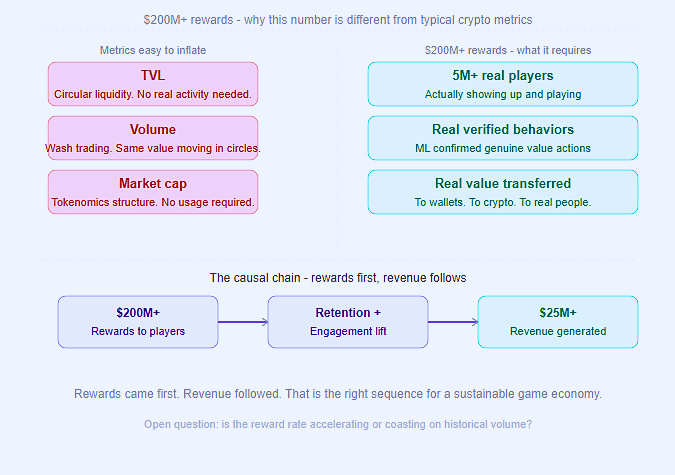
In crypto, we usually see huge numbers everywhere TVL, trading volume, market cap. But the truth is, most of those are easy to manipulate if someone really wants to. You can inflate volume with wash trading. You can boost TVL through circular liquidity. You can even push market cap higher just through token structure and narrative timing. None of those metrics necessarily prove real user behavior is happening underneath.
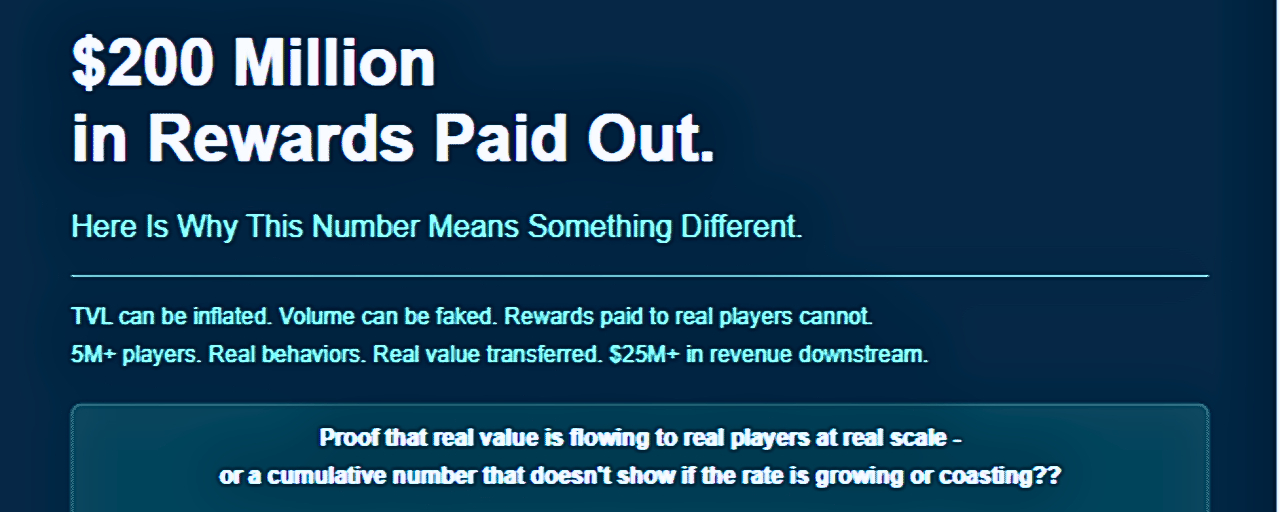
But $200M+ in rewards paid out feels different.
Because that number doesn’t come from charts or dashboards alone. For something like that to exist, real players had to actually do things inside real games. They had to spend time, complete actions, interact with systems, and earn rewards through participation. Not paper gains. Not unrealized value. Actual distributions that ended up in wallets and were claimed by users.
That’s a much harder thing to fake at scale.
And what makes it even more interesting is how that number is built. It’s not one event or one campaign. It’s the accumulation of millions of small interactions over time thousands of decisions made by players, each one triggering some form of reward logic inside the system. When you step back, it starts to look less like a marketing metric and more like a behavioral record of a living ecosystem.
In that sense, the $200M+ isn’t just a financial figure. It’s a footprint of activity. A trace of how people actually moved through the system, what they did, and how the protocol responded to those actions.
On the other side, you also see something like $25M+ in platform revenue tied to $PIXEL s and its ecosystem. That part is important too, because it sits downstream from the reward flow. Studios and partners use the infrastructure, run campaigns, and plug into the reward systems. Those campaigns generate engagement. That engagement gets measured. And some of that eventually converts into real revenue for the platform.
So what’s interesting here is the direction of the flow.
Rewards first. Revenue later.
That sequence matters more than people usually admit. Because in a lot of GameFi experiments, the order is reversed. You extract value from users first, then try to sustain engagement after. That tends to break quickly. It works for a short cycle, but it doesn’t build long-term retention.
Here, at least structurally, it looks like the opposite approach. Value is distributed into the system first, and then the ecosystem tries to convert that activity into sustainable economic outcomes afterward. Whether that fully works or not is still an open question, but the design intention is clear.
Still, there’s one thing I can’t really find in the data, and it matters a lot: how much of that $200M+ is still actively influencing current behavior versus just being historical accumulation.
Because cumulative numbers can be misleading. A system can look extremely large just because it has been running for a long time. That doesn’t automatically mean it is growing today. The real question is whether the flow is accelerating, stable, or slowly flattening out.
That’s the part I keep thinking about.
Is $200M+ in rewards a signal of a system that is scaling with real usage? Or is it a total lifetime figure that looks impressive but doesn’t tell us anything about current momentum?
And maybe that’s the real distinction worth watching. Not just how big the number is, but whether the underlying activity that creates that number is still getting stronger over time or just coasting on what already happened ! 🤔