
The Ceasefire Expires Tomorrow. The Regime Test Starts Today.
Three things happened over the weekend that most of the market has not connected yet, and I want to work through them because I think this week is going to be decisive.
Friday, the Strait of Hormuz reopened under French-British escort. Brent crude collapsed 10%. $BTC broke through $75K and touched $77K. The nine-week geopolitical overhang finally lifted.
Saturday, the U.S. Navy seized an Iranian cargo ship bound for the Strait. Washington and Tehran held no formal talks.
Sunday, $BTC gave back most of Friday’s gains. The open this morning: $73,820. Down 2.5% from Sunday’s close. Within two hours, it recovered to $75,242.
The ceasefire between the U.S. and Iran expires tomorrow, April 21, at end of day. Between now and then, two things will happen. Either a new agreement is reached, or the conflict resumes.
We are in a 48-hour window where the entire framework I have been writing about for two weeks gets tested in real time. And the market is already pricing the answer.
WHAT THE WEEKEND ACTUALLY REVEALED
Most people looked at the weekend pullback and concluded the Friday rally was fake. That reading is missing the most important signal.
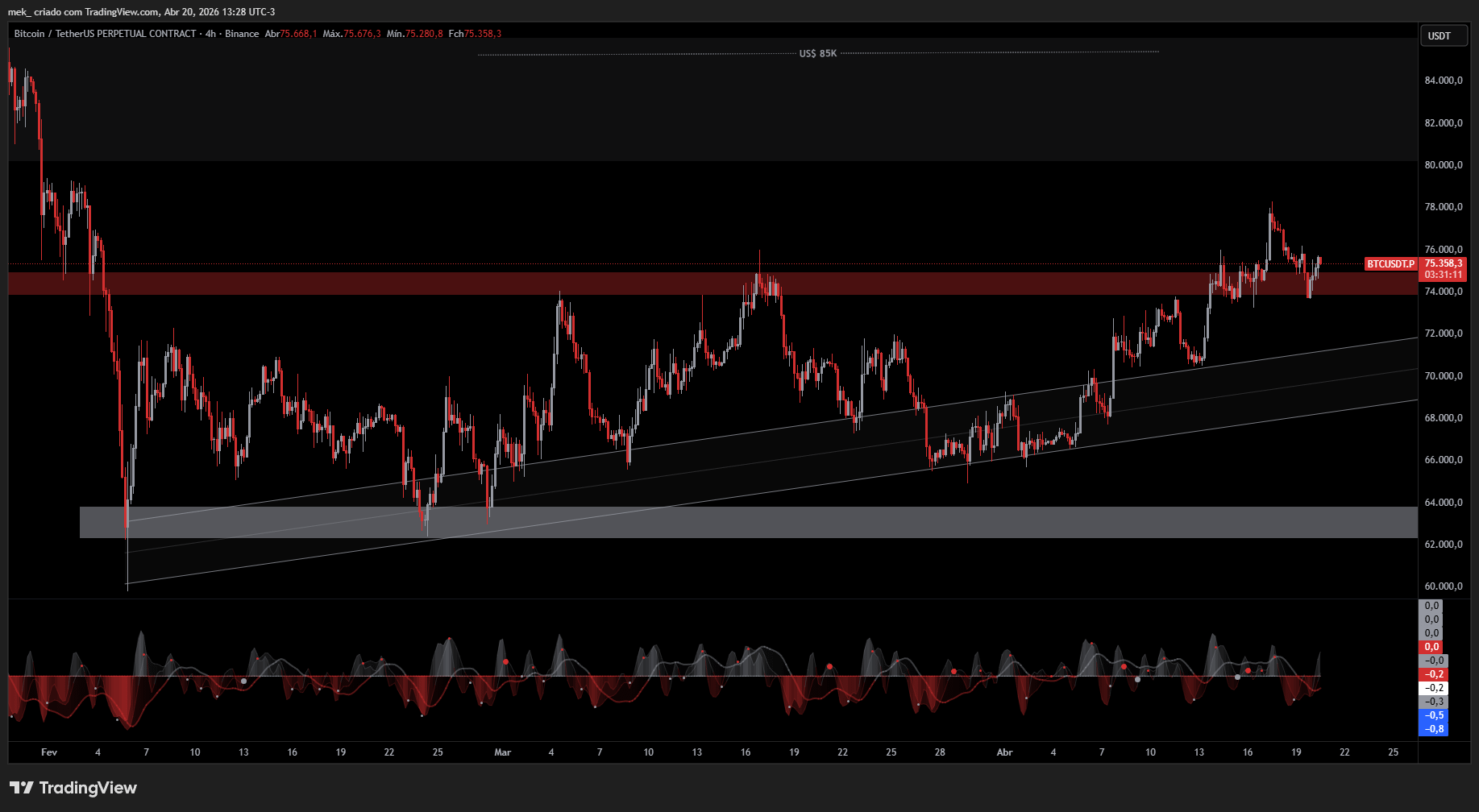
Let me describe exactly what happened. Friday close: $77,100. Saturday: U.S. seizes Iranian vessel. Geopolitical escalation resumes. Sunday open: $75,723, down 1.8%. Sunday close: approximately $75,500. Monday open: $73,820, down another 2.5%. Monday 7:35 AM ET: $75,242, already recovering.
The total peak-to-trough drawdown across a weekend of renewed escalation: roughly 4.3%. Then immediate absorption once U.S. markets opened.
Compare that to February 5 of this year, when $BTC dropped 20% in a weekend on much less specific geopolitical news. Or March 7, when tariff panic caused a 12% move.
The market reaction function has compressed. Each successive shock produces a smaller magnitude response. That is not sentiment improving. That is holder composition shifting.
The weekend answered a question I had been thinking about: would the structural bid hold through renewed escalation, or was it dependent on the ceasefire narrative? The answer is that it held. Friday was not a ceasefire rally that got unwound. Friday was a structural breakout that absorbed a weekend of bad news and held the breakout level.
THE DEEPER PATTERN
Here is the mechanic that most analysis is missing, and it connects to everything I have been writing about since the beginning of April.
Markets pricing geopolitical risk work in a predictable sequence. First, an event occurs. Second, prices reprice to reflect maximum uncertainty. Third, as more information arrives, the range of possible outcomes narrows and prices adjust accordingly.
For most risk assets, this sequence is violent. Equities drop sharply, volatility spikes, correlations converge to one. Capital flees to traditional havens.
$BTC’s behavior over this weekend broke that pattern. Maximum uncertainty event occurred (vessel seizure, ceasefire endangered, 48 hours to potential military action). Price moved 4.3%. That is the response you would expect from a mature asset with deep institutional ownership, not a speculative instrument.
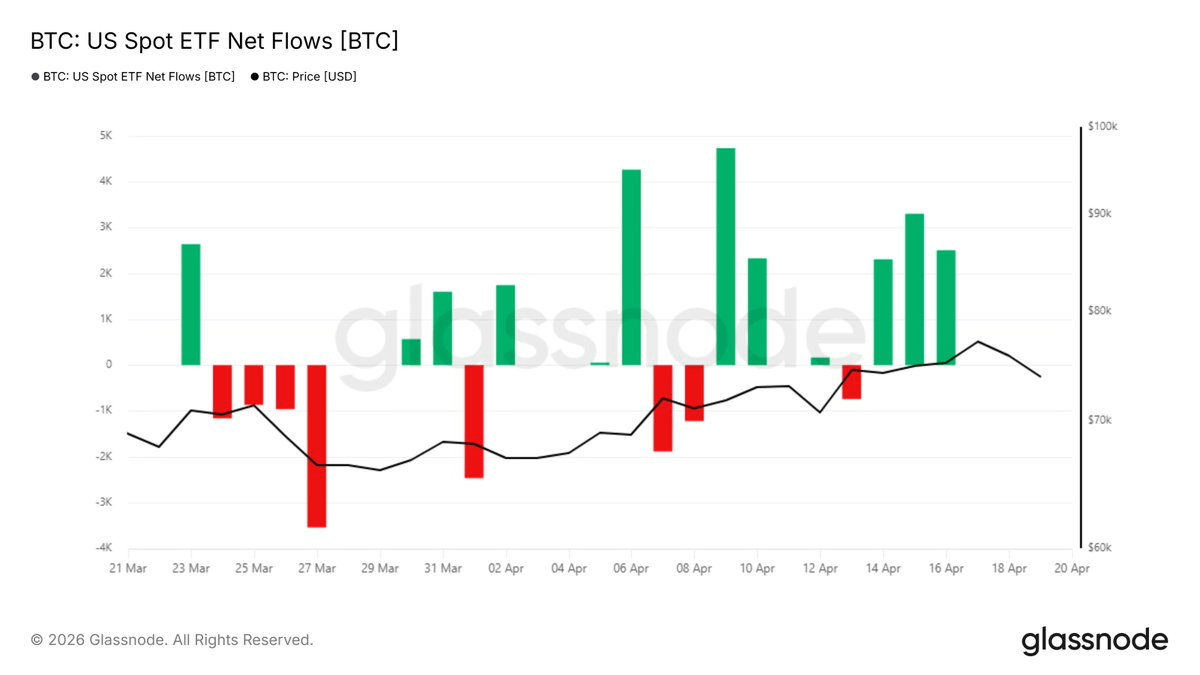
BlackRock’s IBIT captured $284 million in a single session on April 17. Strategy continues deploying STRC capital at current pace. MSBT’s advisor network is in its second week of allocation decisions. Schwab spot trading activated for 35 million brokerage accounts. These buyers do not sell on weekend headlines.
The compression of the reaction function is the signal. Not the price level.
THE 48-HOUR FORK
Tomorrow night, by end of April 21, one of two things happens.
Scenario A: A new agreement is reached. Could be an extension, could be a formal deal, could be a partial accord. Trump stated Thursday that talks are “probably” happening over the weekend. Iran’s behavior this week suggests they want to negotiate. Both sides have reasons to avoid immediate escalation. If this materializes, oil stays below $90, $BTC clears $77K decisively, and the path to $82-85K opens through the April 29 FOMC.
Scenario B: No agreement, ceasefire expires, conflict resumes. Oil spikes back toward $100. $BTC retests $72-73K. This would represent the bear case I outlined Friday. Important: this scenario does not break the structural thesis. The same institutional mechanisms operate at lower prices. Strategy does not stop buying because oil is at $100. ETFs do not reverse allocation decisions because of a geopolitical shock. A retest becomes a buying opportunity for the same structural bid.
The probability I assigned Friday: 60% base, 25% bull, 15% bear. With the weekend behavior showing absorption of renewed escalation, I would now shift to 50% base, 30% bull, 20% bear. The bear case probability rose slightly because the vessel seizure is a real escalation. But the bull probability also rose because the market’s reaction function compression confirms the structural thesis.
WHAT FOMC CHANGES ABOUT THIS
April 29 FOMC is the second variable that matters this week, and it interacts with the ceasefire outcome in specific ways.
Two weeks ago, the Fed dot plot signaled one rate cut in 2026. UBS now forecasts 50 basis points of cuts by year-end, bringing the federal funds rate to 3.00-3.25%. Former Fed Chair Janet Yellen warned last week about potential dollar hyperinflation. Powell faces a choice he did not face three weeks ago: oil is lower (less inflation pressure), geopolitical risk is elevated (justifies dovishness), and the employment picture is softening.
If the ceasefire extends AND FOMC signals a June cut on the table, the combination is maximally bullish for risk assets. That is the bull case path to $90K.
If the ceasefire fails AND FOMC stays hawkish, the combination is a short-term drag. But again, this is a cyclical move, not a structural break. Exchange reserves at 2.21M BTC do not reverse because Powell stays patient.
The interaction matters more than either variable alone. And the market has not fully priced the combination because most participants are reading the events as isolated.
HOW TO POSITION FOR THIS WEEK
I want to be useful here, not just analytical. So let me describe what I am actually watching and why.
First, watch the $73K level. If that breaks with conviction, the bear case is activating. If it holds through the ceasefire expiration, the structural thesis is confirmed and $77K becomes the next test upward.
Second, watch ETF flows tomorrow and Wednesday. If IBIT continues absorbing $200M+ per day through ceasefire uncertainty, that is the single strongest indicator that institutional allocation has decoupled from headline risk.
Third, watch Strategy’s weekly filing, expected Monday or Tuesday. If they disclose another significant STRC-funded purchase despite the weekend volatility, the supply removal machine is confirmed to be macro-agnostic.
Fourth, watch oil. If Brent stays below $90 through Tuesday regardless of ceasefire news, the market is signaling that Hormuz’s operational reopening matters more than political posturing.
Fifth, watch the Fear and Greed Index. It moved from 8 to approximately 35 over the past week. If this continues expanding while $BTC consolidates, sentiment is catching up to structure rather than structure following sentiment.
THE CLOSE
Tomorrow, one of two things happens. Either the ceasefire extends, or it does not.
The market’s response this morning already reveals which outcome it is weighting.
A 2.5% weekend drawdown on maximum geopolitical uncertainty, immediately absorbed, is not the behavior of a fragile market. It is the behavior of a market that has internalized a structural thesis most participants have not yet articulated.
The 48 hours ahead are the regime test. Pay attention not to the price, but to the magnitude of the reaction function.
The narrative will be written by the outcome. The positioning was written by the absorption. $BTC

-Mek