

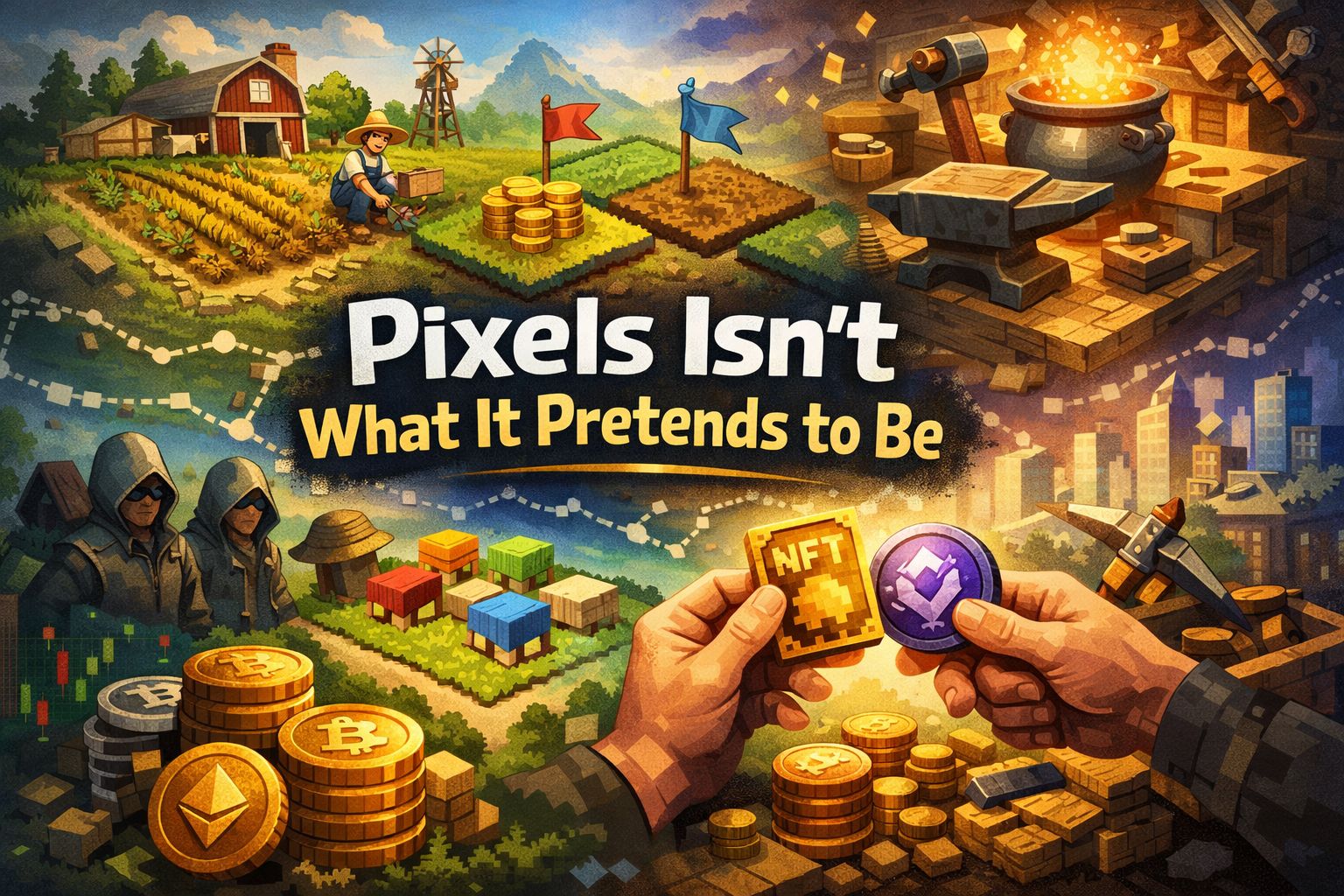
I used to think Pixels was simple.
Log in, plant crops, harvest, maybe craft a few things, log out.
It felt calm… almost too calm.
But after spending more time in it, something started to feel different.
Not obvious at first just small things that didn’t quite fit the “farming game” label everyone throws on it.
And then it clicked.
Pixels isn’t built around farming.
Farming is just the distraction.
What’s actually happening underneath is a system where players quietly compete for position.
Take land, for example.
At first glance, it looks harmless. A bit of space you can call yours.
But the more you understand it, the more you realize it’s less about owning land… and more about controlling opportunity.
What gets produced there, how efficiently it runs, how others interact with it that all adds up.
And once someone sets that up early and correctly, they’re not just ahead… they stay ahead.
That’s the part most people don’t notice until it’s too late.
Then there’s crafting.
This is where the game really starts to show its true shape.
Because you’re not just making items for yourself.
You’re making things other players rely on.
And the moment other players rely on what you produce, everything changes.
Now timing matters.
Availability matters.
Even small decisions start to have ripple effects.
Some players never go beyond casual crafting. They make what they need, when they need it. Nothing wrong with that.
But others start paying attention.
They notice patterns.
They see what runs out quickly.
They understand when demand spikes.
And slowly, without making noise, they move ahead.
It doesn’t feel like grinding at that point.
It feels like positioning.
Guilds push this even further.
Playing solo feels fine… until you see what coordination actually looks like.
When a group splits roles and works with intention, progress speeds up in a way that solo players just can’t match.
Not because the game is unfair but because systems reward organization.
It’s subtle, but powerful.
And then there’s the part people usually doubt the assets.
Most games talk about ownership, but it rarely matters.
Here, it does.
Things aren’t valuable just because they’re rare.
They’re valuable because they’re needed.
And that creates a different kind of attachment.
You don’t hold assets hoping they pump.
You use them because they give you an edge.
That’s a completely different mindset.
So yeah… calling Pixels a farming game doesn’t really capture it.
It’s closer to a quiet, player-driven system where everything connects land, crafting, trade, coordination.
You can still play it casually.
Nothing stops you from doing that.
But if you spend enough time paying attention, you start seeing the structure behind it.
And once you notice that structure…
It’s hard to go back to playing it like it’s just a game.
