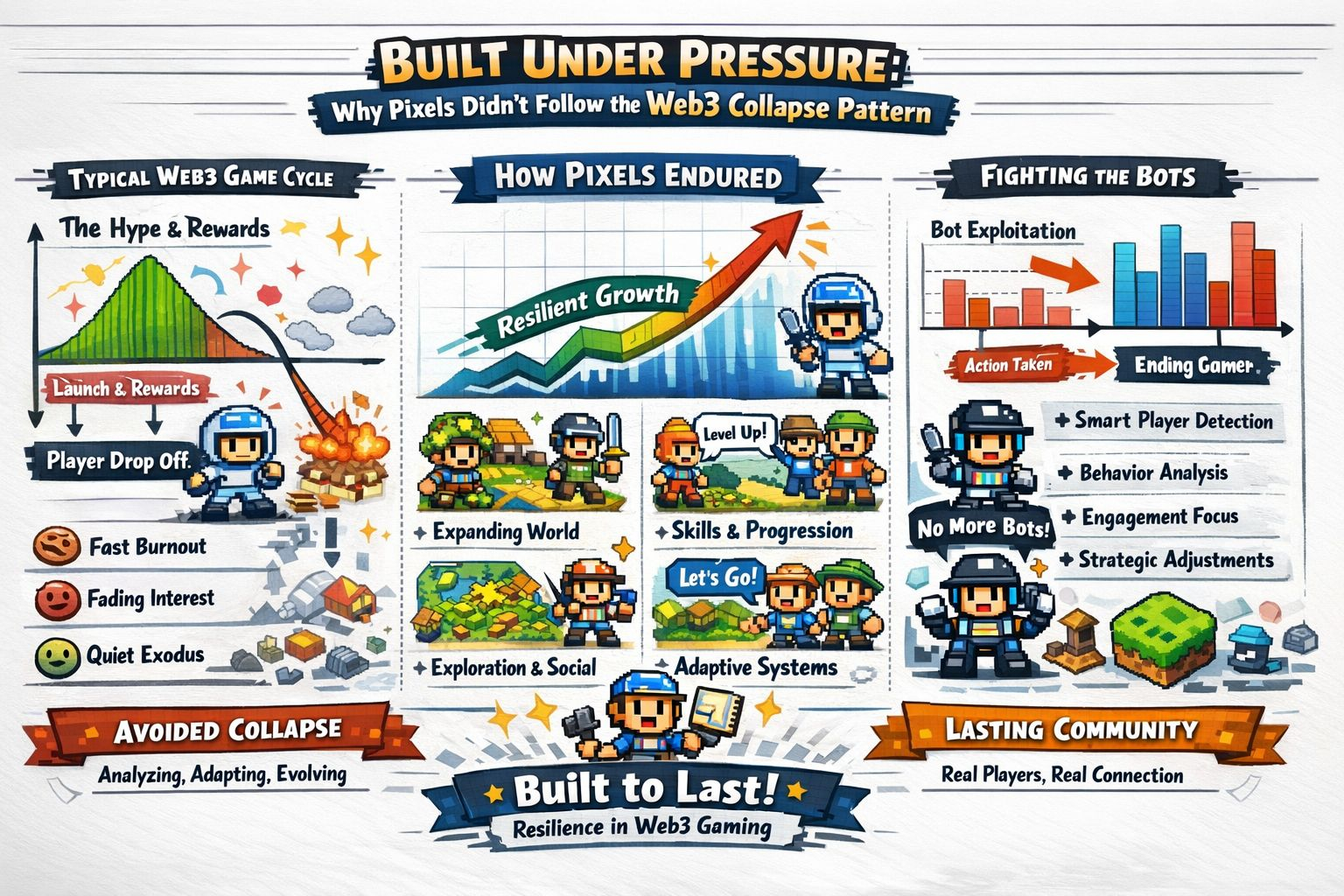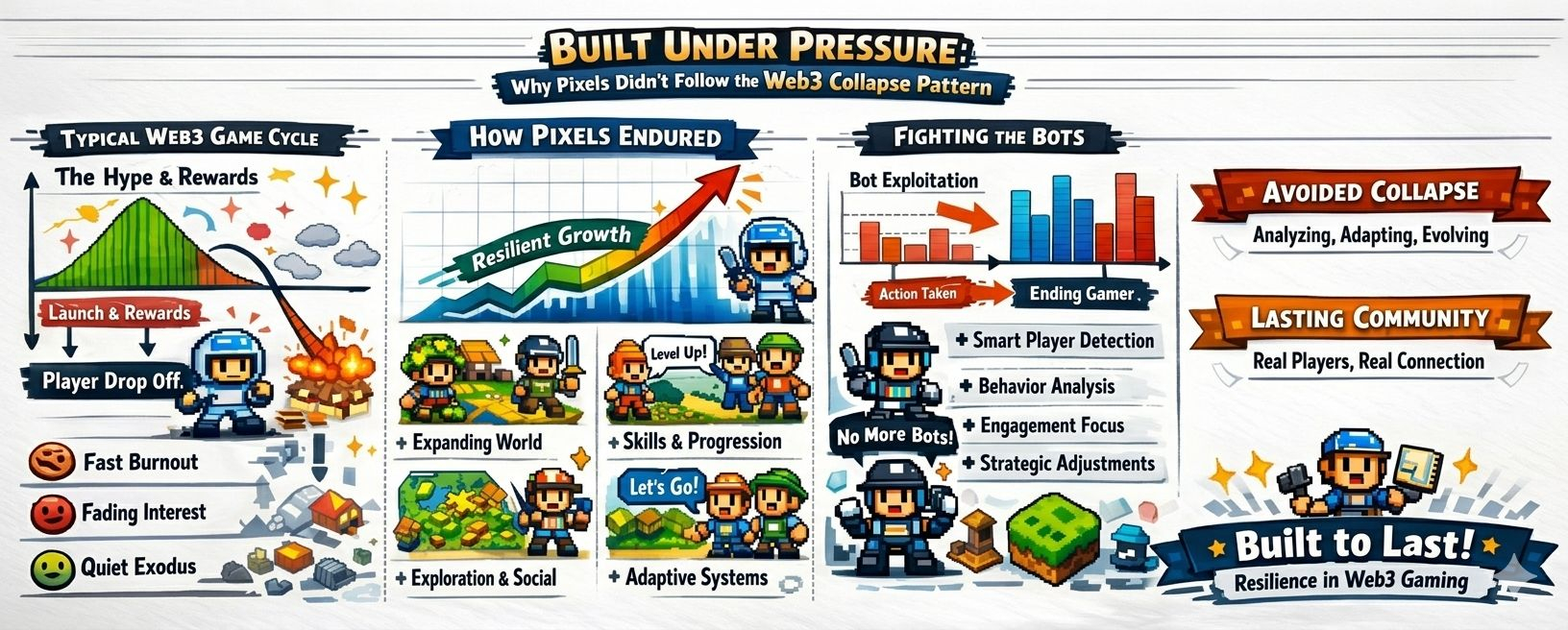
I did not really get what resilience meant in Web3 games…. until I watched Pixels go through real pressure and just… not break.
most games in this space follow the same script. Big launch, juicy incentives, tons of players rushing in. for a whIle, everything feels alive. rewards are flowing, the economy looks healthy, tImelines are full of hype.
then something shIfts.
Usually after the first major reward cycle, the cracks show. the grind starts feeling repetitive. The numbers stop adding up as cleanly. and people do not rage quit… they just fade out quietly.
No big announcement. no drama. Just silence.
Pixels hit that exact phase. and honestly, from the outside, it looked lIke it could go the same way. The grind is real anyone who’s actually played knows that. Energy management, crop timing, Task Board loops, crafting queues…. it is not a chill game once you go deeper. if anything, the better you get, the more it demands from you.
that kind of system usually burns people out.
But here is what made me pause the exit wave never really came.
and that made me question things differently: why did not it collapse lIke the others?
Part of it, I thInk, is how the world expanded. Pixels did not just squeeze more efficiency out of farming or keep tweaking rewards. it started building around the loop instead of over optimIzing it.
Land gave you a reason to care long term.
skIlls added direction.
exploration made thIngs feel open instead of repetitive.
and socIal coordination actually started to matter.
the routine did not disappear but it started to feel like it belonged to something bigger.
you were not just logging in to complete tasks anymore. you were logging into a world.
But if I am being real… that is only half the story.
The real stress test came when bots showed up in a serious way.
at one point, automated accounts were running farming loops way more efficiently than any human could. No fatigue, no mistakes, no distractions. just pure optimization. And they were extracting value from the system fast.
that is where most projects lose it.
They panic. cut rewards. Add restrIctions. Ship quick fixes that end up hurting real players more than bots.
I have e seen that play out too many times.
Pixels did not go that route.
instead of patching surface level issues, they went deeper. They asked a harder question: what actually makes a player… human?
And that is not easy to answer.
it is not just activity. Bots can mimic activity.
It is behavior. Patterns. Small ineffIciencies. Decisions that don’t make perfect sense.
Basically… all the messy stuff real players do.
and instead of ignoring that complexity, Pixels leaned into it.
they started buildIng systems that interpret engagement, not just measure output. systems that can tell the difference between someone playing and something farming.
That shift is huge.
because once you design around behavior instead of raw numbers, you are not just balancing a game anymore you are actually understanding it.
And that is where Stacked comes in , at least how I see it.
it does not feel lIke some random feature added later. It feels lIke something that came out of pressure. like the game needed to evolve, and this is one of the results.
most projects never reach that stage.
Not because they don’t want to but because they do not survive long enough to be forced into that level of thinking.
That is why I think this part of Pixels is underrated.
people focus on the token, or the economy, or whether it is fun. but the real signal is how the team handled things when stuff started breaking.
They didn’t hide from it. They did not slap on band aid fIxes.
they treated failure like a design problem.
And that is rare.
because everything looks smart when thIngs are going well. but when bots are draining your system, when players could leave any day, when the economy is under pressure that’s when real decisions show up.
Pixels did not just survive that phase.
It used it.
and now when I log in, what stands out to me is not just that people are still there… it is why they are still there.
It is not purely about rewards anymore.
it is because the game feels like something you can settle into. Something that adjusts. something that is already been tested and didn’t fall apart.
In a space where most games quietly die out…
that kind of resilience is not normal.
It is a signal.